

Desert Lark vs Arabian Lark
Ammomanes deserti versus Eremalauda eremodites
Play a quiz with Desert Lark and Arabian Lark
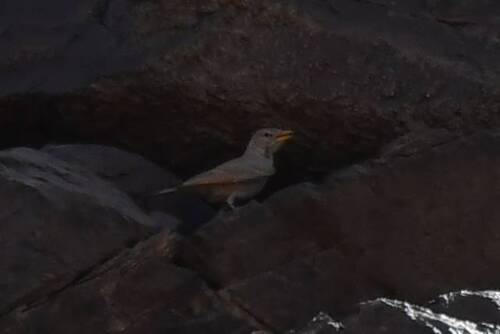 Desert Lark
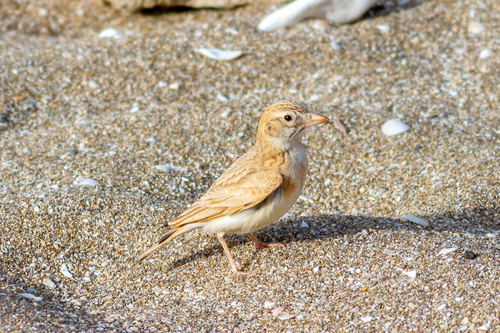 Arabian Lark
In short
The most reliable field mark to separate Desert Lark from Arabian Lark is the tail pattern in flight: Arabian Lark shows distinctly blackish outer tail feathers, while Desert Lark lacks a clear terminal black band and may only show a diffuse dark patch. On the ground, Arabian Lark is stockier with a bulbous, uniformly pink bill and a plain sandy-brown upperpart, whereas Desert Lark is more variable in color and has a longer, narrower bill and more streaked underparts. Desert Lark can show some rufous in the wings and tail, but Arabian Lark's upperparts are plainer and less streaked. Voice and behavior offer additional clues, but tail pattern and bill shape are the most consistent field marks.
Identification tips
- Tail pattern in flight: Arabian Lark shows blackish outer tail feathers, especially obvious when the bird is flying; Desert Lark lacks a sharply defined black tail band and may only show a diffuse dark patch. This is the single most reliable field mark for all ages.
- Bill shape and color: Arabian Lark has a swollen, bulbous, uniformly pink bill, which appears short and thick; Desert Lark's bill is longer, narrower, and less bulbous, with a less striking color. This mark is visible on perched birds at close range.
- Upperpart color: Arabian Lark is plain sandy-brown above, with little streaking; Desert Lark is more variable, ranging from pale greyish brown to deep brown, sometimes with rufous tones, and is often more streaked, especially on the underparts.
- Facial markings: Arabian Lark has a dark moustache-like stripe on the face, which is absent or less pronounced in Desert Lark.
- Underpart streaking: Desert Lark shows more streaking on the underparts than Arabian Lark, which is generally paler and less marked below.
- Wing and tail rufous: Desert Lark may show some rufous in the wings and tail, especially in some subspecies; Arabian Lark's wings and tail are plainer and lack strong rufous tones.
- Body structure: Arabian Lark is stockier and more compact, with a shorter tail and a squat appearance; Desert Lark is longer-tailed, big-headed, and has stouter legs.
- Behavior: Arabian Lark often runs in short bursts and stops abruptly; Desert Lark's movement is less distinctive but may be seen singing from rocks or in undulating flight.
- Song: Desert Lark's song is more melodious and mournful, while Arabian Lark's is a gentle burbling; calls also differ, with Arabian Lark giving a low rattle and two-note whistle.
- Habitat context: If in rocky or basaltic desert, Desert Lark is more likely; in sandy, open desert, Arabian Lark is favored, but this is not diagnostic where ranges overlap.
- Group size: Both are usually solitary or in pairs during breeding, but Arabian Lark may form small groups outside the season.
- Sex and age: No strong sexual dimorphism or age-specific marks are described for either species, so all field marks apply to adults and immatures alike.
- Plumage variability: Desert Lark is highly variable in color, so beware of pale or dark individuals that may resemble Arabian Lark; rely on tail and bill for confirmation.
- Confusion with Bar-tailed Lark: Both species can be confused with Bar-tailed Lark, but the combination of tail pattern, bill shape, and underpart streaking will separate Desert and Arabian from each other and from Bar-tailed.
- When in doubt: Prioritize tail pattern in flight and bill shape on perched birds for the most reliable separation.
Size
Desert Lark is slightly larger, measuring 16–17 cm in length, and appears big-headed and long-billed. Arabian Lark is described as stocky and large-billed but is generally smaller overall. Both species are robust for larks, but Desert Lark's proportions are more elongated, with a longer tail and stouter legs, while Arabian Lark is more compact and squat.
Plumage
In flight, the most diagnostic feature is the tail: Arabian Lark has blackish outer tail feathers, highly visible when the bird is airborne, while Desert Lark lacks a sharply defined black tail band and instead may show only a diffuse dark patch. On the ground, Arabian Lark's upperparts are plain sandy-brown with faint pale patterning and a dark moustache-like stripe on the face; its underparts are paler and less streaked. Desert Lark is highly variable, with upperparts ranging from pale greyish brown to deep brown, sometimes with rufous tones in the wings and tail, and always with more streaking below than Arabian Lark. The bill of Arabian Lark is swollen and pinkish, contrasting with Desert Lark's longer, narrower, and less bulbous bill. Both sexes are similar in each species, and there is no strong seasonal or age-specific variation described for these marks.
Behaviour
Arabian Lark typically moves in short bursts on the ground, running and stopping abruptly, and is usually seen alone or in pairs during the breeding season, sometimes in small groups otherwise. Desert Lark's behavior is less specifically described, but it is noted for singing from the ground or a boulder and for undulating flight. Both species are ground-dwelling and adapted to open desert landscapes.
Habitat
Both species are desert specialists, but their ranges only partially overlap. Desert Lark is widespread from Morocco to western India, occupying a wide range of desert and semi-desert habitats, with local plumage variation matching substrate color (sandy, rocky, or basaltic). Arabian Lark is more restricted to the Arabian Peninsula and adjacent regions, from Syria to Oman, and is found in sandy desert habitats. Habitat alone is not diagnostic where ranges overlap, but Desert Lark is more likely in rocky or varied desert landscapes.
Voice
Desert Lark's song is a mellow, mournful series of notes ('choo-wee-chacha wooee'), less squeaky than Bar-tailed Lark, and its call when flushed is a short 'churree' or 'chee-lu.' Arabian Lark's song is a gentle burbling phrase, with calls including a low rattle and a soft two-note whistle. While both sing from the ground or in display flight, Desert Lark's song is more melodious and less rattling than Arabian Lark's. Voice can help, but is best used in combination with visual marks.