

Dark Pewee vs Western Wood-Pewee
Contopus lugubris versus Contopus sordidulus
Play a quiz with Dark Pewee and Western Wood-Pewee
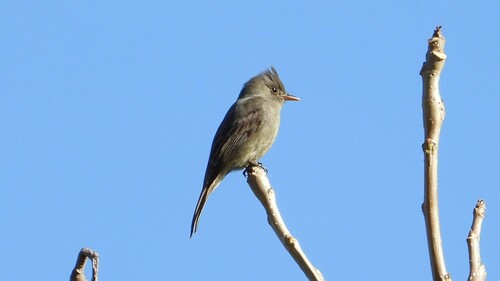 Dark Pewee
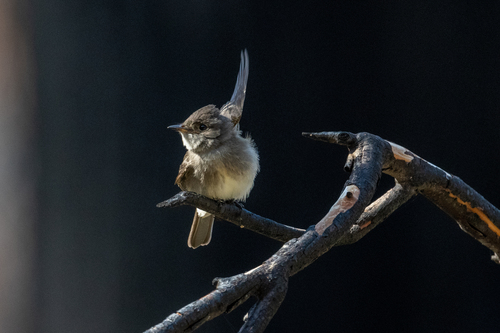 Western Wood-Pewee
In short
The most reliable field mark between Dark Pewee and Western Wood-Pewee is overall darkness and contrast: Dark Pewee is notably sooty and dark overall, with a weak or nearly absent wing bar, while Western Wood-Pewee is paler gray-olive above with two distinct wing bars and a lighter underpart. Juvenile Dark Pewees show rufous fringes on the wing feathers, a feature not present in Western Wood-Pewee. Structurally, Dark Pewee is larger and bulkier, with a more prominent crest. Habitat and range are also key: Dark Pewee is restricted to high-elevation forests of Costa Rica and western Panama, while Western Wood-Pewee is a widespread North American migrant. Voice differs, but both can be loud and repetitive.
Identification tips
- Juvenile wing pattern: Look for rufous fringes on the wing feathers of young Dark Pewees; Western Wood-Pewee juveniles never show this feature.
- Overall darkness: Dark Pewee is sooty and dark overall, especially on the crown and upperparts, while Western Wood-Pewee is paler gray-olive with a more washed-out look.
- Wing bars: Western Wood-Pewee shows two distinct wing bars at all ages, while Dark Pewee's wing bar is weak or nearly absent, especially in adults.
- Bill color: Western Wood-Pewee has a dark bill with yellow at the base of the lower mandible; Dark Pewee's bill color is less contrasting and not noted as diagnostic.
- Crest: Dark Pewee has a more prominent, crested crown, giving it a bulkier-headed appearance compared to the smoother crown of Western Wood-Pewee.
- Underpart color: Dark Pewee's underparts are paler olive-grey than the back, turning yellowish on the lower belly; Western Wood-Pewee's underparts are light with an olive wash on the breast.
- Tail and wings: Dark Pewee's wings and tail are blackish and contrast with the sooty body; Western Wood-Pewee's wings are not as dark and are set off by the pale wing bars.
- Size and structure: Dark Pewee is larger and heavier (21.5 g vs 11–14 g), with a more robust build and longer body, noticeable when seen side-by-side or with experience.
- Habitat and range: Only expect Dark Pewee in high-elevation forests of Costa Rica and western Panama; Western Wood-Pewee is not found there and is a North American species.
- Behavior: Dark Pewee is solitary and returns to the same perch, often defending its territory aggressively; Western Wood-Pewee is less territorial and more likely to be seen in migration.
- Voice: Listen for the loud whip call and 'fred-reek-fear' song of Dark Pewee versus the buzzy 'peeer' and descending 'tsees' of Western Wood-Pewee. Vocalizations are helpful if heard well.
- Context: If you are in Central America at high elevation, especially in the Talamancan range, Dark Pewee is expected; elsewhere, especially in North America, Western Wood-Pewee is the likely candidate.
- Sex differences: Both species are sexually monomorphic; do not rely on sex for identification.
- Seasonal variation: No strong seasonal plumage differences are noted for either species, but juvenile Dark Pewee's rufous wing fringes are only present in young birds.
- Pitfalls: Beware of lighting: Western Wood-Pewee can look darker in shade, but will always show two wing bars and lack the sooty uniformity of Dark Pewee. Juvenile Western Wood-Pewee never shows rufous wing fringes.
Size
Dark Pewee is significantly heavier and slightly longer, with a body mass around 21.5 g compared to Western Wood-Pewee's 11–14 g. Dark Pewee reaches about 16.5 cm in length, while Western Wood-Pewee is 14–16 cm. In the field, Dark Pewee appears bulkier and more robust, often with a more prominent crest, whereas Western Wood-Pewee is slimmer and more delicate in build.
Plumage
- Juvenile/immature birds: Juvenile Dark Pewees are browner above than adults and have distinctive rufous fringes to their wing feathers, which is not seen in Western Wood-Pewee at any age. This rufous edging is a strong separator in young birds.
- Adults: Adult Dark Pewee is sooty-grey overall, darkest on the crown, with blackish wings and tail. The wing bar is weak or nearly absent, and the underparts are a paler olive-grey than the back, becoming yellowish on the lower belly. Western Wood-Pewee adults are gray-olive above, with two clear wing bars and light underparts washed with olive on the breast. The bill of Western Wood-Pewee is dark with yellow at the base of the lower mandible, a subtle but sometimes useful point. In flight, Western Wood-Pewee's wing bars and lighter overall coloration are more apparent, while Dark Pewee maintains a uniform, dark appearance.
Behaviour
Both species perch conspicuously and sally for insects, but Dark Pewee is especially solitary outside the breeding season and is known for returning to the same exposed perch repeatedly. It also aggressively defends its nest against larger birds. Western Wood-Pewee is less territorial and more likely to be seen in migration or in mixed-species contexts. Both species use high perches, but Dark Pewee's behavior is more stationary and watchful.
Habitat
Habitat is a strong separator: Dark Pewee is endemic to the Talamancan montane forests of Costa Rica and western Panama, found at elevations between 1250–2150 m, especially at forest edges, clearings, and semi-open areas with tall trees. Western Wood-Pewee is a widespread migrant in North America, breeding in open woodlands, forest edges, and riparian areas, and does not occur in the range of Dark Pewee. If you are outside Central American highlands, you are almost certainly not seeing Dark Pewee.
Voice
Dark Pewee gives an incessant, loud whip call and a repetitive 'fred-reek-fear' song. Western Wood-Pewee's call is a loud, buzzy 'peeer', and its song is a series of three rapid descending 'tsees' ending with a descending 'peeer'. While both are vocal and repetitive, the quality and pattern of their calls differ, with Dark Pewee's being sharper and more whip-like.