

Motmot

Dark Hawk-Cuckoo vs White-rumped Shama

Hierococcyx bocki versus Copsychus malabaricus

Play a quiz with Dark Hawk-Cuckoo and White-rumped Shama
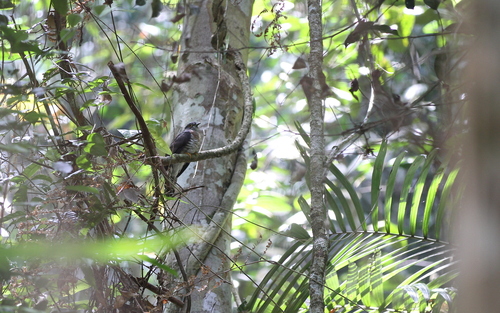
Dark Hawk-Cuckoo (Hierococcyx bocki) Dark Hawk-Cuckoo
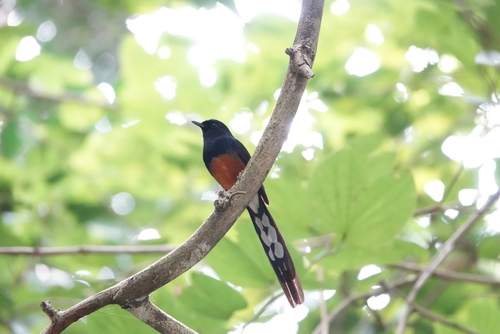
White-rumped Shama (Copsychus malabaricus) White-rumped Shama

Media

Loading…

In short

The most reliable field mark to separate Dark Hawk-Cuckoo from White-rumped Shama is the presence of a bold white rump and outer tail on the shama, which is visible on perched and flying birds of all ages, while the hawk-cuckoo lacks any white in the tail or rump. Juvenile shamas are brownish with a spotted chest, resembling the adult female, but always show the white rump and outer tail. Structurally, the hawk-cuckoo is much more hawk-like, with a longer tail and a more powerful, predatory jizz, while the shama is a compact, upright songbird. In flight, the shama's white tail flashes are distinctive, while the hawk-cuckoo shows a uniform tail. Habitat also helps: shamas prefer dense undergrowth, while hawk-cuckoos are more often in the canopy or mid-story.

Identification tips

  1. White rump and outer tail (all ages, all sexes): Only the White-rumped Shama shows a bold white rump and white outer tail feathers, visible both when perched and in flight. Dark Hawk-Cuckoo never shows white in these areas.
  2. Juvenile/female confusion: Juvenile and female shamas are brownish with spotted or blotchy chests, but still show the white rump/tail. Hawk-cuckoo juveniles are darker and lack spotting or white.
  3. Tail shape and length: Hawk-cuckoo has a longer, straighter, and more hawk-like tail, while shama's tail is long but often fanned or flicked and always shows white sides.
  4. Flight style: Shama has a bounding, undulating flight with frequent tail flicks and flashes of white. Hawk-cuckoo flies more directly and glides, reminiscent of a small hawk.
  5. Perched posture: Shama perches upright, often cocking its tail. Hawk-cuckoo perches more horizontally, with a longer, sleeker profile.
  6. Bill shape: Shama has a short, straight, black bill typical of flycatchers. Hawk-cuckoo has a longer, slightly downcurved bill, more suited to predatory feeding.
  7. Plumage gloss: Adult male shama is glossy black above with a rich chestnut belly. Hawk-cuckoo is more uniformly dark, lacking strong gloss or chestnut tones.
  8. Habitat: Shama is almost always in dense undergrowth or bamboo, rarely venturing into the open. Hawk-cuckoo is more often seen in the canopy or mid-story, sometimes in open forest.
  9. Behavior: Shama is shy, skulking, and territorial, often heard before seen. Hawk-cuckoo is less secretive and may perch in the open.
  10. Courtship display: Shama males display by fanning and flicking their tails and singing; this behavior is not seen in hawk-cuckoo.
  11. Size impression: Shama is compact and small, while hawk-cuckoo appears longer, slimmer, and more hawk-like.
  12. Leg color: Shama has pink legs and feet; leg color is not described for hawk-cuckoo but is unlikely to be pink.
  13. Bill color: Both have dark bills, but shama's is shorter and stubbier.
  14. Voice: Not described here, but shama is a renowned songster; hawk-cuckoo has a different, less musical call.
  15. Context: If the bird is in a cage or near human habitation, shama is more likely due to its popularity as a cage bird.

Size

White-rumped Shama is a small passerine, about 23–28 cm in length and weighing 28–34 g. Dark Hawk-Cuckoo is not described in detail here, but as a hawk-cuckoo, it is generally larger, longer-tailed, and more slender than the shama. The shama is compact and perches upright, while the hawk-cuckoo is rangier and more horizontal in posture. In direct comparison, the hawk-cuckoo appears longer and slimmer, with a proportionally longer tail and wings.

Plumage

Juvenile and female White-rumped Shamas are brownish with a spotted or blotchy chest, but always show a white rump and outer tail feathers, which are diagnostic at all ages and in all plumages. Adult males are glossy black above with a chestnut belly, and the white rump is always obvious. In flight, the shama flashes white in the tail and rump. Dark Hawk-Cuckoo, by contrast, lacks any white in the rump or tail at any age. Its plumage is overall darker and more uniform, with no mention of spotted or blotchy underparts in juveniles. The hawk-cuckoo's tail is longer and more hawk-like, with no white patches. If you see a bird with a white rump or tail sides, it is a shama; if not, and the bird is hawk-like, it is the hawk-cuckoo.

Behaviour

White-rumped Shama is shy, crepuscular, and highly territorial, often skulking in dense undergrowth and singing from hidden perches. Males may display by fanning and flicking their tails. In flight, shamas have a bounding, rising and falling pattern, often flashing their white tail. Dark Hawk-Cuckoo is more likely to be seen perched openly or flying through the mid-story or canopy, with a more direct, gliding flight reminiscent of a small raptor. Hawk-cuckoos do not show the tail-flicking or fanning behavior typical of shamas.

Habitat

White-rumped Shama favors dense undergrowth, bamboo thickets, and lowland forests, often close to the ground and in areas with thick vegetation. It is rarely seen in the open. Dark Hawk-Cuckoo is more likely to be found in the mid-story or canopy, sometimes in more open forest or at forest edges, and does not typically skulk in dense undergrowth. If you see a bird in thick brush, especially on or near the ground, shama is more likely; if higher up or in more open areas, consider hawk-cuckoo.

Submit a better description

Use the same sections as the comparison. Your text is published immediately.

The most reliable field mark to separate Dark Hawk-Cuckoo from White-rumped Shama is the presence of a bold white rump and outer tail on the shama, which is visible on perched and flying birds of all ages, while the hawk-cuckoo lacks any white in the tail or rump. Juvenile shamas are brownish with a spotted chest, resembling the adult female, but always show the white rump and outer tail. Structurally, the hawk-cuckoo is much more hawk-like, with a longer tail and a more powerful, predatory jizz, while the shama is a compact, upright songbird. In flight, the shama's white tail flashes are distinctive, while the hawk-cuckoo shows a uniform tail. Habitat also helps: shamas prefer dense undergrowth, while hawk-cuckoos are more often in the canopy or mid-story.

  1. White rump and outer tail (all ages, all sexes): Only the White-rumped Shama shows a bold white rump and white outer tail feathers, visible both when perched and in flight. Dark Hawk-Cuckoo never shows white in these areas.
  2. Juvenile/female confusion: Juvenile and female shamas are brownish with spotted or blotchy chests, but still show the white rump/tail. Hawk-cuckoo juveniles are darker and lack spotting or white.
  3. Tail shape and length: Hawk-cuckoo has a longer, straighter, and more hawk-like tail, while shama's tail is long but often fanned or flicked and always shows white sides.
  4. Flight style: Shama has a bounding, undulating flight with frequent tail flicks and flashes of white. Hawk-cuckoo flies more directly and glides, reminiscent of a small hawk.
  5. Perched posture: Shama perches upright, often cocking its tail. Hawk-cuckoo perches more horizontally, with a longer, sleeker profile.
  6. Bill shape: Shama has a short, straight, black bill typical of flycatchers. Hawk-cuckoo has a longer, slightly downcurved bill, more suited to predatory feeding.
  7. Plumage gloss: Adult male shama is glossy black above with a rich chestnut belly. Hawk-cuckoo is more uniformly dark, lacking strong gloss or chestnut tones.
  8. Habitat: Shama is almost always in dense undergrowth or bamboo, rarely venturing into the open. Hawk-cuckoo is more often seen in the canopy or mid-story, sometimes in open forest.
  9. Behavior: Shama is shy, skulking, and territorial, often heard before seen. Hawk-cuckoo is less secretive and may perch in the open.
  10. Courtship display: Shama males display by fanning and flicking their tails and singing; this behavior is not seen in hawk-cuckoo.
  11. Size impression: Shama is compact and small, while hawk-cuckoo appears longer, slimmer, and more hawk-like.
  12. Leg color: Shama has pink legs and feet; leg color is not described for hawk-cuckoo but is unlikely to be pink.
  13. Bill color: Both have dark bills, but shama's is shorter and stubbier.
  14. Voice: Not described here, but shama is a renowned songster; hawk-cuckoo has a different, less musical call.
  15. Context: If the bird is in a cage or near human habitation, shama is more likely due to its popularity as a cage bird.

White-rumped Shama is a small passerine, about 23–28 cm in length and weighing 28–34 g. Dark Hawk-Cuckoo is not described in detail here, but as a hawk-cuckoo, it is generally larger, longer-tailed, and more slender than the shama. The shama is compact and perches upright, while the hawk-cuckoo is rangier and more horizontal in posture. In direct comparison, the hawk-cuckoo appears longer and slimmer, with a proportionally longer tail and wings.

Juvenile and female White-rumped Shamas are brownish with a spotted or blotchy chest, but always show a white rump and outer tail feathers, which are diagnostic at all ages and in all plumages. Adult males are glossy black above with a chestnut belly, and the white rump is always obvious. In flight, the shama flashes white in the tail and rump. Dark Hawk-Cuckoo, by contrast, lacks any white in the rump or tail at any age. Its plumage is overall darker and more uniform, with no mention of spotted or blotchy underparts in juveniles. The hawk-cuckoo's tail is longer and more hawk-like, with no white patches. If you see a bird with a white rump or tail sides, it is a shama; if not, and the bird is hawk-like, it is the hawk-cuckoo.

White-rumped Shama is shy, crepuscular, and highly territorial, often skulking in dense undergrowth and singing from hidden perches. Males may display by fanning and flicking their tails. In flight, shamas have a bounding, rising and falling pattern, often flashing their white tail. Dark Hawk-Cuckoo is more likely to be seen perched openly or flying through the mid-story or canopy, with a more direct, gliding flight reminiscent of a small raptor. Hawk-cuckoos do not show the tail-flicking or fanning behavior typical of shamas.

White-rumped Shama favors dense undergrowth, bamboo thickets, and lowland forests, often close to the ground and in areas with thick vegetation. It is rarely seen in the open. Dark Hawk-Cuckoo is more likely to be found in the mid-story or canopy, sometimes in more open forest or at forest edges, and does not typically skulk in dense undergrowth. If you see a bird in thick brush, especially on or near the ground, shama is more likely; if higher up or in more open areas, consider hawk-cuckoo.

Discard your changes?

You have unsaved edits. If you leave now, those changes will be lost.

Dark Hawk-Cuckoo · White-rumped Shama · My Tricky Birds