
Dark Chanting-Goshawk vs Pale Chanting-Goshawk
Melierax metabates versus Melierax canorus
Play a quiz with Dark Chanting-Goshawk and Pale Chanting-Goshawk
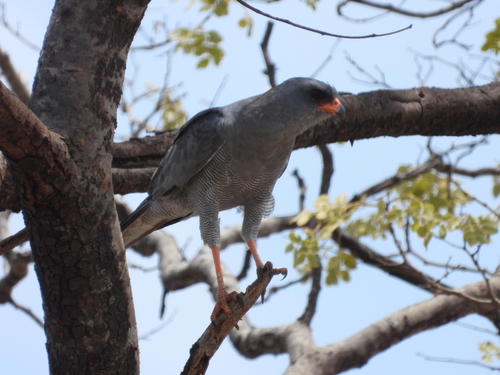 Dark Chanting-Goshawk
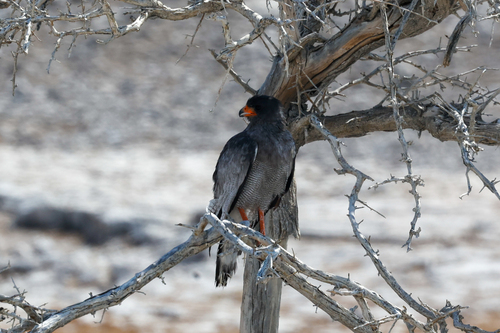 Pale Chanting-Goshawk
In short
Immature Dark and Pale Chanting-Goshawks are most reliably separated in flight by their underwing and underpart coloration: juvenile Pale Chanting-Goshawks show rufous underparts and a white rump, while juvenile Dark Chanting-Goshawks are browner overall, more buzzard-like, and lack the rufous tones. Adults differ in the shade of grey and the extent of white on the rump and secondaries, with Pale being paler and showing a white rump and pale secondaries, while Dark is darker grey above and lacks a distinct white rump. Structure and bare part color are similar, but Pale is slightly larger and more likely to be seen in open, arid habitats perched on poles. Focus on rump color, underpart tone, and flight feather contrast for the most reliable field separation, especially in immature birds.
Identification tips
- Juvenile/immature underparts: Juvenile Pale Chanting-Goshawk shows rufous underparts and a white rump, while juvenile Dark Chanting-Goshawk is browner overall, lacks rufous tones, and has no white rump. This is the single most reliable mark for immatures in flight.
- Rump color (all ages): Pale shows a distinct white rump in both adults and immatures; Dark lacks a white rump, appearing uniformly dark grey above.
- Adult upperpart shade: Adult Pale is noticeably paler grey, especially on the head and upper breast, while Dark is a deeper, darker grey overall.
- Flight feather contrast (adults): In flight, adult Pale has very pale (almost white) secondaries contrasting with black primaries and grey forewings; Dark's upperwing is more uniformly dark, with black primaries but no striking pale panel.
- Tail pattern: Both have black and white barring, but Pale's central tail feathers are black tipped with white, and outer feathers are barred grey and white; Dark's tail is broadly barred black and white but lacks the same contrast.
- Underpart barring (adults): Both have finely barred underparts, but Pale's are barred dark grey and white, while Dark's are white with fine black barring (except for the grey breast).
- Bare part color: Both have orange-red cere and long legs, but Pale also has red facial skin and a bill that is red at the base and dark grey at the tip. These are subtle and often not visible at a distance.
- Eye color (immatures): Immature Pale has pale yellow eyes, while adult Pale has dark brown eyes. Eye color for Dark is not specified in the notes.
- Size and structure: Pale is slightly larger and bulkier, but this is subtle and not always reliable in the field. Both have long legs and upright postures.
- Perching behavior: Pale is often seen perched on roadside poles in open country; Dark is less likely to be seen in such exposed, arid settings.
- Habitat context: In southern Africa, especially in dry, open semi-desert, Pale is expected; in more wooded or varied habitats, especially outside southern Africa, Dark is more likely.
- Vocalization: Only Pale's call is described (a tuneful whistle); if heard, this supports Pale, but lack of vocalization is not helpful.
- Buzzard-like appearance (juveniles): Juvenile Dark can look like a buzzard (Buteo), but with a longer tail and broader wings; Pale juveniles are paler below and have a white rump.
- Nest site: Pale may nest on poles or pylons as well as trees; Dark nests only in trees.
- Group structure: If you observe a trio of adults at a nest (rare), this suggests Pale, as polyandry is recorded for this species.
Size
Pale Chanting-Goshawk averages slightly heavier (810g vs 758.5g for Dark), and is described as larger overall. Both are medium-sized, long-legged hawks with upright postures. The difference is subtle and not always apparent in the field, but Pale may appear a bit bulkier and longer-winged, especially when perched. Sexes are similar in both, though female Dark Chanting-Goshawks can be heavier than males.
Plumage
- Juveniles/Immatures:
- Pale Chanting-Goshawk: Brown upperparts with a striking white rump and black-barred tail; underparts are rufous, and the throat is white with dark streaks. In flight, the underwing and tail are white with black barring, and the secondaries are very pale (almost white from a distance).
- Dark Chanting-Goshawk: Juveniles are browner overall, resembling a buzzard, but with a long-tailed, broad-winged silhouette. They lack the white rump and rufous underparts of Pale; instead, the underparts are white, finely barred with black, and the upperparts are dark grey-brown.
- Adults:
- Pale: Pale grey head and upper breast, white rump, finely barred dark grey and white underparts, black primaries, very pale (almost white) secondaries, and grey forewings. Tail pattern is black-tipped with white, outer feathers barred grey and white.
- Dark: Uniformly darker grey head, breast, and upperparts; white underparts with fine black barring (except the breast, which is grey); tail broadly barred black and white, but no distinct white rump. Both have orange-red cere and legs, but Pale's facial skin is also red.
Behaviour
Both species hunt from perches and swoop down on prey, but Pale Chanting-Goshawk is especially noted for being conspicuous on roadside poles and in open terrain. Dark Chanting-Goshawk may follow mammals or people to catch prey disturbed by their movement. Both are territorial nesters, building stick nests in trees, but Pale may also use poles or pylons. Social structure can differ: Pale sometimes forms polyandrous trios, especially in prey-rich areas, while Dark is typically monogamous.
Habitat
Pale Chanting-Goshawk is a resident of southern Africa's dry, open semi-desert regions with less than 75 cm annual rainfall, and is commonly seen in very open country, often on roadside poles. Dark Chanting-Goshawk has a broader range across sub-Saharan Africa and southern Arabia, favoring savanna, woodland, and more varied habitats, and is less tied to arid open country. If you see a chanting-goshawk in true semi-desert or perched on a pole in southern Africa, Pale is much more likely.
Voice
Only Pale Chanting-Goshawk's call is described in the notes: a tuneful, whistling 'kleeu-kleeu-kleeu-ku-ku-ku' given from a treetop perch, especially during the breeding season. Vocal differences are not well covered for Dark in these notes, so voice is not a primary field mark for separation here.
Dark Chanting-Goshawk · Pale Chanting-Goshawk · My Tricky Birds