

Damara Tern vs Australian Fairy Tern
Sternula balaenarum versus Sternula nereis
Play a quiz with Damara Tern and Australian Fairy Tern
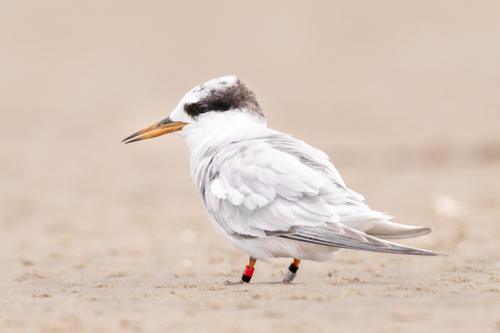
 Damara Tern
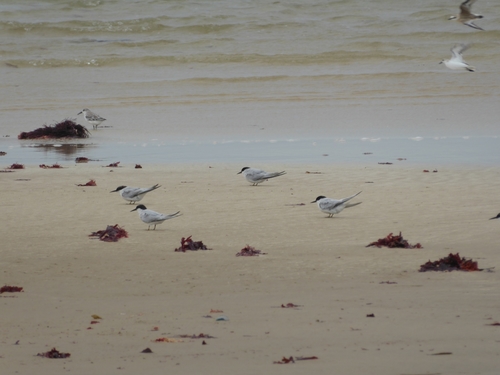
 Australian Fairy Tern
In short
The most reliable field mark between Damara Tern and Australian Fairy Tern is the pattern and extent of black on the head in breeding adults: Damara Tern shows a full black cap extending from forehead to nape, while Australian Fairy Tern's black only reaches the eye, never as far as the bill. In flight, Damara Tern adults display a distinctive black triangular wingtip, whereas Australian Fairy Tern's wings are a more uniform pale bluish-grey. Immature Damara Terns show buff bars across the mantle, a feature not present in Australian Fairy Tern immatures. Both are small, pale terns, but subtle differences in bill and leg color, as well as head pattern, are key for separation, especially in breeding season. Be aware of seasonal changes in head pattern and bill color, which can cause confusion outside the breeding period.
Identification tips
- Head Pattern in Breeding Adults: Damara Tern shows a full black cap from forehead to nape; Australian Fairy Tern's black patch stops at the eye and never reaches the bill. This is the single most reliable mark in breeding season.
- Non-breeding Head Pattern: Both species lose the full cap in non-breeding plumage, but Damara Tern retains a black mask around the eyes to nape, while Australian Fairy Tern's head is mostly white with only a reduced dark patch.
- Immature Upperparts: Damara Tern immatures have buff bars across the mantle, which are absent in Australian Fairy Tern immatures. Look for this in juvenile flocks or post-breeding dispersal.
- Wing Pattern in Flight: Damara Tern adults show a black triangular wingtip from carpal to tip; Australian Fairy Tern's wings are evenly pale bluish-grey with no strong black triangle.
- Bill Color in Breeding: Both have yellowish-orange bills in breeding, but Australian Fairy Tern's is often brighter and more orange, especially in courtship. In non-breeding, Australian Fairy Tern's bill becomes black-tipped and at the base, while Damara Tern's bill color is less described but may be duller.
- Leg Color: Both species have yellowish-orange legs in breeding, but this is not a strong separator.
- Size: Damara Tern is slightly smaller (23cm, 46g) than Australian Fairy Tern (25cm), but this is rarely useful unless birds are side-by-side.
- Back Color: Damara Tern's back is very pale grey; Australian Fairy Tern's wings are a slightly bluer grey, but this is subtle and variable with light.
- Feeding Behavior: Damara Tern often feeds alone and from lower heights; Australian Fairy Tern hovers higher and may be seen with other terns or near predatory fish activity.
- Habitat/Range: If you are in southern Africa, expect Damara Tern; in Australia/New Zealand/New Caledonia, expect Australian Fairy Tern. Their ranges do not overlap.
- Seasonal Context: Damara Tern breeds in southern summer (Nov–Feb), Australian Fairy Tern breeds in spring to early summer (Sep–Feb). Timing can help if you know local breeding cycles.
- Sexes: Sexes are similar in both species; do not rely on sex for ID.
- Tail and Structure: No strong differences described; both are compact, short-tailed terns with similar jizz.
- Voice: No diagnostic differences described in the sources provided.
- Common Pitfall: Non-breeding and immature birds are most often confused due to reduced head pattern and similar size—look for the presence or absence of buff mantle bars and the extent of black on the head for the best separation.
Size
Both species are very small terns and similar in overall size, but Damara Tern is slightly smaller (body mass 46g, length 23cm) compared to Australian Fairy Tern (length about 25cm; mass not specified but similar). In the field, this size difference is subtle and rarely diagnostic unless seen side-by-side.
Plumage
-
Juvenile/Immature: Damara Tern immatures show distinctive buff bars across the mantle, which is not seen in Australian Fairy Tern. Australian Fairy Tern immatures resemble non-breeding adults, lacking strong mantle barring.
-
Adult Breeding: Damara Tern adults have a full black cap from forehead to nape and a very pale grey back, with a black triangular wingtip in flight. Australian Fairy Tern adults have a black patch that extends no further than the eye (never to the bill), with a white body and pale bluish-grey wings. Bill and legs are yellowish-orange in both, but Damara's black cap is more extensive.
-
Adult Non-breeding: Both species lose the full black cap in non-breeding plumage, replaced by more white on the forehead and crown. Damara Tern shows a black mask around the eyes extending to the nape, while Australian Fairy Tern's black is reduced and the bill becomes black-tipped and at the base. Sexes are similar in both species.
Behaviour
Both species feed mainly on small fish by plunge-diving, but Damara Tern typically dives from a lower height (3–8m), while Australian Fairy Tern hovers higher (5–15m) and uses a shallower, surface-skimming plunge. Damara Tern often feeds solitarily, spacing out from other terns, especially in wintering flocks, while Australian Fairy Tern is more likely to be seen in colonies or loose groups near feeding sites. Both species breed in colonies, but Damara Tern's breeding is more tightly linked to southern Africa's summer, while Australian Fairy Tern breeds in spring to early summer in the southwestern Pacific.
Habitat
Damara Tern breeds on southern African coasts and migrates to tropical West African coasts in winter; it is strictly coastal. Australian Fairy Tern is found along coastlines and estuaries of Australia, New Zealand, and New Caledonia, often near shallow tidal pools and estuaries. Their ranges do not overlap, but both prefer open, sandy or shell-strewn beaches for breeding and shallow waters for feeding. If you are outside the southwestern Pacific or southern Africa, the species present is almost certainly the local one.