
Cyprus Wheatear vs Pied Wheatear
Oenanthe cypriaca versus Oenanthe pleschanka
Play a quiz with Cyprus Wheatear and Pied Wheatear
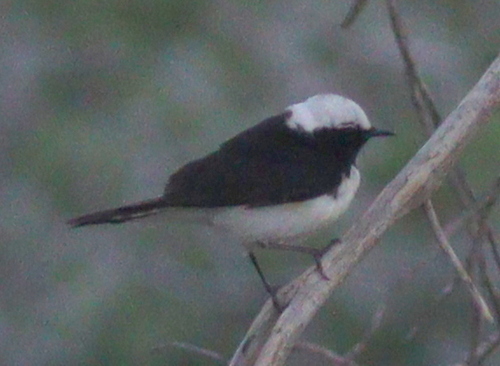 Cyprus Wheatear
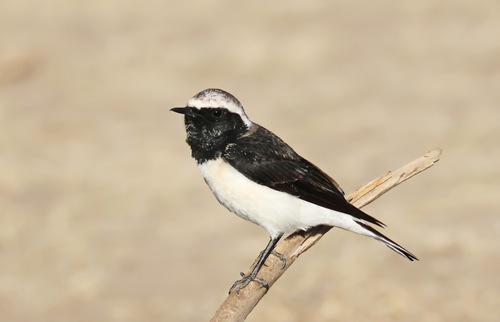 Pied Wheatear
In short
The most reliable field mark to separate Cyprus Wheatear from Pied Wheatear is the lack of sexual dimorphism in Cyprus Wheatear: males and females look alike, whereas Pied Wheatear shows strong male-female differences, especially in breeding plumage. Cyprus Wheatear is overall darker above, with more extensive black on the head, back, and tail, and lacks the sandy or buff tones typical of female and juvenile Pied Wheatear. In flight or at rest, Pied Wheatear usually shows a distinctive 'inverted T' pattern on the tail, while Cyprus Wheatear's tail is darker overall. Habitat can also be a clue: Cyprus Wheatear favors more wooded and arboreal settings, while Pied Wheatear is tied to open, stony ground. Vocalizations are very different, but are not always available in the field.
Identification tips
- Sexual dimorphism: Only Pied Wheatear shows strong male-female differences in plumage. If you see a pair and both look alike, Cyprus Wheatear is far more likely.
- Tail pattern: Look for the 'inverted T' on the tail in Pied Wheatear—central feathers black, outer feathers white with black tips. Cyprus Wheatear's tail is darker overall, with more black and less clear white.
- Upperparts color: Cyprus Wheatear is darker above, with more black on the head and back, while Pied Wheatear (especially females and juveniles) is browner and often shows sandy or buff tones.
- Crown and head: Male Pied Wheatear has a white crown tinged with brown, contrasting with a black face and throat. Cyprus Wheatear lacks the white crown and is more uniformly dark-headed.
- Facial pattern: Pied Wheatear shows a narrow buff line from the beak over the eye; Cyprus Wheatear's face is plainer and darker.
- Rump and upper tail coverts: Pied Wheatear has a white rump and upper tail coverts; Cyprus Wheatear's rump is less contrasting and darker.
- Underparts: Pied Wheatear shows creamy-buff underparts, especially in females and juveniles; Cyprus Wheatear is whiter below, with less buff.
- Juvenile pattern: Juvenile Pied Wheatear is speckled above (pale centers to brown feathers); Cyprus Wheatear juveniles are not described as speckled and should appear darker and more uniform.
- Habitat: In Cyprus, a wheatear in woodland, forest edge, or high in trees is almost certainly Cyprus Wheatear. In open, stony ground, especially outside Cyprus, Pied Wheatear is more likely.
- Perching height: Cyprus Wheatear often perches high (5–10 m) in trees; Pied Wheatear prefers rocks and low perches.
- Song: Cyprus Wheatear's song is high-pitched and insect-like; Pied Wheatear's is low, musical, and variable. If you hear a buzzing song, it's Cyprus Wheatear.
- Call: Pied Wheatear gives a harsh 'zack zack'; Cyprus Wheatear's calls are not described in detail here.
- Flight jizz: Both species show typical wheatear flight, but Cyprus Wheatear may appear more at home in trees and use more aerial sallying.
- Range: Cyprus Wheatear breeds only in Cyprus; Pied Wheatear is a rare vagrant there. Outside Cyprus, Pied Wheatear is the default.
- Season: In Cyprus, breeding birds in spring/summer are almost always Cyprus Wheatear. Migrant Pied Wheatear is rare and usually outside the breeding season.
Size
Both species are very similar in size, with Cyprus Wheatear at 14–15 cm and Pied Wheatear at about 14–14.6 cm in length [wikipedia]. There is no practical size difference in the field, and both are small, slim wheatears.
Plumage
-
Juvenile/First-year birds: Pied Wheatear juveniles have brown upperparts with pale centers near the tips, giving a speckled look. Females and juveniles are browner overall, with buff tips and sandy tones, especially on the head and upperparts. Cyprus Wheatear juveniles are not described in detail, but the species as a whole lacks the sandy or buff tones and is darker above, with more black on the head and back.
-
Adult males: Pied Wheatear males are boldly marked with a white crown, black face and throat, and a white rump. The tail shows a clear inverted black 'T' pattern. Cyprus Wheatear males (and females) are darker above, with more extensive black on the head, back, and tail, and lack the strong white crown and sandy tones.
-
Adult females: Pied Wheatear females are browner, with a sandy buff wash on the head and less white on the rump. Cyprus Wheatear females look like the males, with no sexual dimorphism, and are darker and more contrasting overall.
-
Tail pattern: Pied Wheatear shows a white tail with a black inverted 'T' (central feathers black, outer feathers white with black tips), while Cyprus Wheatear's tail is darker with more black overall.
Behaviour
Cyprus Wheatear is the most arboreal of the western Palearctic wheatears, often perching high (5–10 meters) and using aerial sallying to catch insects. It frequently breeds in woodland and forest edge, and uses perch-pounce tactics. Pied Wheatear is more terrestrial, typically found in open, stony, sparsely vegetated areas, and sings from rocks or in flight. In flight, both species show typical wheatear jizz, but Cyprus Wheatear may appear more at home in trees and higher perches.
Habitat
Cyprus Wheatear is strongly associated with Cyprus, breeding only on the island, and prefers woodland, forest edge, and areas with both open ground and high bush/tree cover. It is much more arboreal than Pied Wheatear. Pied Wheatear breeds from southeast Europe to Mongolia in open, stony, and sparsely vegetated habitats, often at higher elevations. It is rarely found in wooded areas and avoids dense vegetation. In Cyprus, Pied Wheatear is a rare migrant or vagrant; Cyprus Wheatear is the default breeding species.
Voice
Cyprus Wheatear has a distinctive, high-pitched, insect-like song made up of buzzing bursts, quite unlike the Pied Wheatear. Pied Wheatear's song is low-pitched, musical, and varied, sometimes lark-like or whistling, and is performed from a perch or in flight. The call of Pied Wheatear is a harsh 'zack zack'. Song is a strong separator when heard.