

Motmot

Curve-billed Thrasher vs Bendire's Thrasher

Toxostoma curvirostre versus Toxostoma bendirei

Play a quiz with Curve-billed Thrasher and Bendire's Thrasher
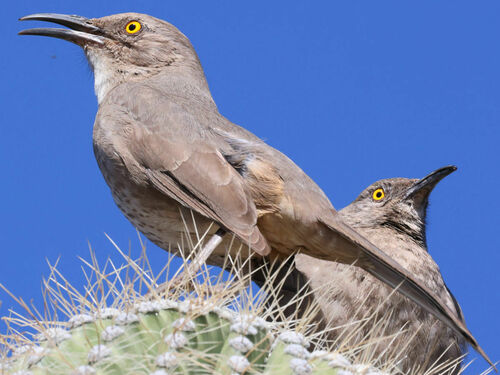
Curve-billed Thrasher (Toxostoma curvirostre) Curve-billed Thrasher
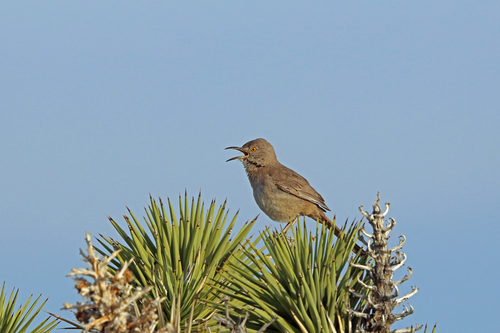
Bendire's Thrasher (Toxostoma bendirei) Bendire's Thrasher

Media

Loading…

In short

The most reliable field mark between Curve-billed and Bendire's Thrashers is the bill: Curve-billed has a long, evenly curved all-dark bill, while Bendire's shows a shorter bill with a straighter lower edge and a pale base to the lower mandible. Eye color can help—Bendire's usually has bright yellow eyes, while Curve-billed tends toward orange—but both can show intermediate shades. On the breast, Curve-billed typically shows larger, rounder spots, while Bendire's has smaller, sharper arrowhead-shaped markings. Juvenile and immature birds are especially tricky, but bill shape and base color remain the most consistent clues.

Identification tips

  1. Bill shape and color: Curve-billed Thrasher has a long, smoothly and evenly curved all-dark bill; Bendire's has a shorter bill, with the upper mandible curved but the lower mandible nearly straight and often showing a pale base. This is the most reliable mark at all ages.
  2. Eye color: Bendire's usually shows bright yellow eyes, while Curve-billed's are typically orange to golden. However, both can show intermediate shades (yellow-orange, red-orange), so use with caution, especially in poor light or on young birds.
  3. Breast spotting: Curve-billed usually has larger, rounder, grayish-brown spots on the breast; Bendire's shows smaller, sharper, arrowhead-shaped markings. This is most useful on adults and eastern Curve-billed subspecies, but beware of overlap and individual variation.
  4. Tail pattern: Bendire's often shows white tips to the tail feathers, especially when fanned; this is less obvious or absent in Curve-billed.
  5. Juvenile plumage: Young Curve-billed lack pale tips on the tail and have a rufous wash to the upperparts and chest, with unkempt abdominal feathers. Juvenile Bendire's are less well described, but bill shape and base color remain the best clues.
  6. Overall coloration: Bendire's is generally paler below, with faint dark streaks rather than bold spots; Curve-billed is more uniformly grayish-brown above and below, with more distinct spotting (especially in eastern subspecies).
  7. Habitat: Curve-billed is common in suburban settings, brushy desert, and cactus stands; Bendire's prefers open grassland with scattered yucca or hedgerows and avoids dense vegetation and suburban areas. Use habitat as a supporting clue, not a primary mark.
  8. Behavior: Both forage on the ground, but Curve-billed is more tolerant of human presence and often seen in suburban landscapes. Bendire's is more secretive and sticks to open, less vegetated areas.
  9. Vocalizations: Listen for the Curve-billed's sharp 'whit-wheet' call, which is diagnostic; Bendire's song is more melodic and continuous, with a 'chuck' note. Calls are often the easiest way to separate them when seen poorly.
  10. Size and structure: Both are similar in size, but Curve-billed may appear slightly bulkier and heavier-bodied, with a proportionally shorter tail. Bendire's can look more slender and longer-tailed, but this is subtle and unreliable alone.
  11. Subspecies variation: Be aware that Curve-billed subspecies can vary in spotting, wing bars, and overall tone, which may obscure some plumage marks. Always prioritize bill and eye color over breast pattern in ambiguous cases.
  12. Confusion with age: Immature Bendire's can be mistaken for young Curve-billed due to bill length; focus on the shape and base color of the bill, not just length.
  13. Perched vs. in flight: Most marks are visible when perched; in flight, look for tail pattern (white tips in Bendire's), but bill shape may be harder to judge.
  14. Lighting and distance: At a distance or in poor light, bill color and eye color can be hard to assess. Try to get multiple angles and views, and use a combination of marks.
  15. When in doubt: If you cannot see the bill base or eye color clearly, and breast spotting is ambiguous, consider the habitat and listen for calls to support your identification.

Size

Both species are medium-sized thrashers with long tails and similar overall proportions. Bendire's Thrasher averages about 62 grams in mass [wikidata], but direct mass comparisons for Curve-billed are lacking. In the field, Curve-billed often appears slightly bulkier and heavier-bodied, but this is subtle and unreliable for single birds. Both have long tails, but the Curve-billed's is proportionally shorter compared to other thrashers, and Bendire's tail may appear longer and more slender.

Plumage

Juvenile and immature birds of both species can be confusing, but some differences persist. Curve-billed juveniles lack pale tips on the rectrices (tail feathers) and have a rufous wash to the upperparts and chest, with unkempt abdominal feathers. Bendire's juveniles are less well described, but the key difference is in the bill: even young Curve-billed show a long, smoothly curved, all-dark bill, while young Bendire's have a shorter bill with a pale base to the lower mandible and a straighter lower edge. On the breast, Curve-billed (especially eastern subspecies) shows larger, rounder spots, while Bendire's has smaller, sharper, arrowhead-shaped markings. Subspecies variation in Curve-billed can affect spotting and wing bars, but Bendire's underparts are generally paler with faint dark streaks rather than bold spots. In both, upperparts are grayish-brown, but Bendire's tends to be paler overall, especially on the underparts. Tail tips are often white in Bendire's, a feature less obvious in Curve-billed.

Behaviour

Both species are ground-foraging mimids, often seen running or hopping on open ground. Curve-billed is more likely to be seen in suburban settings, showing some tolerance for human presence, while Bendire's tends to avoid dense vegetation and prefers open grassland with scattered yucca or hedgerows. In flight, both show long tails and short, rounded wings, but behavioral context (such as proximity to human habitation) can provide supporting clues.

Habitat

Curve-billed Thrasher is the most common desert thrasher across much of its range, often found in suburban areas, brushy desert, and cactus stands. Bendire's Thrasher prefers more open grassland habitats with scattered yucca or agricultural hedgerows, and is less likely to be found in dense mesquite or suburban environments. Habitat overlap does occur, but Bendire's is generally more restricted to open, less vegetated areas.

Voice

Curve-billed Thrasher is famous for its abrupt, brash 'whit-wheet' call, often given from high perches. Its song is varied, mimicking, and pleasant, but less melodic and continuous than Bendire's. Bendire's Thrasher delivers a more melodic, continuous song with a characteristic 'chuck' note. While both can mimic other birds, the Curve-billed's call is usually the more distinctive and easily recognized in the field.

Submit a better description

Use the same sections as the comparison. Your text is published immediately.

The most reliable field mark between Curve-billed and Bendire's Thrashers is the bill: Curve-billed has a long, evenly curved all-dark bill, while Bendire's shows a shorter bill with a straighter lower edge and a pale base to the lower mandible. Eye color can help—Bendire's usually has bright yellow eyes, while Curve-billed tends toward orange—but both can show intermediate shades. On the breast, Curve-billed typically shows larger, rounder spots, while Bendire's has smaller, sharper arrowhead-shaped markings. Juvenile and immature birds are especially tricky, but bill shape and base color remain the most consistent clues.

  1. Bill shape and color: Curve-billed Thrasher has a long, smoothly and evenly curved all-dark bill; Bendire's has a shorter bill, with the upper mandible curved but the lower mandible nearly straight and often showing a pale base. This is the most reliable mark at all ages.
  2. Eye color: Bendire's usually shows bright yellow eyes, while Curve-billed's are typically orange to golden. However, both can show intermediate shades (yellow-orange, red-orange), so use with caution, especially in poor light or on young birds.
  3. Breast spotting: Curve-billed usually has larger, rounder, grayish-brown spots on the breast; Bendire's shows smaller, sharper, arrowhead-shaped markings. This is most useful on adults and eastern Curve-billed subspecies, but beware of overlap and individual variation.
  4. Tail pattern: Bendire's often shows white tips to the tail feathers, especially when fanned; this is less obvious or absent in Curve-billed.
  5. Juvenile plumage: Young Curve-billed lack pale tips on the tail and have a rufous wash to the upperparts and chest, with unkempt abdominal feathers. Juvenile Bendire's are less well described, but bill shape and base color remain the best clues.
  6. Overall coloration: Bendire's is generally paler below, with faint dark streaks rather than bold spots; Curve-billed is more uniformly grayish-brown above and below, with more distinct spotting (especially in eastern subspecies).
  7. Habitat: Curve-billed is common in suburban settings, brushy desert, and cactus stands; Bendire's prefers open grassland with scattered yucca or hedgerows and avoids dense vegetation and suburban areas. Use habitat as a supporting clue, not a primary mark.
  8. Behavior: Both forage on the ground, but Curve-billed is more tolerant of human presence and often seen in suburban landscapes. Bendire's is more secretive and sticks to open, less vegetated areas.
  9. Vocalizations: Listen for the Curve-billed's sharp 'whit-wheet' call, which is diagnostic; Bendire's song is more melodic and continuous, with a 'chuck' note. Calls are often the easiest way to separate them when seen poorly.
  10. Size and structure: Both are similar in size, but Curve-billed may appear slightly bulkier and heavier-bodied, with a proportionally shorter tail. Bendire's can look more slender and longer-tailed, but this is subtle and unreliable alone.
  11. Subspecies variation: Be aware that Curve-billed subspecies can vary in spotting, wing bars, and overall tone, which may obscure some plumage marks. Always prioritize bill and eye color over breast pattern in ambiguous cases.
  12. Confusion with age: Immature Bendire's can be mistaken for young Curve-billed due to bill length; focus on the shape and base color of the bill, not just length.
  13. Perched vs. in flight: Most marks are visible when perched; in flight, look for tail pattern (white tips in Bendire's), but bill shape may be harder to judge.
  14. Lighting and distance: At a distance or in poor light, bill color and eye color can be hard to assess. Try to get multiple angles and views, and use a combination of marks.
  15. When in doubt: If you cannot see the bill base or eye color clearly, and breast spotting is ambiguous, consider the habitat and listen for calls to support your identification.

Both species are medium-sized thrashers with long tails and similar overall proportions. Bendire's Thrasher averages about 62 grams in mass [wikidata], but direct mass comparisons for Curve-billed are lacking. In the field, Curve-billed often appears slightly bulkier and heavier-bodied, but this is subtle and unreliable for single birds. Both have long tails, but the Curve-billed's is proportionally shorter compared to other thrashers, and Bendire's tail may appear longer and more slender.

Juvenile and immature birds of both species can be confusing, but some differences persist. Curve-billed juveniles lack pale tips on the rectrices (tail feathers) and have a rufous wash to the upperparts and chest, with unkempt abdominal feathers. Bendire's juveniles are less well described, but the key difference is in the bill: even young Curve-billed show a long, smoothly curved, all-dark bill, while young Bendire's have a shorter bill with a pale base to the lower mandible and a straighter lower edge. On the breast, Curve-billed (especially eastern subspecies) shows larger, rounder spots, while Bendire's has smaller, sharper, arrowhead-shaped markings. Subspecies variation in Curve-billed can affect spotting and wing bars, but Bendire's underparts are generally paler with faint dark streaks rather than bold spots. In both, upperparts are grayish-brown, but Bendire's tends to be paler overall, especially on the underparts. Tail tips are often white in Bendire's, a feature less obvious in Curve-billed.

Both species are ground-foraging mimids, often seen running or hopping on open ground. Curve-billed is more likely to be seen in suburban settings, showing some tolerance for human presence, while Bendire's tends to avoid dense vegetation and prefers open grassland with scattered yucca or hedgerows. In flight, both show long tails and short, rounded wings, but behavioral context (such as proximity to human habitation) can provide supporting clues.

Curve-billed Thrasher is the most common desert thrasher across much of its range, often found in suburban areas, brushy desert, and cactus stands. Bendire's Thrasher prefers more open grassland habitats with scattered yucca or agricultural hedgerows, and is less likely to be found in dense mesquite or suburban environments. Habitat overlap does occur, but Bendire's is generally more restricted to open, less vegetated areas.

Curve-billed Thrasher is famous for its abrupt, brash 'whit-wheet' call, often given from high perches. Its song is varied, mimicking, and pleasant, but less melodic and continuous than Bendire's. Bendire's Thrasher delivers a more melodic, continuous song with a characteristic 'chuck' note. While both can mimic other birds, the Curve-billed's call is usually the more distinctive and easily recognized in the field.

Discard your changes?

You have unsaved edits. If you leave now, those changes will be lost.

Curve-billed Thrasher · Bendire's Thrasher · My Tricky Birds