

Curlew Sandpiper vs Sanderling
Calidris ferruginea versus Calidris alba
Play a quiz with Curlew Sandpiper and Sanderling
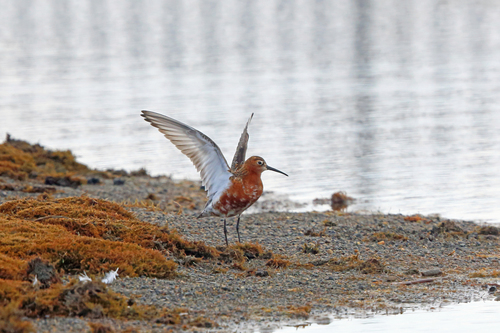 Curlew Sandpiper
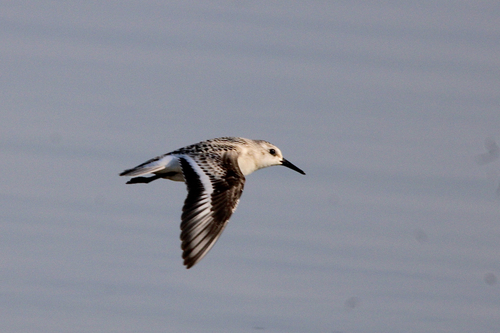 Sanderling
In short
The most reliable field mark between Curlew Sandpiper and Sanderling is the bill: Curlew Sandpiper always shows a noticeably longer, downcurved black bill, while Sanderling's bill is shorter, straight, and stouter. In flight, both species show a strong white wingbar, but Curlew Sandpiper has a large white rump patch extending up the lower back, which Sanderling lacks. Juvenile and non-breeding birds can be especially confusing, but Curlew Sandpiper is slimmer and longer-legged, with a more elegant jizz, while Sanderling is chunkier and often appears almost neckless. Both have black legs and black bills, but Sanderling's legs are thicker and it lacks a hind toe. Plumage differences are subtle in non-breeding birds, but Curlew Sandpiper shows a longer primary projection and a distinct white supercilium, while Sanderling is paler overall with cleaner white underparts.
Identification tips
- Bill shape and length: Curlew Sandpiper always has a noticeably longer, slender, and downcurved black bill, while Sanderling's bill is shorter, straight, and stouter. This is the single most reliable field mark at any age or season.
- White rump patch (flight): Curlew Sandpiper shows a large white rump extending up the lower back, visible in flight from behind. Sanderling lacks this feature and has a plain grey rump.
- Wingbar (flight): Both species show a strong white wingbar, so this is not diagnostic alone. Use in combination with rump and structure.
- Primary projection: Curlew Sandpiper has longer primary projection beyond the tertials, giving a more elongated look when perched. Sanderling's primaries are shorter, adding to its compact appearance.
- Legs: Both have black legs, but Sanderling's are thicker and it lacks a hind toe (not easily seen in the field). Curlew Sandpiper's legs are longer and finer.
- Supercilium: Curlew Sandpiper has a more distinct white supercilium, especially in non-breeding and juvenile plumages. Sanderling's face is plainer, with less contrast.
- Plumage (non-breeding): Sanderling is paler overall, with very clean white underparts and pale grey upperparts. Curlew Sandpiper is slightly darker above, with a mottled look from feather centers and some pale streaking below.
- Plumage (juvenile): Curlew Sandpiper juveniles are buffier and more evenly scaly above, with a slimmer tail and more streaked head. Sanderling juveniles are paler, with less streaking and a whiter face.
- Plumage (breeding): Curlew Sandpiper is brick-red below and on the face, with some streaking. Sanderling is never all-red below; instead, it shows rufous, black, and white on the upperparts and white underparts.
- Structure/jizz: Curlew Sandpiper is slim, long-legged, and elegant, often feeding with a more deliberate gait. Sanderling is compact, short-necked, and often runs rapidly along the shoreline.
- Habitat: On open sandy beaches, Sanderling is much more likely, especially in large flocks. Curlew Sandpiper prefers muddy or vegetated flats and is less likely to be seen on pure sand.
- Group size: Sanderling is highly gregarious in winter, often in large, tight flocks. Curlew Sandpiper is more solitary or in loose groups.
- Feeding behavior: Sanderling's 'bicycling' run as it chases receding waves is distinctive. Curlew Sandpiper feeds more methodically, probing mud or shallow water.
- Tail shape: Curlew Sandpiper's tail is longer and slimmer; Sanderling's is shorter and stubbier, but this is subtle.
- Pitfalls: In dull light or at distance, both can appear similar in non-breeding plumage. Always try to get a good look at the bill and rump in flight for confirmation.
Size
Curlew Sandpiper is slightly larger, measuring 18–23 cm in length with a wingspan of 38–46 cm and weighing 44–117 g [wikipedia]. Sanderling is similar in size but generally a bit smaller and stouter, with a more compact build [wikipedia]. Both species are small waders, but Curlew Sandpiper gives a longer, slimmer impression, especially in the legs and bill.
Plumage
- Juvenile/First-winter: Both species have pale, scaly upperparts, but Curlew Sandpiper juveniles are more buff-tinged and show finer, more even fringing, with a distinct white supercilium and a large white rump visible in flight. Sanderling juveniles are paler, with cleaner white underparts and a strong white wingbar in flight, but lack the white rump patch.
- Non-breeding: Curlew Sandpiper is grey above and white below, with a prominent white supercilium and a slightly mottled look due to darker feather centers. Sanderling is even paler, almost ghostly white below and pale grey above, with little to no streaking and a very clean look. In flight, both show a white wingbar, but only Curlew Sandpiper has the white rump extending up the back.
- Breeding: Curlew Sandpiper adults are brick-red below and on the face, with some streaking and a white rump. Sanderling breeding plumage is much more patterned, with rufous, black, and white on the upperparts and a white face and underparts. Sanderling never shows the all-rufous underparts of Curlew Sandpiper.
Behaviour
Sanderling is highly gregarious in winter, often forming tight, fast-moving flocks on sandy beaches, and is famous for its 'bicycling' running action as it chases waves. Curlew Sandpiper is more often found singly or in loose groups, feeding methodically on tidal mudflats and saltpans. Sanderling is more likely to be seen on open sandy beaches, while Curlew Sandpiper prefers muddier or more vegetated shorelines. In flight, Curlew Sandpiper appears more elongated and graceful, while Sanderling is compact and direct.
Habitat
Curlew Sandpiper breeds in boggy, coastal lowlands of the Siberian Arctic and winters on tidal mudflats and saltpans, especially in Africa and southern Eurasia [wikipedia]. Sanderling breeds even farther north on the high Arctic tundra and is most often seen on sandy beaches worldwide in winter, but can also occur on mudflats and lake shores [wikipedia]. If the bird is on a sandy ocean beach, Sanderling is more likely; on muddy or vegetated flats, Curlew Sandpiper is more probable.