

Crested Goshawk vs Japanese Sparrowhawk
Lophospiza trivirgata versus Tachyspiza gularis
Play a quiz with Crested Goshawk and Japanese Sparrowhawk
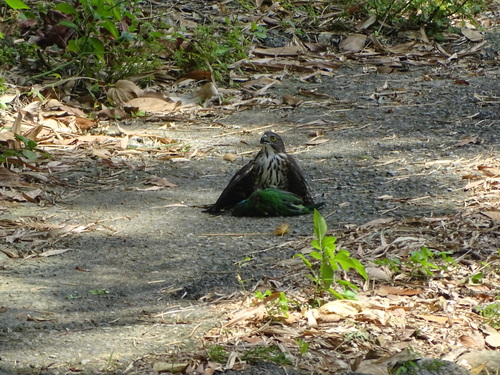 Crested Goshawk
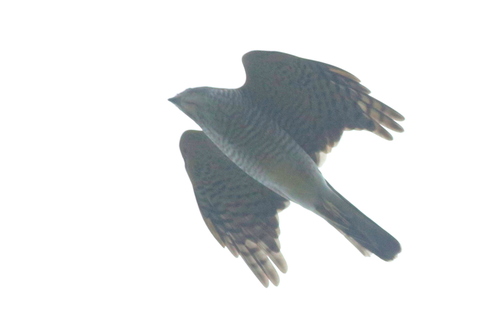 Japanese Sparrowhawk
In short
The most reliable field mark between Crested Goshawk and Japanese Sparrowhawk is the presence of a short, obvious crest on the Crested Goshawk, which is never shown by Japanese Sparrowhawk. In flight, both can look similar, but the Goshawk is noticeably larger and bulkier, with broader wings and a longer tail, while the Sparrowhawk is smaller, more compact, and has relatively longer, slimmer legs and toes. Juvenile plumages are subtly different: juvenile Goshawks have buffy underparts with rufous streaks and pale fringes on the head, while juvenile Sparrowhawks show cream underparts with red-brown streaks and spots, and a distinct white supercilium. Adult males of both species have barred underparts, but the Goshawk’s are rufous and the Sparrowhawk’s are more brown-grey, with a red-brown wash on the Sparrowhawk’s chest sides. Females of both are browner above, but the Goshawk is again larger and shows a crest. Use size, structure, and especially the crest for quick separation; check underpart pattern and head markings for confirmation, especially in young birds.
Identification tips
- Look for a crest: Crested Goshawk always shows a short, obvious crest, especially when alert or perched. Japanese Sparrowhawk never has a crest. This is the single best field mark at any age.
- Size and bulk: Goshawk is much larger and bulkier, especially in females. If the bird looks small and compact, suspect Sparrowhawk; if large and powerful, Goshawk is more likely.
- Wing and tail shape in flight: Goshawk has short, broad wings and a long tail, giving a broad, paddle-shaped look. Sparrowhawk has more pointed wingtips, a shorter tail, and a more compact profile.
- Flight style: Goshawk uses slow, powerful flaps and glides; Sparrowhawk is quicker, more agile, and may show undulating display flights.
- Legs and toes: Sparrowhawk has noticeably longer, slimmer legs and toes, often visible when perched or handling prey. Goshawk’s legs are proportionally shorter and thicker.
- Juvenile underparts: Juvenile Goshawk is buff below with rufous streaks and pale head fringes; juvenile Sparrowhawk is cream below with red-brown streaks, spots, and a white supercilium and nape patch.
- Adult male head pattern: Goshawk shows a dark brown crown, grey head sides, and black moustachial and throat stripes; Sparrowhawk male has a white nape, brown-grey cheek patches, and a subtle throat line.
- Adult underpart barring: Goshawk males have rufous streaks and bars; Sparrowhawk males have brown-grey barring with a red-brown wash on the chest sides. Females of both are browner, but Goshawk is larger and crested.
- Tail pattern: Sparrowhawk tail has four distinct dark bands; Goshawk’s tail is less distinctly banded.
- Eye color: Adult Sparrowhawk males have red-orange eyes; females have yellow eyes. Juveniles have brown eyes. Goshawk eye color is not specified in the notes, so use with caution.
- Supercilium and nape patch: Juvenile Sparrowhawk shows a clear white supercilium and nape patch, absent in Goshawk.
- Throat stripe: Both species show a throat stripe, but it is more obvious in female Sparrowhawk and in Goshawk males it is black and bold.
- Habitat context: If in deep, mature tropical forest, Goshawk is more likely; in mixed or edge habitats, especially in East Asia, Sparrowhawk may be expected.
- Vocalization: If you hear a chattering 'kiki-kik-kik...', suspect Sparrowhawk, but absence of calls is not diagnostic.
- Sexual dimorphism: Both species show size differences between sexes, but the difference is more pronounced in Goshawk. Always consider the possibility of a large female Sparrowhawk versus a small male Goshawk, but use crest and structure for confirmation.
Size
Crested Goshawk is significantly larger: 30–46 cm in length, with females much larger than males. Japanese Sparrowhawk is much smaller, 23–30 cm long, with a wingspan of 46–58 cm. The Goshawk is bulkier and heavier overall, while the Sparrowhawk is more delicate and compact. Both species are sexually dimorphic, but the size gap is much greater in Goshawk. In the field, a Crested Goshawk will look noticeably bigger and more powerful, especially when perched or soaring.
Plumage
- Juveniles:
- Crested Goshawk juveniles have buff underparts with rufous streaks on the breast and bars on the belly, pale fringes to head feathers, and a generally buffier look below.
- Japanese Sparrowhawk juveniles have cream underparts with red-brown streaking on the breast, spots on the abdomen, barring on the sides, and a distinct white supercilium and nape patch. Their upperparts are dark brown, and their eyes are brown (not yellow as in adults).
- Adult males:
- Crested Goshawk males have a dark brown crown, grey sides to the head, black moustachial and throat stripes, pale underparts with rufous streaks and bars, and a short, visible crest.
- Japanese Sparrowhawk males have black-slate upperparts, white nape, whitish underparts with brown-grey and red-brown barring, a faint red-brown wash on the chest sides, and a subtle throat line. Their tail has four dark bands.
- Adult females:
- Crested Goshawk females are larger, browner on the head, and have brown underpart streaks and bars, with a crest.
- Japanese Sparrowhawk females are brown above, white below with brown-grey barring, and have a more obvious throat stripe, but lack any crest.
- In flight:
- Goshawk shows broader wings and a longer tail, with a slow, powerful flap-glide. Sparrowhawk is more compact, with pointed wingtips and a shorter tail, and appears more agile and rapid in flight.
Behaviour
Crested Goshawk typically flies with a slow flap, slow flap, straight glide pattern, reminiscent of larger Accipiters. It is adapted for maneuvering through dense forest with short, broad wings and a long tail. Japanese Sparrowhawk is more agile and rapid, with undulating flight, high circling, and sky-dancing displays during breeding. Perched, Goshawk appears bulkier and more upright, often showing its crest, while Sparrowhawk is sleeker, with longer legs and toes often visible.
Habitat
Both species are forest raptors, but Crested Goshawk is widely distributed in tropical Asia and is more associated with dense, mature forest or wooded areas. Japanese Sparrowhawk breeds in East Asia (Russia, Korea, Japan, China) and is also found in forested habitats, but may be more likely to be encountered in mixed or edge habitats during migration. Habitat alone is not diagnostic where ranges overlap, but Goshawk is more strictly tied to deep forest.
Voice
Japanese Sparrowhawk occasionally gives a chattering 'kiki-kik-kik...' call, especially in display or alarm. No distinctive vocalization is described for Crested Goshawk in the provided notes, so voice is not a strong separator in most field situations.