

Motmot

Crested Bobwhite vs Marbled Wood-Quail

Colinus cristatus versus Odontophorus gujanensis

Play a quiz with Crested Bobwhite and Marbled Wood-Quail
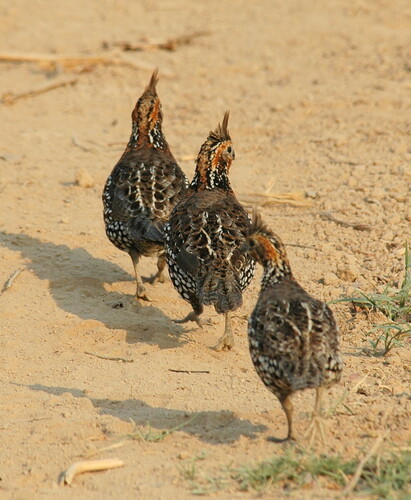
Crested Bobwhite (Colinus cristatus) Crested Bobwhite
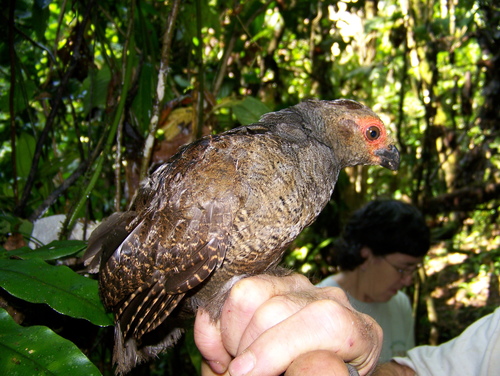
Marbled Wood-Quail (Odontophorus gujanensis) Marbled Wood-Quail

Media

Loading…

In short

The most reliable field mark to separate Crested Bobwhite from Marbled Wood-Quail is the color and shape of the crest and facial pattern: Crested Bobwhite has a long, pale buff or white crest and a contrasting white or buff throat, while Marbled Wood-Quail shows a short, loose, reddish-brown crest and a drab brown face with orange or red bare skin around the eye. In all ages, the bobwhite is much paler below with more distinct throat contrast, whereas the wood-quail is darker and more uniform. Juvenile Marbled Wood-Quail can be told by their reddish-orange bills and non-vermiculated, reddish-brown crests. Size is also helpful: Marbled Wood-Quail is noticeably larger and bulkier. Both species can be found in overlapping regions, but their preferred habitats differ markedly.

Identification tips

  1. Crest color and shape: Crested Bobwhite shows a long, pale buff or white crest (sometimes with dark tips), while Marbled Wood-Quail has a short, loose, reddish-brown crest. This is visible in both perched and walking birds of all ages.
  2. Facial pattern: Look for the strongly contrasting white or buff throat and marbled black-and-white neck on Crested Bobwhite. Marbled Wood-Quail has a drab brown face and throat, with no sharp contrast.
  3. Bare skin around eye: Only Marbled Wood-Quail has orange or red bare skin around the eye, a subtle but reliable mark at close range.
  4. Bill color in juveniles: Juvenile Marbled Wood-Quail have reddish-orange bills, while Crested Bobwhite (all ages) has a black bill.
  5. Underparts color: Crested Bobwhite is much paler below, with buff, cinnamon, and black markings; Marbled Wood-Quail is drab brown below with faint barring.
  6. Upperparts and back: Both are mottled, but Marbled Wood-Quail's upperparts are brown with black vermiculations, while Crested Bobwhite is more mottled with black, brown, and grey, often appearing lighter overall.
  7. Size and bulk: Marbled Wood-Quail is noticeably larger and heavier-bodied than Crested Bobwhite. Use this only when you have a clear sense of scale.
  8. Leg color: Both have bluish-grey legs, so this is not helpful for separation.
  9. Sex differences: Both species are sexually similar; female Crested Bobwhite is only slightly browner than the male, which is not a strong field mark.
  10. Flight behavior: Marbled Wood-Quail flushes low and quickly into cover; Crested Bobwhite may linger at the edge of open ground.
  11. Habitat: Crested Bobwhite is found in open or semi-open habitats, rarely deep in forest. Marbled Wood-Quail is strictly a bird of dense, humid forest.
  12. Group size and behavior: Crested Bobwhite is often in small, visible groups; Marbled Wood-Quail is secretive, usually hidden in dense undergrowth.
  13. Vocalizations: If you hear a fast, husky 'quoit bob-white' or 'oh, wheet', you are hearing Crested Bobwhite. Marbled Wood-Quail's call is not described here.
  14. Geographic context: Both can occur in northern South America and Panama, but Crested Bobwhite is more likely in open country and on certain islands.
  15. Juvenile marks: If you see a reddish-orange bill and plain reddish-brown crest (without vermiculations), it is a juvenile Marbled Wood-Quail.

Size

Crested Bobwhite is significantly smaller, measuring 178–216 mm (7.0–8.5 in) in length, while Marbled Wood-Quail is larger at 230–290 mm (9–11 in). In the field, Marbled Wood-Quail appears much bulkier and heavier-bodied, with a stouter bill. If seen together, the size difference is immediately apparent, but beware of lone birds where size can be hard to judge without context.

Plumage

Juvenile Marbled Wood-Quail are distinctive with their reddish-orange bills and plain, reddish-brown crests lacking the fine vermiculations of adults. Adult Marbled Wood-Quail have a short, loose, reddish-brown crest, a drab brown face, and orange or red bare skin around the eye. Their upperparts are brown with black vermiculations, and the underparts are drab brown with faint barring. In contrast, Crested Bobwhite of all ages shows a longer, pale buff or white crest (sometimes with dark tips), a strongly contrasting white or buff throat (sometimes spotted with black), and a marbled black-and-white neck. The upperparts are mottled black, brown, and grey, and the underparts are pale with buff, cinnamon, and black markings, giving a much lighter and more patterned appearance overall. Both sexes are similar in both species, but female Crested Bobwhite is slightly browner. The eye color is brown in both, but only Marbled Wood-Quail has colored bare skin around the eye. In flight, neither species shows distinctive upperwing panels or contrasting patterns, so separation relies on body and head plumage.

Behaviour

Crested Bobwhite is typically seen in small groups on the ground, often near thick cover, and behaves much like its close relative, the Northern Bobwhite. It is usually more approachable and visible at the edges of open or semi-open habitats. Marbled Wood-Quail, on the other hand, is very secretive, moving quietly in dense forest undergrowth and rarely venturing into open spaces. If flushed, Marbled Wood-Quail tends to fly low and quickly back into cover, whereas Crested Bobwhite may linger longer at the edge or in more open ground.

Habitat

Crested Bobwhite favors open or semi-open habitats such as grasslands, scrub, and agricultural edges, often near thick cover but rarely deep inside forest. Its range extends through northern South America, Panama, and just into Costa Rica, and it can occur on islands such as Aruba. Marbled Wood-Quail is a bird of subtropical or tropical moist lowland forests, rarely leaving dense woodland. Even where their ranges overlap, the habitat preference is a strong clue: open country for bobwhite, dense humid forest for wood-quail.

Voice

Crested Bobwhite males have a distinctive, fast, husky three-syllable call ('quoit bob-white') or a two-syllable 'oh, wheet' during breeding season. Marbled Wood-Quail's vocalizations are not described in the provided notes, so voice is only diagnostic if the bobwhite's characteristic call is heard.

Submit a better description

Use the same sections as the comparison. Your text is published immediately.

The most reliable field mark to separate Crested Bobwhite from Marbled Wood-Quail is the color and shape of the crest and facial pattern: Crested Bobwhite has a long, pale buff or white crest and a contrasting white or buff throat, while Marbled Wood-Quail shows a short, loose, reddish-brown crest and a drab brown face with orange or red bare skin around the eye. In all ages, the bobwhite is much paler below with more distinct throat contrast, whereas the wood-quail is darker and more uniform. Juvenile Marbled Wood-Quail can be told by their reddish-orange bills and non-vermiculated, reddish-brown crests. Size is also helpful: Marbled Wood-Quail is noticeably larger and bulkier. Both species can be found in overlapping regions, but their preferred habitats differ markedly.

  1. Crest color and shape: Crested Bobwhite shows a long, pale buff or white crest (sometimes with dark tips), while Marbled Wood-Quail has a short, loose, reddish-brown crest. This is visible in both perched and walking birds of all ages.
  2. Facial pattern: Look for the strongly contrasting white or buff throat and marbled black-and-white neck on Crested Bobwhite. Marbled Wood-Quail has a drab brown face and throat, with no sharp contrast.
  3. Bare skin around eye: Only Marbled Wood-Quail has orange or red bare skin around the eye, a subtle but reliable mark at close range.
  4. Bill color in juveniles: Juvenile Marbled Wood-Quail have reddish-orange bills, while Crested Bobwhite (all ages) has a black bill.
  5. Underparts color: Crested Bobwhite is much paler below, with buff, cinnamon, and black markings; Marbled Wood-Quail is drab brown below with faint barring.
  6. Upperparts and back: Both are mottled, but Marbled Wood-Quail's upperparts are brown with black vermiculations, while Crested Bobwhite is more mottled with black, brown, and grey, often appearing lighter overall.
  7. Size and bulk: Marbled Wood-Quail is noticeably larger and heavier-bodied than Crested Bobwhite. Use this only when you have a clear sense of scale.
  8. Leg color: Both have bluish-grey legs, so this is not helpful for separation.
  9. Sex differences: Both species are sexually similar; female Crested Bobwhite is only slightly browner than the male, which is not a strong field mark.
  10. Flight behavior: Marbled Wood-Quail flushes low and quickly into cover; Crested Bobwhite may linger at the edge of open ground.
  11. Habitat: Crested Bobwhite is found in open or semi-open habitats, rarely deep in forest. Marbled Wood-Quail is strictly a bird of dense, humid forest.
  12. Group size and behavior: Crested Bobwhite is often in small, visible groups; Marbled Wood-Quail is secretive, usually hidden in dense undergrowth.
  13. Vocalizations: If you hear a fast, husky 'quoit bob-white' or 'oh, wheet', you are hearing Crested Bobwhite. Marbled Wood-Quail's call is not described here.
  14. Geographic context: Both can occur in northern South America and Panama, but Crested Bobwhite is more likely in open country and on certain islands.
  15. Juvenile marks: If you see a reddish-orange bill and plain reddish-brown crest (without vermiculations), it is a juvenile Marbled Wood-Quail.

Crested Bobwhite is significantly smaller, measuring 178–216 mm (7.0–8.5 in) in length, while Marbled Wood-Quail is larger at 230–290 mm (9–11 in). In the field, Marbled Wood-Quail appears much bulkier and heavier-bodied, with a stouter bill. If seen together, the size difference is immediately apparent, but beware of lone birds where size can be hard to judge without context.

Juvenile Marbled Wood-Quail are distinctive with their reddish-orange bills and plain, reddish-brown crests lacking the fine vermiculations of adults. Adult Marbled Wood-Quail have a short, loose, reddish-brown crest, a drab brown face, and orange or red bare skin around the eye. Their upperparts are brown with black vermiculations, and the underparts are drab brown with faint barring. In contrast, Crested Bobwhite of all ages shows a longer, pale buff or white crest (sometimes with dark tips), a strongly contrasting white or buff throat (sometimes spotted with black), and a marbled black-and-white neck. The upperparts are mottled black, brown, and grey, and the underparts are pale with buff, cinnamon, and black markings, giving a much lighter and more patterned appearance overall. Both sexes are similar in both species, but female Crested Bobwhite is slightly browner. The eye color is brown in both, but only Marbled Wood-Quail has colored bare skin around the eye. In flight, neither species shows distinctive upperwing panels or contrasting patterns, so separation relies on body and head plumage.

Crested Bobwhite is typically seen in small groups on the ground, often near thick cover, and behaves much like its close relative, the Northern Bobwhite. It is usually more approachable and visible at the edges of open or semi-open habitats. Marbled Wood-Quail, on the other hand, is very secretive, moving quietly in dense forest undergrowth and rarely venturing into open spaces. If flushed, Marbled Wood-Quail tends to fly low and quickly back into cover, whereas Crested Bobwhite may linger longer at the edge or in more open ground.

Crested Bobwhite favors open or semi-open habitats such as grasslands, scrub, and agricultural edges, often near thick cover but rarely deep inside forest. Its range extends through northern South America, Panama, and just into Costa Rica, and it can occur on islands such as Aruba. Marbled Wood-Quail is a bird of subtropical or tropical moist lowland forests, rarely leaving dense woodland. Even where their ranges overlap, the habitat preference is a strong clue: open country for bobwhite, dense humid forest for wood-quail.

Crested Bobwhite males have a distinctive, fast, husky three-syllable call ('quoit bob-white') or a two-syllable 'oh, wheet' during breeding season. Marbled Wood-Quail's vocalizations are not described in the provided notes, so voice is only diagnostic if the bobwhite's characteristic call is heard.

Discard your changes?

You have unsaved edits. If you leave now, those changes will be lost.

Crested Bobwhite · Marbled Wood-Quail · My Tricky Birds