

Crested Barbet vs Pied Barbet
Trachyphonus vaillantii versus Tricholaema leucomelas
Play a quiz with Crested Barbet and Pied Barbet
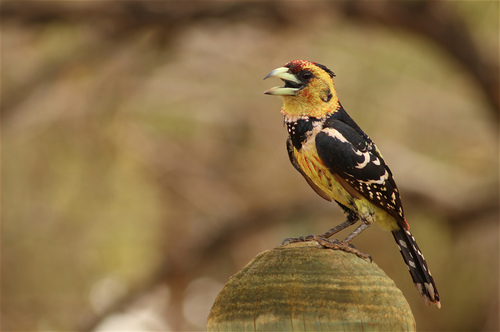 Crested Barbet
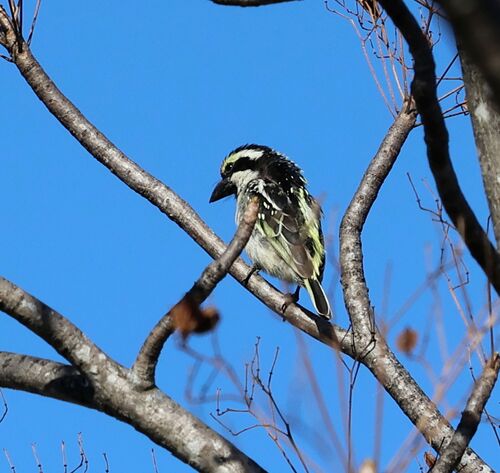 Pied Barbet
In short
The most reliable way to separate Crested Barbet from Pied Barbet is by overall color and head pattern: Crested Barbet is vividly multicolored with a speckled yellow and red face and a small black crest, while Pied Barbet has a black-and-white striped head with a red forehead and a yellowish eyebrow. Juvenile Pied Barbets lack the red forehead, which can cause confusion, but Crested Barbet’s dense speckling, yellow belly, and broader color palette remain distinctive. In flight or perched, Crested Barbet’s black-and-white speckled wings and bold black neck band stand out, compared to the more restrained, streaky underparts and bib of Pied Barbet. Habitat overlap is possible, but Crested Barbet is more likely in denser woodland or gardens, while Pied Barbet prefers drier, more open areas.
Identification tips
- Head pattern is key: Crested Barbet always shows a small black crest and a speckled yellow and red face, while Pied Barbet has a black-and-white striped head with a red forehead and yellowish eyebrow. If the crest is visible, it is diagnostic for Crested Barbet.
- Overall color: Crested Barbet is much more colorful, with yellow, red, black, and white all present in bold patches and speckles. Pied Barbet is mostly black, white, and pale yellow, with a red forehead but otherwise much less color.
- Neck and bib: Crested Barbet has a broad black band on the neck, while Pied Barbet has a black bib under the chin. The bib of Pied Barbet is more sharply defined, while Crested Barbet's black neck band is broader and more integrated into the overall speckled pattern.
- Underparts: Crested Barbet has a yellow belly with red speckles; Pied Barbet has white or streaky underparts (more yellowish in some subspecies). Juvenile Pied Barbet is especially streaky below, but never as bright or speckled as Crested Barbet.
- Wings: Crested Barbet’s wings are black with white specks—look for this in flight or when perched with wings folded. Pied Barbet’s wings are not described as speckled and appear more uniform.
- Juvenile confusion: Juvenile Pied Barbet lacks the red forehead and has streaky underparts, but will never show the crest or the full color range of Crested Barbet. If you see a duller, streaky bird without a crest, consider Pied Barbet, but check for other marks.
- Bill structure: Crested Barbet has a thicker, more robust bill, which is obvious at close range. Pied Barbet’s bill is slightly slimmer and less imposing.
- Crest presence: Only Crested Barbet has a crest, though it can be flattened at times. If you see a crest, even a small one, it rules out Pied Barbet.
- Flight style: Crested Barbet is reluctant to fly and usually makes short, weak flights. Pied Barbet has a fast, direct flight; if you see a barbet zipping across open ground, Pied Barbet is more likely.
- Vocalization: A long, trilling call points to Crested Barbet. If you hear this, look for the crest and speckled plumage.
- Habitat clues: In dense woodland or gardens with thick vegetation, Crested Barbet is more likely. In open, dry, or semi-arid areas, Pied Barbet is favored, especially if there are alien acacias or similar trees.
- Aggression: Crested Barbet is notably territorial and may be seen chasing other birds or even attacking small mammals. Pied Barbet is less aggressive in demeanor.
- Perching behavior: Both species perch in the open, but Crested Barbet often calls from a prominent branch, while Pied Barbet may be more active and restless.
- Sexes similar: Both species show little sexual dimorphism, so all these marks apply to both males and females.
- Subspecies variation: Pied Barbet shows some variation in underpart color and streaking by region, but never approaches the color intensity or patterning of Crested Barbet.
Size
Both species are small barbets, but the notes do not provide direct size or mass comparisons. Structure is more useful than size: Crested Barbet appears stockier and more robust, with a thicker bill and a more compact, bushy look, especially when the crest is raised. Pied Barbet is slightly slimmer and has a less bulky head and bill. These differences can be subtle at a distance and are best used in combination with plumage and head pattern.
Plumage
- Juvenile/immature birds: Juvenile Pied Barbet lacks the red mark on the forehead and has more streaky underparts, which can make it look duller and less sharply patterned than adults. However, even young Crested Barbets retain their multicolored, speckled appearance and small crest, so a juvenile Pied Barbet will never show the same riot of color or the black crest of Crested Barbet.
- Adults: Crested Barbet is unmistakably colorful: yellow head and belly, red speckles on the face and belly, black-and-white speckled wings, a broad black neck band, and a small black crest. Pied Barbet, by contrast, has a much more limited palette: black-and-white striped head, red forehead and forecrown, pale yellow eyebrow, black bib, and white or streaky underparts depending on subspecies. The wings of Pied Barbet are not described as speckled or boldly patterned, and the overall impression is more restrained and less variegated than Crested Barbet.
- Flight views: No distinctive upperwing or flight pattern marks are described for either species, but Crested Barbet’s contrasting wing speckling and overall color should still be visible in flight, while Pied Barbet will look plainer and more monochrome.
Behaviour
Crested Barbet is often seen bouncing on the ground or calling from an exposed branch, but it is not a strong flier and tends to make only short flights. It is aggressive toward other birds and can be quite territorial. Pied Barbet is also usually seen singly or in pairs, but is described as more restless, with a fast and direct flight. Both species nest in cavities and may be seen in gardens, but Crested Barbet is more likely to be seen defending territory or chasing off intruders, while Pied Barbet is more likely to be seen foraging actively or drilling holes in dead wood.
Habitat
Crested Barbet prefers forests, woodland thickets, suburban gardens, and watercourses—generally denser or more vegetated habitats. Pied Barbet is more typical of semi-arid savanna, grassland, fynbos, and open agricultural or urban areas, especially where alien trees have been planted. There is some overlap in suburban gardens, but if you are in a dry, open area with scattered trees, Pied Barbet is more likely; in denser bush or woodland, Crested Barbet is favored.
Voice
Crested Barbet is extremely vocal, with a distinctive, long, trilling call that can continue for extended periods. Pied Barbet’s vocalizations are not described in the notes, so voice is only diagnostic if you hear the characteristic trill of Crested Barbet. If you hear a long, continuous trill, Crested Barbet is the likely candidate.