

crested barbet vs pied barbet
Trachyphonus vaillantii versus Tricholaema leucomelas
Jogue um quiz com crested barbet e pied barbet
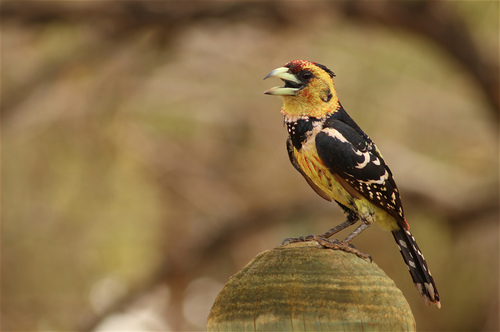 crested barbet
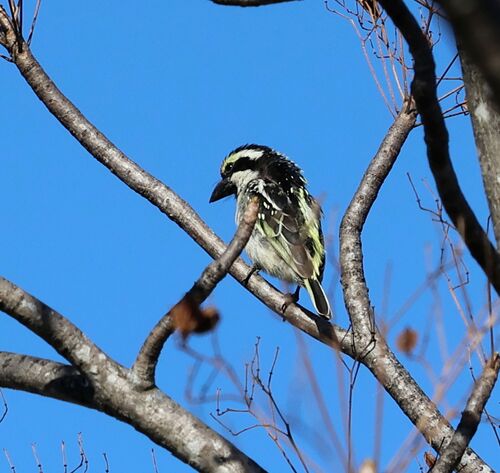 pied barbet
Em resumo
A maneira mais confiável de separar o crested barbet do pied barbet é pela cor geral e padrão da cabeça: o crested barbet é vividamente multicolorido, com um rosto amarelo e vermelho salpicado e uma pequena crista preta, enquanto o pied barbet tem uma cabeça listrada em preto e branco com uma testa vermelha e uma sobrancelha amarelada. Os juvenis do pied barbet não têm a testa vermelha, o que pode causar confusão, mas a densa salpicadura do crested barbet, a barriga amarela e a paleta de cores mais ampla permanecem distintas. Em voo ou empoleirado, as asas salpicadas em preto e branco do crested barbet e a ousada faixa negra no pescoço se destacam, em comparação com as partes inferiores mais discretas e listradas do pied barbet. A sobreposição de habitat é possível, mas o crested barbet é mais provável em florestas densas ou jardins, enquanto o pied barbet prefere áreas mais secas e abertas.
Dicas de identificação
- O padrão da cabeça é fundamental: O crested barbet sempre apresenta uma pequena crista preta e um rosto amarelo e vermelho salpicado, enquanto o pied barbet tem uma cabeça listrada em preto e branco com uma testa vermelha e sobrancelha amarelada. Se a crista for visível, é um diagnóstico para o crested barbet.
- Cor geral: O crested barbet é muito mais colorido, com amarelo, vermelho, preto e branco presentes em manchas e salpicaduras ousadas. O pied barbet é principalmente preto, branco e amarelo pálido, com uma testa vermelha, mas de outra forma tem muito menos cor.
- Pescoço e babador: O crested barbet tem uma ampla faixa preta no pescoço, enquanto o pied barbet tem um babador preto sob o queixo. O babador do pied barbet é mais bem definido, enquanto a faixa negra do pescoço do crested barbet é mais ampla e mais integrada ao padrão salpicado geral.
- Partes inferiores: O crested barbet tem uma barriga amarela com salpicaduras vermelhas; o pied barbet tem partes inferiores brancas ou listradas (mais amareladas em algumas subespécies). O juvenil do pied barbet é especialmente listrado embaixo, mas nunca tão brilhante ou salpicado quanto o crested barbet.
- Asas: As asas do crested barbet são pretas com manchas brancas—procure por isso em voo ou quando empoleirado com as asas dobradas. As asas do pied barbet não são descritas como salpicadas e parecem mais uniformes.
- Confusão juvenil: O juvenil do pied barbet não tem a testa vermelha e tem partes inferiores listradas, mas nunca mostrará a crista ou a gama completa de cores do crested barbet. Se você ver um pássaro mais apagado e listrado sem crista, considere o pied barbet, mas verifique outros sinais.
- Estrutura do bico: O crested barbet tem um bico mais grosso e robusto, que é óbvio a curta distância. O bico do pied barbet é ligeiramente mais fino e menos imponente.
- Presença da crista: Apenas o crested barbet tem uma crista, embora possa ser achatada às vezes. Se você ver uma crista, mesmo que pequena, isso elimina o pied barbet.
- Estilo de voo: O crested barbet é relutante em voar e geralmente faz voos curtos e fracos. O pied barbet tem um voo rápido e direto; se você ver um barbet atravessando rapidamente um terreno aberto, é mais provável que seja um pied barbet.
- Vocalização: Um chamado longo e trinado aponta para o crested barbet. Se você ouvir isso, procure pela crista e plumagem salpicada.
- Dicas de habitat: Em florestas densas ou jardins com vegetação espessa, o crested barbet é mais provável. Em áreas abertas, secas ou semiáridas, o pied barbet é favorecido, especialmente se houver acácias alienígenas ou árvores semelhantes.
- Agressão: O crested barbet é notavelmente territorial e pode ser visto perseguindo outros pássaros ou até atacando pequenos mamíferos. O pied barbet é menos agressivo em comportamento.
- Comportamento de empoleiramento: Ambas as espécies empoleiram-se em locais abertos, mas o crested barbet frequentemente chama de um galho proeminente, enquanto o pied barbet pode ser mais ativo e inquieto.
- Sexos semelhantes: Ambas as espécies mostram pouco dimorfismo sexual, então todas essas marcas se aplicam tanto a machos quanto a fêmeas.
- Variação de subespécies: O pied barbet mostra alguma variação na cor e listras das partes inferiores por região, mas nunca se aproxima da intensidade de cor ou padrão do crested barbet.
Tamanho
Ambas as espécies são pequenos barbets, mas as notas não fornecem comparações diretas de tamanho ou massa. A estrutura é mais útil do que o tamanho: o crested barbet parece mais robusto e robusto, com um bico mais grosso e uma aparência mais compacta e espessa, especialmente quando a crista está levantada. O pied barbet é ligeiramente mais esguio e tem uma cabeça e bico menos volumosos. Essas diferenças podem ser sutis à distância e são melhor utilizadas em combinação com plumagem e padrão da cabeça.
Plumagem
- Pássaros juvenis/imaturos: O juvenil do pied barbet não tem a marca vermelha na testa e tem partes inferiores mais listradas, o que pode fazê-lo parecer mais apagado e menos nitidamente padronizado do que os adultos. No entanto, mesmo os jovens crested barbets mantêm sua aparência multicolorida e salpicada e pequena crista, então um juvenil do pied barbet nunca mostrará a mesma explosão de cores ou a crista preta do crested barbet.
- Adultos: O crested barbet é inconfundivelmente colorido: cabeça e barriga amarelas, salpicaduras vermelhas no rosto e barriga, asas salpicadas em preto e branco, uma ampla faixa negra no pescoço e uma pequena crista preta. O pied barbet, em contraste, tem uma paleta muito mais limitada: cabeça listrada em preto e branco, testa vermelha e coroa frontal, sobrancelha amarelada, babador preto e partes inferiores brancas ou listradas dependendo da subespécie. As asas do pied barbet não são descritas como salpicadas ou com padrões ousados, e a impressão geral é mais contida e menos variegada do que a do crested barbet.
- Visões de voo: Nenhum sinal distintivo de padrão de asa superior ou de voo é descrito para ambas as espécies, mas a salpicadura contrastante das asas do crested barbet e a cor geral ainda devem ser visíveis em voo, enquanto o pied barbet parecerá mais simples e mais monocromático.
Comportamento
O crested barbet é frequentemente visto pulando no chão ou chamando de um galho exposto, mas não é um bom voador e tende a fazer apenas voos curtos. É agressivo em relação a outros pássaros e pode ser bastante territorial. O pied barbet também é geralmente visto sozinho ou em pares, mas é descrito como mais inquieto, com um voo rápido e direto. Ambas as espécies fazem ninhos em cavidades e podem ser vistas em jardins, mas o crested barbet é mais provável de ser visto defendendo território ou perseguindo intrusos, enquanto o pied barbet é mais provável de ser visto forrageando ativamente ou perfurando buracos em madeira morta.
Habitat
O crested barbet prefere florestas, matas densas, jardins suburbanos e cursos d'água—geralmente habitats mais densos ou mais vegetados. O pied barbet é mais típico de savanas semiáridas, pastagens, fynbos e áreas agrícolas ou urbanas abertas, especialmente onde árvores alienígenas foram plantadas. Há alguma sobreposição em jardins suburbanos, mas se você estiver em uma área seca e aberta com árvores dispersas, o pied barbet é mais provável; em matas ou florestas mais densas, o crested barbet é favorecido.
Voz
O crested barbet é extremamente vocal, com um chamado distinto e longo que pode continuar por períodos prolongados. As vocalizações do pied barbet não são descritas nas notas, então a voz é apenas diagnóstica se você ouvir o trinado característico do crested barbet. Se você ouvir um trinado longo e contínuo, o crested barbet é o candidato provável.