

Crested Auklet vs Long-billed Murrelet
Aethia cristatella versus Brachyramphus perdix
Play a quiz with Crested Auklet and Long-billed Murrelet
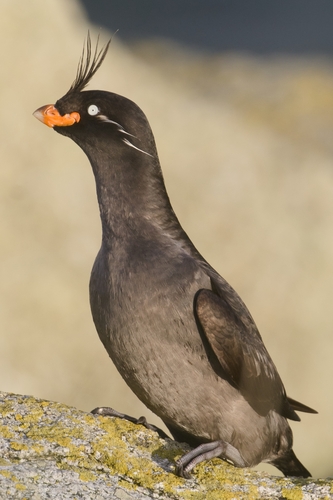 Crested Auklet
 Long-billed Murrelet
In short
The most reliable field mark to separate Crested Auklet from Long-billed Murrelet is the presence of a prominent black forward-curving crest and bright orange bill on the Crested Auklet, which are never shown by Long-billed Murrelet. In flight or at rest, Crested Auklet is a compact, dark, sooty-grey bird with white facial plumes and a thick, short bill, while Long-billed Murrelet appears more slender, with a long, thin black bill and contrasting black-and-white or brownish, scaly plumage depending on season. Juvenile and non-breeding Crested Auklets lose most of their ornamentation but remain plain dark overall, lacking the sharp black-and-white contrast of murrelets. Bill shape and facial pattern are key at all ages and seasons. Both species can occur in the North Pacific, but Long-billed Murrelet is much more likely to be seen as a vagrant inland.
Identification tips
- Crested Auklet's black forward-curving crest is diagnostic in all adults during the breeding season; no murrelet shows any crest at any age or season.
- Bill color and shape: Crested Auklet has a thick, short, bright orange bill (with accessory plates in breeding adults), while Long-billed Murrelet always has a long, thin, black bill. Juvenile and winter Crested Auklets have a duller, smaller bill but it remains short and thick.
- Facial plumes: Crested Auklet shows white auricular plumes from eye to ear in breeding adults; absent in all murrelets and in juvenile/winter Crested Auklets.
- Overall plumage: Crested Auklet is sooty dark grey all over, lacking the sharp black-and-white or brown-and-scaly contrast of Long-billed Murrelet. This is true for all ages and seasons.
- Non-breeding/winter plumage: Long-billed Murrelet is white below and black above, with a white eye ring and no collar (unlike Marbled Murrelet). Crested Auklet in winter is still dark overall, with reduced crest and bill plates.
- Juvenile confusion: Juvenile Crested Auklets are plain dark with a dull brownish-yellow bill, lacking any white underparts or facial contrast. Juvenile Long-billed Murrelets resemble adults in non-breeding plumage, with strong black-and-white contrast and a long black bill.
- Flight profile: Crested Auklet appears compact, short-necked, and dark in flight, with little contrast. Long-billed Murrelet is more slender, with pointed wings and strong contrast between dark upperparts and white underparts in winter.
- Size and jizz: Crested Auklet is smaller, chunkier, and shorter-billed; Long-billed Murrelet is longer-bodied and more slender, with a noticeably long bill.
- Habitat context: Crested Auklet is strictly marine and colonial; Long-billed Murrelet can be found far inland as a vagrant, often alone or in pairs.
- Behavior: Crested Auklet is often seen in dense flocks, especially at breeding colonies; Long-billed Murrelet is more solitary or in small groups.
- Scent: Crested Auklet produces a distinctive citrus-like odor (not a field mark for most birders, but unique among auks).
- Vocalizations: Crested Auklet's complex trumpet and cackling calls are heard in colonies; Long-billed Murrelet's calls are less well described and not a practical field mark.
- Seasonal changes: Crested Auklet loses crest and bill plates in winter, but remains dark and compact; Long-billed Murrelet's seasonal change is from scaly brown (breeding) to sharp black-and-white (non-breeding).
- No overlap in key ornaments: Any bird with a crest, orange bill, or white auricular plumes is a Crested Auklet; any bird with a long, thin, black bill and white underparts is a Long-billed Murrelet.
- Common pitfalls: Immature Crested Auklets may seem plain and dark, but never show the strong black-and-white contrast or long bill of a murrelet. Murrelets never show a crest or orange bill at any age.
Size
Crested Auklet is generally smaller and chunkier, measuring 18–27 cm in length and weighing 195–330 g [wikipedia]. Long-billed Murrelet is about 25 cm long and about 20% heavier than Marbled Murrelet, making it slightly larger and more slender than Crested Auklet [wikipedia]. In the field, Crested Auklet appears more compact and short-necked, while Long-billed Murrelet is longer-bodied with a proportionally longer bill.
Plumage
Juvenile and non-breeding Crested Auklets are dark sooty grey overall, lacking the white underparts and sharp black-and-white contrast of Long-billed Murrelet in winter. Juvenile Crested Auklets lack the crest and auricular plumes, and have a dull brownish-yellow bill, but still appear plain and dark. In breeding plumage, adult Crested Auklets show a black forward-curving crest, white auricular plumes, and a bright orange bill with accessory plates. Long-billed Murrelet in breeding plumage is brown and scaly with a pale throat and white central underparts (often hidden when swimming), and in non-breeding plumage is sharply black above and white below, with a white eye ring and no crest or facial plumes. The murrelet's bill is always long, thin, and black. No age or season of Long-billed Murrelet shows any crest or orange bill. In flight, Crested Auklet remains dark and compact, while Long-billed Murrelet shows more contrast and pointed wings.
Behaviour
Crested Auklets are highly social, nesting in dense colonies and often seen in large flocks on the water. They are known for their elaborate courtship displays involving both visual (crest, bill plates) and olfactory (citrus scent) signals. Long-billed Murrelets are more solitary or found in pairs, often seen alone or in small groups, and are notable for their tendency to wander far inland as vagrants. In flight, Crested Auklet appears compact and direct, while Long-billed Murrelet is more slender and swift, with pointed wings.
Habitat
Crested Auklet breeds in immense colonies on remote islands in the Bering Sea and Sea of Okhotsk, foraging offshore in deep waters. Long-billed Murrelet also breeds in the North Pacific but is unique among auks for nesting far inland in old-growth forests, and winters at sea around northern Japan and Korea. Long-billed Murrelet is much more likely to be found as a vagrant at inland lakes and rivers, sometimes hundreds of kilometers from the sea, while Crested Auklet is strictly marine.
Voice
Crested Auklet has a variety of calls, including complex trumpet calls and mutual cackling during courtship displays. These are most often heard in breeding colonies and are used for pair bonding and territory. Long-billed Murrelet's vocalizations are not described in detail in the provided notes, but the name 'murrelet' may imitate the call of the common guillemot. Vocalizations are not a primary field mark for separation in the field.