

Cream-vented Bulbul vs Red-eyed Bulbul
Pycnonotus simplex versus Pycnonotus brunneus
Play a quiz with Cream-vented Bulbul and Red-eyed Bulbul
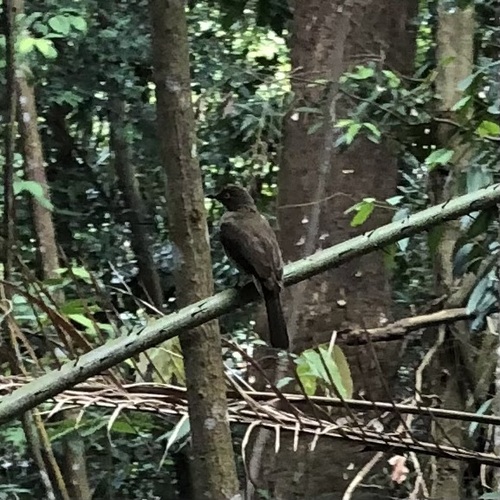 Cream-vented Bulbul
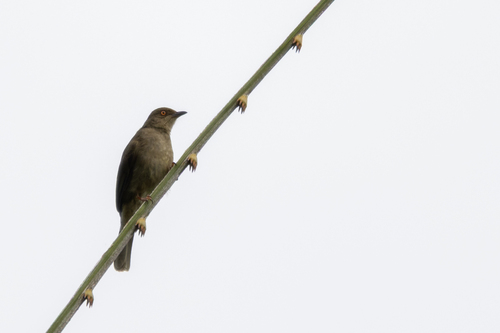 Red-eyed Bulbul
In short
The most reliable field mark between Cream-vented Bulbul and Red-eyed Bulbul is the eye color: Cream-vented Bulbul has a pale, whitish or cream-colored iris, while Red-eyed Bulbul shows a distinctly red or reddish-brown iris in adults. Both species are similar in overall size and structure, and share much of their range and habitat, so careful attention to the eye color is essential. Other plumage and structural differences are subtle or not well described in the available sources, making iris color the key separator in the field. Immature birds may show duller eye colors, which can complicate identification.
Identification tips
- Iris color is the single most reliable field mark: Cream-vented Bulbul shows a pale, whitish or cream iris, while Red-eyed Bulbul has a red or reddish-brown iris in adults. Always check eye color in good light before making an identification.
- Beware of immature birds: Young Red-eyed Bulbuls may have a duller, brownish iris that can resemble Cream-vented. If the eye is not clearly red, consider age and look for other supporting marks, though these are not well described in the sources.
- Overall plumage is similar: Both species are olive-brown above and paler below, with no strong differences in body coloration or pattern. Do not rely on general color tone to separate them.
- No distinctive wing or tail pattern: There are no documented differences in wing or tail markings, either perched or in flight, for any age group.
- Structure is not diagnostic: Bill shape, tail length, and overall proportions are not described as differing between these two species.
- Behavior is not helpful: Both species behave like typical bulbuls, foraging in similar ways and habitats.
- Habitat overlap is extensive: Both occur in the same types of lowland forests throughout their shared range, so do not use habitat as a primary separator.
- Do not rely on vocalizations: No distinctive differences in calls or songs are described in the sources; identification should be visual.
- Lighting can affect iris color: In poor light or shade, even the red iris of Red-eyed Bulbul may appear dull or dark, so always try to confirm in good conditions.
- Check multiple individuals: If possible, look at several birds in a group, as mixed flocks can occur and eye color may be more obvious on some individuals than others.
- Photograph for later review: If uncertain, a clear photo of the head and eye can allow for later confirmation, especially if iris color is ambiguous in the field.
- Do not use range as a separator: Both species are present throughout the Malay Peninsula, Sumatra, and Borneo, so geographic location within this area does not help.
- No sexual dimorphism: Males and females are similar in both species, so sex cannot be used for identification.
- Seasonal plumage changes are not described: Assume adult plumage is stable year-round for both species based on available notes.
- When in doubt, prioritize iris color and age: If you cannot see a clear red iris, consider the possibility of a young Red-eyed Bulbul, but if the iris is distinctly pale, Cream-vented is most likely.
Size
Based on available data, both species are very similar in size, with Red-eyed Bulbul averaging around 28 grams in body mass. There is no measurement data for Cream-vented Bulbul in the sources, but field experience and taxonomic proximity suggest little to no size difference visible in the field. Structure, including bill and tail, is not described as diagnostic between these two species.
Plumage
No distinctive juvenile or immature wing or flight pattern differences are described for either species in the available notes. Both species are typical bulbuls with generally olive-brown or brownish upperparts and paler underparts. The main plumage distinction is in the iris color: Cream-vented Bulbul has a pale, whitish or cream iris, while Red-eyed Bulbul has a red or reddish-brown iris in adults. Immature Red-eyed Bulbuls may show a duller, brownish iris, potentially overlapping with Cream-vented, so caution is needed with young birds. No further age- or season-specific plumage differences are documented in the sources.
Behaviour
Both species are typical bulbuls in behavior, often seen foraging in pairs or small groups in the forest midstory or canopy. There are no described behavioral differences that would help separate them in the field.
Habitat
Both Cream-vented Bulbul and Red-eyed Bulbul inhabit subtropical or tropical moist lowland forests, and their ranges overlap extensively on the Malay Peninsula, Sumatra, and Borneo. Habitat preference is not a reliable separator, as both species can be found in similar forest types and elevations within their shared range.