

Motmot

Costa Rican Pygmy-Owl vs Central American Pygmy-Owl

Glaucidium costaricanum versus Glaucidium griseiceps

Play a quiz with Costa Rican Pygmy-Owl and Central American Pygmy-Owl
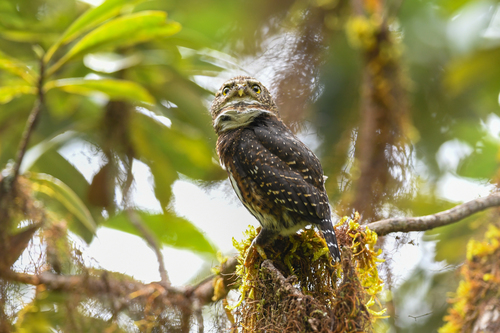
Costa Rican Pygmy-Owl (Glaucidium costaricanum) Costa Rican Pygmy-Owl
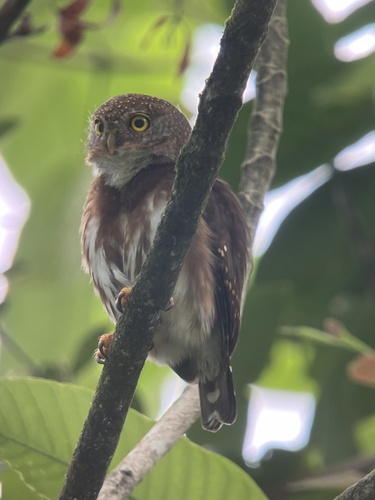
Central American Pygmy-Owl (Glaucidium griseiceps) Central American Pygmy-Owl

Media

Loading…

In short

The most reliable field mark between Costa Rican Pygmy-Owl and Central American Pygmy-Owl is the underpart pattern: Costa Rican shows mostly white underparts with little streaking, while Central American has bold reddish-brown streaks below. Both species have 'false eyes' on the nape, but Costa Rican is more variable in color (brown or rufous morphs), and Central American is always grayish-brown above. Juvenile Central American Pygmy-Owls are uniquely gray-crowned and lack crown spots, unlike Costa Rican. Both are small, chunky owls with banded tails, but subtle differences in plumage and range are key for confident separation.

Identification tips

  1. Juvenile crown color: Juvenile Central American Pygmy-Owls have a plain gray, unspotted crown and sooty nape 'false eyes', unlike Costa Rican juveniles, which are not described as gray-crowned or unspotted. Use this for birds in juvenile plumage.
  2. Underpart streaking: Adult Central American Pygmy-Owls show bold reddish-brown streaks on the whitish underparts; Costa Rican Pygmy-Owls have mostly white underparts with little or no streaking. This is a key field mark for perched birds of all ages except juveniles.
  3. Color morphs: Costa Rican Pygmy-Owl comes in brown and rufous morphs, while Central American is always grayish-brown above. A rufous bird is Costa Rican.
  4. Crown spotting: Central American adults have buff to whitish spots on the crown; Costa Rican adults have paler spots but can be less distinct, especially in rufous morphs.
  5. Tail pattern: Both have banded tails, but Costa Rican's tail has four white bands and a white tip, while Central American's tail is rich brown with pale bars. The difference is subtle and not always visible in the field.
  6. Facial disc: Costa Rican's facial disc matches the basal color with narrow buff and white marks; Central American's facial disc is less distinctly marked, but this is subtle.
  7. Bill color: Costa Rican has a greenish-yellow maxilla and light brown mandible with yellow tip; Central American's bill color is not specified but likely less contrasting.
  8. Nape 'false eyes': Both have dark nape spots bordered pale, but these are especially sooty and contrasting in juvenile Central American.
  9. Eye and foot color: Both have yellow eyes and feet, not a separator.
  10. Range and elevation: In Costa Rica and Panama, a montane forest bird is more likely Costa Rican; in lowland or outside these countries, Central American is more probable.
  11. Vocalizations: Central American's song starts with a few spaced hoots, then a rapid series; Costa Rican's voice is not described here, so use with caution.
  12. Behavior: Both behave similarly, so do not rely on hunting or perching style.
  13. Size: Both are similar in size and weight; do not use size for identification.
  14. Sex and season: No significant sexual or seasonal plumage differences are described for either species; use age and underpart pattern instead.
  15. When in doubt: Focus on underpart streaking (bold = Central American, plain = Costa Rican) and juvenile crown color (gray, unspotted = Central American).

Size

Both species are very similar in size, with Costa Rican Pygmy-Owl measuring 14.5–17 cm and Central American Pygmy-Owl 13–18 cm in length. Males of both are around 50–70 g, with Costa Rican females reaching up to 99 g, slightly heavier than Central American (about 56 g). In the field, size alone is not a reliable separator, as overlap is substantial and both appear small and compact.

Plumage

Juvenile Central American Pygmy-Owls have a gray, unspotted crown and sooty nape 'false eyes', making them stand out from Costa Rican juveniles, which are not described as having this gray, unspotted crown. Adult Costa Rican Pygmy-Owls come in two morphs: brown and rufous, both with pale spots above and a tail with four white bands and a white tip. Their underparts are mostly white with little or no streaking, and the flanks match the upperparts. Central American adults are always grayish-brown above, with buff to whitish spots on the crown and bold reddish-brown streaks on the whitish underparts. Their tail is rich brown with pale bars. Both have 'false eyes' on the nape, but these are more contrasting in juveniles of Central American. The facial disc of Costa Rican is the basal color with narrow buff and white marks, while Central American is less distinctly marked. Eye and foot color are yellow in both, but bill color differs subtly: Costa Rican has a greenish-yellow maxilla and light brown mandible with yellow tip.

Behaviour

Both species perch low in dense foliage and hunt with short, swift dashes, often returning to the perch if they miss. Both are active by day and night and may swish their tails when agitated. Behavioral differences are not reliably diagnostic in the field.

Habitat

Costa Rican Pygmy-Owl is restricted to Costa Rica and Panama, typically in montane forests. Central American Pygmy-Owl has a much wider range, from Mexico through Central America to Colombia and Ecuador, and is found in a broader variety of forested habitats, including lowlands. In Costa Rica and Panama, both can occur, but Costa Rican is more likely at higher elevations. Habitat alone can be a clue, but overlap is possible in some regions.

Voice

Central American Pygmy-Owl gives a song that starts with 2–4 evenly spaced hoots, pauses, then continues with a rapid series of 6–18 similar notes ('huu-huu, huu-huu-huu...'), sometimes with trills. No detailed vocal description is provided for Costa Rican Pygmy-Owl here, so voice is not a reliable separator unless the full song is known.

Submit a better description

Use the same sections as the comparison. Your text is published immediately.

The most reliable field mark between Costa Rican Pygmy-Owl and Central American Pygmy-Owl is the underpart pattern: Costa Rican shows mostly white underparts with little streaking, while Central American has bold reddish-brown streaks below. Both species have 'false eyes' on the nape, but Costa Rican is more variable in color (brown or rufous morphs), and Central American is always grayish-brown above. Juvenile Central American Pygmy-Owls are uniquely gray-crowned and lack crown spots, unlike Costa Rican. Both are small, chunky owls with banded tails, but subtle differences in plumage and range are key for confident separation.

  1. Juvenile crown color: Juvenile Central American Pygmy-Owls have a plain gray, unspotted crown and sooty nape 'false eyes', unlike Costa Rican juveniles, which are not described as gray-crowned or unspotted. Use this for birds in juvenile plumage.
  2. Underpart streaking: Adult Central American Pygmy-Owls show bold reddish-brown streaks on the whitish underparts; Costa Rican Pygmy-Owls have mostly white underparts with little or no streaking. This is a key field mark for perched birds of all ages except juveniles.
  3. Color morphs: Costa Rican Pygmy-Owl comes in brown and rufous morphs, while Central American is always grayish-brown above. A rufous bird is Costa Rican.
  4. Crown spotting: Central American adults have buff to whitish spots on the crown; Costa Rican adults have paler spots but can be less distinct, especially in rufous morphs.
  5. Tail pattern: Both have banded tails, but Costa Rican's tail has four white bands and a white tip, while Central American's tail is rich brown with pale bars. The difference is subtle and not always visible in the field.
  6. Facial disc: Costa Rican's facial disc matches the basal color with narrow buff and white marks; Central American's facial disc is less distinctly marked, but this is subtle.
  7. Bill color: Costa Rican has a greenish-yellow maxilla and light brown mandible with yellow tip; Central American's bill color is not specified but likely less contrasting.
  8. Nape 'false eyes': Both have dark nape spots bordered pale, but these are especially sooty and contrasting in juvenile Central American.
  9. Eye and foot color: Both have yellow eyes and feet, not a separator.
  10. Range and elevation: In Costa Rica and Panama, a montane forest bird is more likely Costa Rican; in lowland or outside these countries, Central American is more probable.
  11. Vocalizations: Central American's song starts with a few spaced hoots, then a rapid series; Costa Rican's voice is not described here, so use with caution.
  12. Behavior: Both behave similarly, so do not rely on hunting or perching style.
  13. Size: Both are similar in size and weight; do not use size for identification.
  14. Sex and season: No significant sexual or seasonal plumage differences are described for either species; use age and underpart pattern instead.
  15. When in doubt: Focus on underpart streaking (bold = Central American, plain = Costa Rican) and juvenile crown color (gray, unspotted = Central American).

Both species are very similar in size, with Costa Rican Pygmy-Owl measuring 14.5–17 cm and Central American Pygmy-Owl 13–18 cm in length. Males of both are around 50–70 g, with Costa Rican females reaching up to 99 g, slightly heavier than Central American (about 56 g). In the field, size alone is not a reliable separator, as overlap is substantial and both appear small and compact.

Juvenile Central American Pygmy-Owls have a gray, unspotted crown and sooty nape 'false eyes', making them stand out from Costa Rican juveniles, which are not described as having this gray, unspotted crown. Adult Costa Rican Pygmy-Owls come in two morphs: brown and rufous, both with pale spots above and a tail with four white bands and a white tip. Their underparts are mostly white with little or no streaking, and the flanks match the upperparts. Central American adults are always grayish-brown above, with buff to whitish spots on the crown and bold reddish-brown streaks on the whitish underparts. Their tail is rich brown with pale bars. Both have 'false eyes' on the nape, but these are more contrasting in juveniles of Central American. The facial disc of Costa Rican is the basal color with narrow buff and white marks, while Central American is less distinctly marked. Eye and foot color are yellow in both, but bill color differs subtly: Costa Rican has a greenish-yellow maxilla and light brown mandible with yellow tip.

Both species perch low in dense foliage and hunt with short, swift dashes, often returning to the perch if they miss. Both are active by day and night and may swish their tails when agitated. Behavioral differences are not reliably diagnostic in the field.

Costa Rican Pygmy-Owl is restricted to Costa Rica and Panama, typically in montane forests. Central American Pygmy-Owl has a much wider range, from Mexico through Central America to Colombia and Ecuador, and is found in a broader variety of forested habitats, including lowlands. In Costa Rica and Panama, both can occur, but Costa Rican is more likely at higher elevations. Habitat alone can be a clue, but overlap is possible in some regions.

Central American Pygmy-Owl gives a song that starts with 2–4 evenly spaced hoots, pauses, then continues with a rapid series of 6–18 similar notes ('huu-huu, huu-huu-huu...'), sometimes with trills. No detailed vocal description is provided for Costa Rican Pygmy-Owl here, so voice is not a reliable separator unless the full song is known.

Discard your changes?

You have unsaved edits. If you leave now, those changes will be lost.

Costa Rican Pygmy-Owl · Central American Pygmy-Owl · My Tricky Birds