

Coqui Francolin vs Red-winged Francolin
Campocolinus coqui versus Scleroptila levaillantii
Play a quiz with Coqui Francolin and Red-winged Francolin
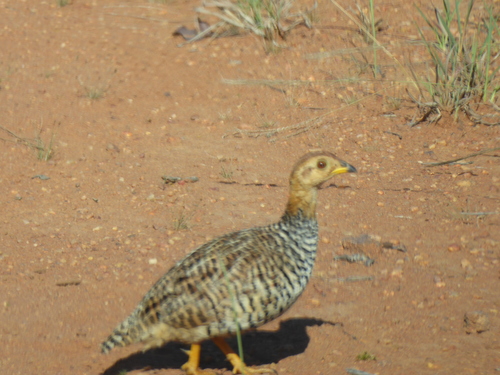 Coqui Francolin
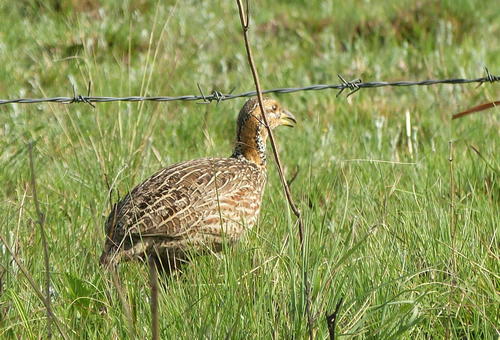 Red-winged Francolin
In short
The most reliable field mark to separate Coqui Francolin from Red-winged Francolin is the presence of rich chestnut-red panels on the upperwings of the Red-winged Francolin, especially obvious in flight and on perched birds with wings partly open; Coqui Francolin lacks these red panels entirely. Immature and adult Red-winged Francolins both show this feature. Both species are small, ground-dwelling francolins with similar body shapes, but habitat and subtle plumage differences can help. If you see a bird flush and catch a glimpse of rufous in the wings, it's Red-winged Francolin; if the wings are plain brown, it's Coqui. Structural differences are subtle and not reliable in the field.
Identification tips
- Red upperwing panel: Red-winged Francolin of all ages shows a rich chestnut-red patch on the upperwing coverts, visible in flight or when stretching. Coqui Francolin never shows this—its wings are plain brown. This is the single most reliable field mark.
- In-flight views: If you flush a bird and see a flash of rufous or red in the wings, it's Red-winged. If the wings are uniformly brown, it's Coqui.
- Perched birds with wings open: Look for the red panel on the folded or partially open wing for Red-winged Francolin. Coqui will never show this color.
- Overall plumage tone: Red-winged Francolin tends to look warmer, richer, and more rufous on the upperparts and flanks, while Coqui is generally plainer, colder brown, and more finely barred.
- Back and underpart pattern: Both species are cryptically marked, but Coqui is more finely vermiculated and less boldly marked than Red-winged, which can show broader, richer streaks and barring.
- Habitat context: In wet, upland grasslands or montane meadows, expect Red-winged Francolin. In drier, more open savanna or woodland, Coqui is more likely. Use this only as supporting evidence.
- Size and structure: Both are similar in size and shape; do not rely on this in the field.
- Bill and legs: No reliable differences in bill or leg color/shape are noted for field use.
- Sex and age: The red wing panel is present in both sexes and all ages for Red-winged; there is no age or sex where Coqui shows rufous in the wing.
- Voice: No diagnostic vocal differences are provided in the sources; do not use voice for separation here.
- Mixed flocks: Both species are usually in pairs or small groups, not mixed together.
- Pitfall—molting birds: Even in molt, Red-winged Francolin should retain at least some rufous in the wing; Coqui never shows this.
- Pitfall—juvenile confusion: Juvenile Red-winged Francolins still show the red wing panel, so this mark is reliable across all ages.
- Pitfall—lighting: In poor light, the rufous panel may be hard to see; try to catch the bird in flight or with wings open for confirmation.
- Summary tip: If you see a small francolin and are unsure, focus on the upperwing in flight or when stretching—red equals Red-winged, plain brown equals Coqui.
Size
Both species are small francolins, and their overall size and proportions are similar enough that size alone is not a reliable field mark in the field. Without direct comparison or measurement, you are unlikely to separate them by size with binoculars.
Plumage
The key plumage difference is the upperwing: Red-winged Francolin of all ages has prominent chestnut-red panels on the upperwing coverts, which are especially visible in flight or when the bird is stretching its wings. Coqui Francolin lacks any rufous or red in the wing; its upperwing is uniformly brown or mottled, matching the rest of the upperparts. This contrast is valid for both adults and immatures. On the ground, both species are cryptically patterned with brown, black, and buff, but Red-winged Francolin often appears richer and warmer-toned overall, while Coqui is plainer and more finely barred. No age-specific upperwing patterns (like black W's or trailing edges) are mentioned for either species, so the red panel is the best mark.
Behaviour
Both species are ground-dwelling and tend to flush explosively when disturbed, flying a short distance before dropping back into cover. Their behavior is typical of francolins: secretive, often only seen when flushed, and usually in pairs or small groups. There are no major behavioral differences noted that would reliably separate them in the field.
Habitat
Red-winged Francolin is typically found in moist grasslands, upland meadows, and montane areas, often at higher elevations and in wetter habitats than Coqui Francolin. Coqui Francolin prefers drier savannas, open woodland, and grassland, sometimes in more arid or mixed habitats. If you are in a wet, high-altitude grassland, Red-winged is more likely; in drier, lower, or mixed woodland-grassland, Coqui is more probable. However, there is some overlap, so habitat should be used with caution.