

Connecticut Warbler vs Mourning Warbler
Oporornis agilis versus Geothlypis philadelphia
Play a quiz with Connecticut Warbler and Mourning Warbler
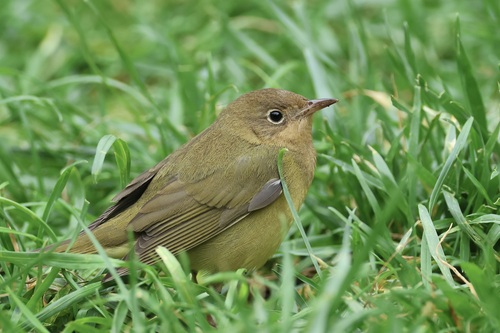 Connecticut Warbler
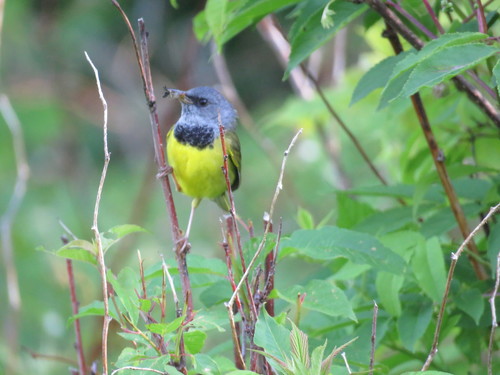 Mourning Warbler
In short
The most reliable field mark to separate Connecticut Warbler from Mourning Warbler in all plumages is the eye-ring: Connecticut Warbler always shows a bold, complete eye-ring, while Mourning Warbler never has a complete eye-ring—females and immatures have an incomplete or broken one. For immatures, also check the chest color: Connecticut Warbler is paler and whiter below, while Mourning Warbler is more yellowish. Adult males of both species have gray hoods, but only Mourning Warbler males show a black patch on the throat and breast, and black lores. Both have yellow underparts and olive upperparts, but careful attention to these subtle facial and throat details is key, especially in fall or with young birds.
Identification tips
- Eye-ring (all ages): Connecticut Warbler always has a bold, complete white eye-ring. Mourning Warbler never has a full eye-ring; females and immatures show only a broken or incomplete one. This is the single most reliable field mark at all seasons and ages.
- Chest and throat color in immatures: Immature Connecticut Warbler has a paler, whiter chest and throat, while immature Mourning Warbler is more yellowish or olive-washed below. Use this in conjunction with the eye-ring, especially in fall.
- Adult male throat and hood: Mourning Warbler males have a gray hood with a black patch on the throat and breast and black lores. Connecticut Warbler males have a plain gray hood with no black on the throat and a pale, unmarked face.
- Female/immature face pattern: Female and immature Connecticut Warblers are brownish with a complete eye-ring and a whitish throat. Female and immature Mourning Warblers have a gray-brown head, incomplete eye-ring, and a yellow-gray throat with a brown or olive tint to the breast.
- Bill and legs: Both have thin, pointed bills and pink legs; these features are not useful for separation.
- Upperparts: Both are olive-green above, but Connecticut Warbler may appear slightly paler overall, especially in immatures.
- Underparts: Both show yellow underparts, but Connecticut Warbler is paler, especially on the chest and throat, while Mourning Warbler is more evenly yellow or olive-yellow.
- Tail and wing structure: No strong differences are noted in tail shape or wing formula; both are typical warbler proportions.
- Behavior: Connecticut Warbler often walks on the ground and bobs its tail, while Mourning Warbler forages low in dense vegetation and is less likely to be seen walking on the ground.
- Habitat preference: In breeding season, Mourning Warbler prefers dense, regenerating thickets; Connecticut Warbler is more likely in open, boreal, or mixedwood forests with less dense undergrowth.
- Seasonal changes: Mourning Warbler male's black throat patch fades in fall, making them more similar to Connecticut Warbler, but the eye-ring difference remains reliable.
- Confusion with other species: Both can be confused with MacGillivray's and Nashville Warblers, but among these two, the eye-ring and throat color are the most useful marks.
- Group context: Connecticut Warbler is more solitary, while Mourning Warbler may join mixed flocks or be found in small groups during migration.
- Size: Connecticut Warbler is slightly larger and heavier, but this is rarely obvious in the field unless both are seen together.
- Flight views: If only a brief flight view is obtained, focus on the face: a strong, complete eye-ring points to Connecticut Warbler; a broken or faint eye-ring suggests Mourning Warbler.
Size
Both species are similar in overall size and structure, but Connecticut Warbler is slightly larger and heavier on average. Connecticut Warbler measures 13–15 cm in length with a 22–23 cm wingspan, and adults can weigh up to 15 g or even 25 g before migration. Mourning Warbler is a bit smaller, ranging from 10–15 cm in length, with an 18 cm wingspan and an average mass of about 11.9 g. In the field, this size difference is subtle and rarely diagnostic unless both are seen together.
Plumage
- Immature/Juvenile plumage: The most diagnostic feature is the eye-ring: Connecticut Warbler (all ages) shows a strong, complete white eye-ring, while Mourning Warbler (immature/female) has only a broken or incomplete eye-ring. Immature Connecticut Warblers also have a paler, whiter throat and chest, contrasting with the yellowish, more olive-washed underparts of immature Mourning Warblers.
- Adult males: Both have gray hoods, but Mourning Warbler males have a black patch on the throat and breast and black lores, while Connecticut Warbler males lack black on the throat and have a plainer gray hood. Mourning Warbler's hood and black patch fade in fall, becoming less distinct, but the lack of a complete eye-ring remains a key difference.
- Females: Female Connecticut Warblers are browner with a complete eye-ring and a whitish throat, while female Mourning Warblers are gray-brown on the head, have an incomplete eye-ring, and a yellow-gray throat with a brown or olive tint to the breast.
- Upperparts and underparts: Both are olive above and yellow below, but Connecticut Warbler tends to be paler and more washed out below, especially in immatures.
Behaviour
Connecticut Warbler is more solitary and often forages on the ground, walking and bobbing its tail in a manner reminiscent of wrens or sandpipers. Mourning Warbler is more likely to forage low in dense vegetation, along branches, and occasionally catches insects in flight. Both species feed on insects and some fruit, but Connecticut Warbler's ground-walking and tail-bobbing are more distinctive behaviors. Mourning Warbler is also more likely to be found in small groups or mixed-species flocks during migration.
Habitat
Connecticut Warbler prefers more open, often boreal or mixedwood forests, and is often found on the ground or in low vegetation. Mourning Warbler favors dense second-growth thickets, regenerating clearings, and shrubby habitats, especially in areas disturbed by logging or storms. While both can overlap in migration, Mourning Warbler is more closely tied to dense, regenerating habitats, whereas Connecticut Warbler is more likely in open, less shrubby areas.