
Common Whitethroat vs Goldcrest
Curruca communis versus Regulus regulus
Play a quiz with Common Whitethroat and Goldcrest
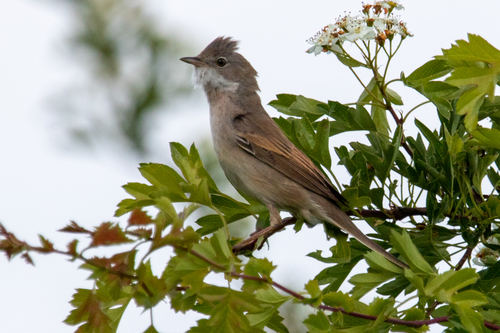 Common Whitethroat
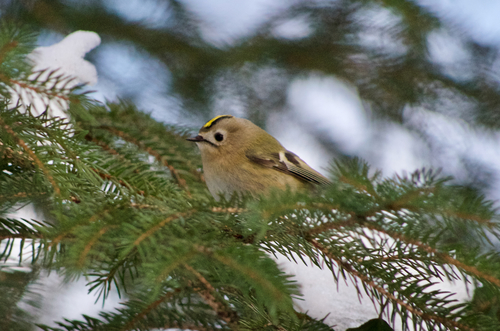 Goldcrest
In short
The most reliable field mark to separate Common Whitethroat from Goldcrest is the presence of a bold, bright yellow (with orange center in males) crest on the Goldcrest’s head, which is completely absent in Whitethroat of any age or sex. In addition, Goldcrest is dramatically smaller and more compact, with a plain face and two white wingbars, while Whitethroat is larger, longer-tailed, and shows a white throat with a contrasting grey head in adult males. Juvenile Goldcrests lack the colored crest but still show a plain face and small, round structure, unlike any Whitethroat. In flight or perched, these differences are immediately apparent with binoculars.
Identification tips
- Crest color (adults): Goldcrest always shows a bright yellow crest (orange-centered in males), bordered by black on the crown—never present in Whitethroat.
- Crest absence (juveniles): Juvenile Goldcrests lack the colored crest but still have a plain face and two white wingbars; Whitethroat juveniles never show wingbars or a crest.
- Wingbars: Goldcrest of all ages has two bold white wingbars; Whitethroat never shows wingbars, but may have chestnut fringes to the secondaries.
- Head pattern: Adult male Whitethroat has a grey head and white throat, creating a strong contrast; Goldcrest has a plain olive-green face with a colored crown, lacking any grey or white throat.
- Face pattern: Both species have plain faces, but Goldcrest is especially featureless except for the crest; Whitethroat may show a slightly paler throat, especially in males.
- Size: Goldcrest is much smaller and rounder, with a short tail and tiny bill; Whitethroat is larger, longer-tailed, and more slender.
- Bill: Goldcrest has a very short, thin, black bill; Whitethroat’s bill is longer and more typical of a warbler.
- Tail: Goldcrest’s tail is short and square; Whitethroat’s tail is longer and often appears fanned or cocked.
- Flight style: Goldcrest moves in quick, fluttering bursts with frequent hovering; Whitethroat flies more directly and perches more upright.
- Habitat: Goldcrest prefers conifers and mixed woodland; Whitethroat is found in open scrub, hedgerows, and brambles.
- Vocalizations: Goldcrest’s song is high and thin, while Whitethroat’s is scratchy and scolding. Calls are also distinct: Goldcrest’s are very high-pitched, Whitethroat’s are hoarse and nasal.
- Sex differences: Only male Whitethroat shows a grey head; female is browner but still lacks any crest or wingbars.
- Seasonal confusion: In autumn, juvenile Goldcrests may lack the crest but still show wingbars and tiny size; Whitethroat juveniles remain larger and lack wingbars.
- Common pitfalls: Poor views may obscure the crest on Goldcrest, but the combination of tiny size, wingbars, and plain face is unique. Whitethroat never shows wingbars or a colored crown.
- Context: In a conifer, especially high in the canopy, expect Goldcrest; in brambles or open scrub, expect Whitethroat.
Size
Goldcrest is the smallest European bird, weighing only 4.5–7.0 g and measuring 8.5–9.5 cm in length, with a wingspan of 13.5–15.5 cm. In contrast, Common Whitethroat is much larger and heavier (body mass ~14.5 g), with a noticeably longer tail and a more elongated body. Even at a distance or in poor light, the size difference is striking: Goldcrest appears tiny, almost wren-like, while Whitethroat is closer to a typical warbler in proportions.
Plumage
- Juveniles: Goldcrest juveniles lack the colored crest but retain a plain olive-green upperpart, buff-white underparts, and two white wingbars. Their face remains plain, and they are still very small and round-bodied. Juvenile Whitethroats are brown above and buff below, lacking any wingbars or colored crown, and have a longer tail and a more slender, warbler-like appearance.
- Adults: Adult male Whitethroat has a grey head and white throat, with chestnut fringes to the secondaries; females are browner and lack the grey head, but still show a pale throat. Goldcrest adults of both sexes have a bright yellow crest (with orange in males), black-bordered crown, olive-green upperparts, and two white wingbars. The face is plain, lacking any supercilium or eye-stripe, and the bill is very fine and short.
- Wing pattern: Goldcrest always shows two distinct white wingbars on otherwise plain wings, while Whitethroat lacks wingbars and instead may show chestnut fringes to the secondaries.
Behaviour
Goldcrest is extremely active, often seen flitting rapidly among foliage, hovering, and making quick, darting flights with whirring wingbeats and sudden changes of direction. It frequently creeps along branches and even up and down trunks. Whitethroat is more deliberate, often seen foraging in shrubs or brambles, making short flights, and perching more upright with a longer tail. In flight, Whitethroat appears more elongated and less frenetic than the restless Goldcrest.
Habitat
Goldcrest is typically found in coniferous or mixed woodland, especially among spruce and fir, but can also occur in parks and gardens with suitable trees. Whitethroat prefers open country, hedgerows, bramble patches, and scrubby areas, rarely venturing into dense woodland. If you see a small bird in a conifer, especially high up, Goldcrest is much more likely; a bird in brambles or open scrub is more likely to be Whitethroat.
Voice
Whitethroat’s song is a fast, scratchy warble with a scolding tone, and its call is a hoarse, nasal wed-wed or woid-woid, with a rough warning cry (tschehr). Goldcrest’s song consists of high, thin, repeated notes, higher-pitched and much less scratchy than Whitethroat. Goldcrest calls are very high and thin, often at the upper limit of human hearing, and lack the harsh, scolding quality of Whitethroat.