

Common Tailorbird vs Brown-throated Sunbird
Orthotomus sutorius versus Anthreptes malacensis
Play a quiz with Common Tailorbird and Brown-throated Sunbird
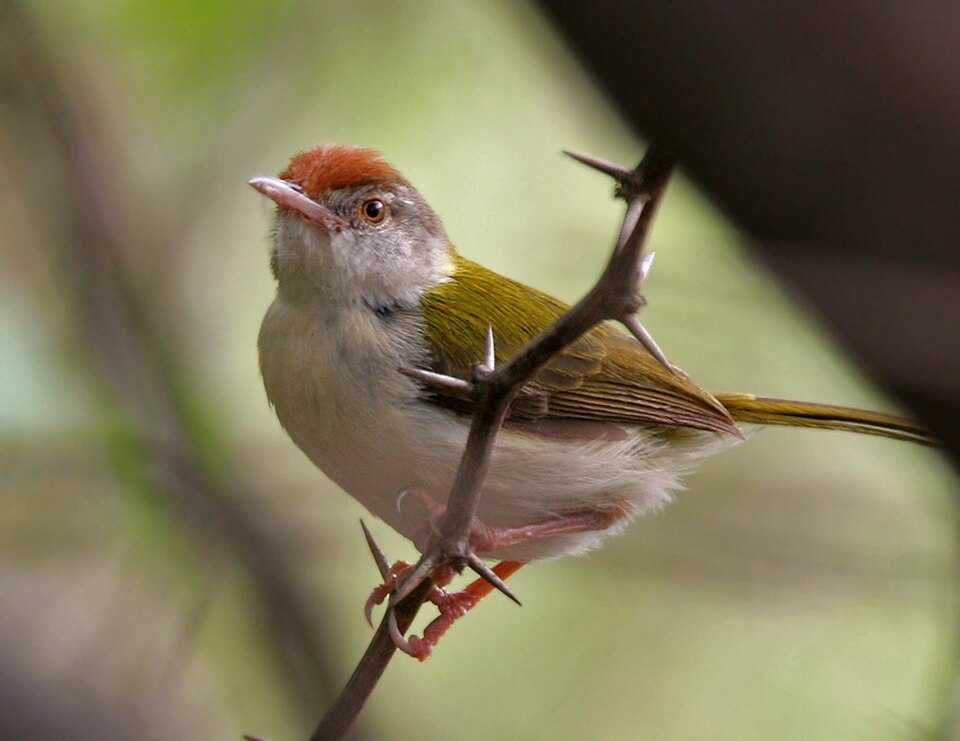 Common Tailorbird
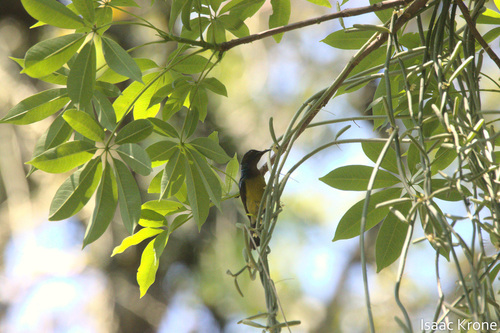 Brown-throated Sunbird
In short
The most reliable field mark to separate Common Tailorbird from Brown-throated Sunbird is overall structure and tail: tailorbirds are small, slim, wren-like birds with a long, often cocked tail and a thin, slightly decurved bill, while sunbirds are chunkier, with a thick, straight bill and a much shorter tail. Adult male Brown-throated Sunbirds are unmistakable with their iridescent green and purple upperparts and bright yellow underparts, but females and immatures can be confused with tailorbirds at a glance. However, even in duller plumages, the sunbird's heavy bill, stockier build, and lack of rufous crown are key. Both species can be found in gardens and semi-open habitats, but the tailorbird is more likely to be seen flitting through dense low vegetation, while the sunbird often visits flowers more openly. If you see a small, bright green bird with a long, upright tail and rufous crown, it's a tailorbird; if the bird is chunkier with a thick bill and shorter tail, especially if feeding at flowers, it's a sunbird.
Identification tips
- Tail length and carriage: Tailorbirds have a long, often cocked tail that is frequently flicked and held upright. Sunbirds have a much shorter tail, rarely flicked or cocked.
- Bill shape and thickness: Tailorbird's bill is thin, slightly decurved, and delicate; sunbird's bill is thick, straight, and noticeably heavier for the bird's size.
- Crown color: All ages and sexes of tailorbird show a rufous crown, a key field mark missing in sunbirds, which have plain olive or iridescent crowns.
- Overall structure: Tailorbirds are slim, wren-like, and agile; sunbirds are chunkier, with a more robust body and a heavier head and bill.
- Plumage brightness: Male sunbirds are unmistakable with iridescent green/purple upperparts and bright yellow below. Tailorbirds are never iridescent and always have creamy underparts.
- Female/immature confusion: Female and young sunbirds can look olive above and yellowish below, but lack the rufous crown and have a thicker bill and shorter tail compared to tailorbird. Always check for crown color and bill structure.
- Face pattern: Tailorbirds have a more contrasting face with the rufous crown and pale underparts, while sunbirds have a plainer face, especially in females and immatures.
- Behavior: Tailorbirds are restless, often hidden, and flick their tails; sunbirds are more likely to be seen feeding at flowers in the open and move more deliberately.
- Habitat context: Tailorbirds prefer dense, tangled vegetation; sunbirds are more often in semi-open areas with flowering plants.
- Feeding behavior: If the bird is probing flowers for nectar, especially in the open, sunbird is likely; tailorbirds rarely feed in this way.
- Vocalization: A loud, repetitive 'cheeup' call is a strong indicator of tailorbird; sunbird calls are not described here.
- Sexual dimorphism: Only male sunbirds are highly colorful; tailorbird sexes are similar except for longer central tail feathers in breeding males (not always reliable in the field).
- Juvenile confusion: Young tailorbirds are duller but still show rufous crown; young sunbirds lack rufous crown and have a thicker bill.
- Perched vs. in flight: Tailorbirds often perch with tail cocked and flicking; sunbirds perch more horizontally with tail down.
- Size impression: Tailorbirds look tiny and delicate, sunbirds look heavier and more robust for their length.
Size
Common Tailorbird is smaller and lighter (body mass ~7.5 g, length 10–14 cm) than Brown-throated Sunbird (mass 7.4–13.5 g, length about 14 cm). The sunbird is heavier and bulkier for its length, with a noticeably thicker bill and more robust body. Tailorbird appears more delicate and slim, with a proportionally much longer tail. In the field, tailorbirds look tiny and agile, while sunbirds are more solid and purposeful in movement.
Plumage
- Juveniles/Immatures: Young tailorbirds are duller but still show olive-green upperparts, creamy underparts, and a rufous crown. Young Brown-throated Sunbirds (especially females) are olive-green above and yellowish below, lacking any rufous on the crown and with a plain face.
- Adult males: Tailorbird males look like females except for long central tail feathers in breeding season; both sexes have a rufous crown and olive-green back. Male sunbirds are striking: iridescent green and purple on the upperparts, chestnut on wing-coverts, and bright yellow below—never confused with tailorbird.
- Adult females: Female sunbirds are olive-green above and yellowish below, similar in tone to tailorbirds but lack the rufous crown and have a thicker bill and shorter tail. Tailorbirds always have a rufous crown and paler, creamy underparts.
- Flight/wing pattern: No distinctive upperwing pattern is described for either species in any age, so separation relies on overall color, crown, and structure.
Behaviour
Tailorbirds are highly active, often skulking and flitting through dense foliage, frequently flicking and cocking their long tails. They rarely visit flowers openly and are more often heard than seen. Brown-throated Sunbirds are more deliberate, usually seen feeding at flowers in the open, sometimes hovering but more often perching to feed. Sunbirds are less likely to flick their tails and tend to move with more purpose between feeding stations. Tailorbirds are insectivorous, while sunbirds primarily feed on nectar but also take small fruits and insects (especially for juveniles).
Habitat
Both species can occur in gardens and semi-open habitats, but Common Tailorbird is a classic bird of dense shrubbery, urban gardens, and tangled vegetation, often remaining hidden. Brown-throated Sunbird prefers semi-open areas with flowering trees and shrubs and is more likely to be seen in the open, especially at nectar sources. If you see a small bird moving through thick cover, tailorbird is more likely; if it is visiting flowers in the open, sunbird is more likely.
Voice
Common Tailorbird is very vocal, with a loud, repetitive 'cheeup-cheeup-cheeup' call that often gives away its presence even when hidden. Brown-throated Sunbird's vocalizations are not described in the provided notes, so this is not a reliable separator here.
Common Tailorbird · Brown-throated Sunbird · My Tricky Birds