
Common Tailorbird vs Ashy Tailorbird
Orthotomus sutorius versus Orthotomus ruficeps
Play a quiz with Common Tailorbird and Ashy Tailorbird
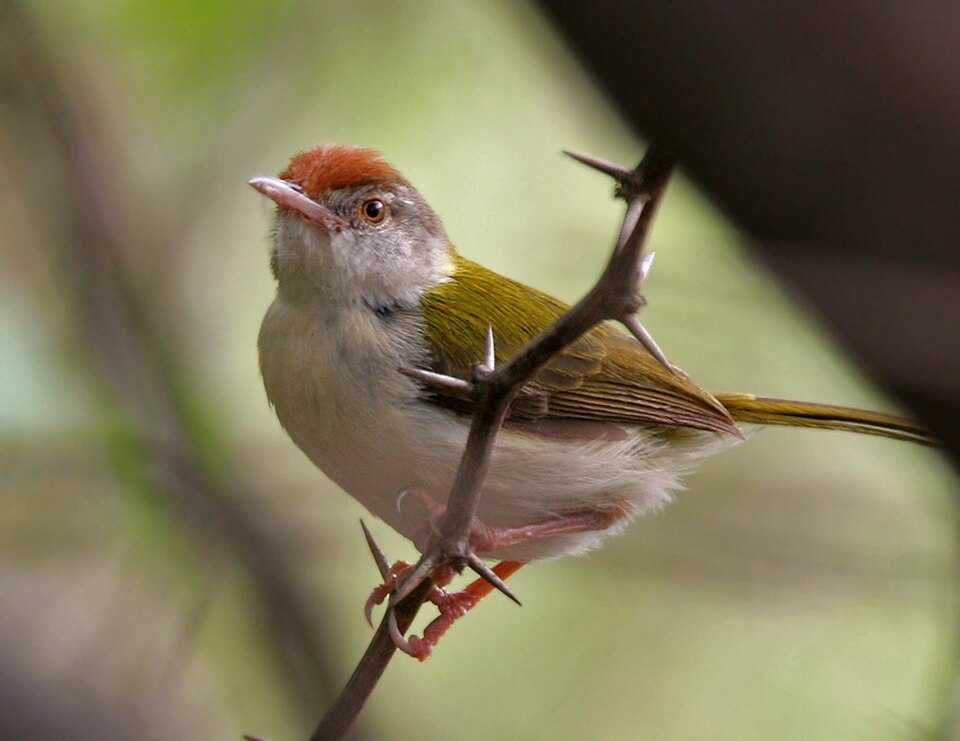 Common Tailorbird
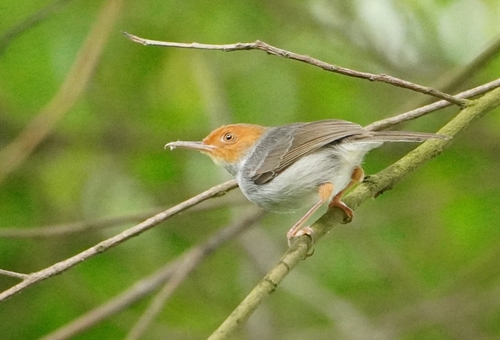 Ashy Tailorbird
In short
The most reliable field mark to separate Common Tailorbird from Ashy Tailorbird is the color and pattern of the head and upperparts: Common Tailorbird shows a bright rufous crown with olive-green upperparts and creamy underparts, while Ashy Tailorbird males have a rufous-chestnut face and forecrown but a distinctly ashy-grey back and paler grey tail, with the female being even paler and lacking the rufous on the throat. Juveniles of both species are duller, but Ashy Tailorbird juveniles lack any red on the head and have olive-green upperparts, making them potentially confusing with Common Tailorbird immatures. Structurally, both are small, active, long-tailed warblers, but Common Tailorbird tends to look brighter and greener overall, especially in urban gardens, while Ashy Tailorbird is more ashy-grey and typically found in forest edge or plantation settings. Vocalizations are not described in detail for Ashy Tailorbird, but Common Tailorbird is known for its loud, repeated cheeup calls. Use head color, back color, and habitat context as your primary clues, especially in duller birds.
Identification tips
- Head and face color (adult males): Common Tailorbird shows a bright rufous crown (not face), while Ashy Tailorbird male has rufous-chestnut extending over the face, chin, and forecrown. If the rufous is only on the crown, it's Common; if it covers the face and chin, it's Ashy.
- Back and upperparts: Common Tailorbird is olive-green above, while Ashy Tailorbird is ashy-grey (male) or paler grey (female). Greenish back points to Common; greyish to Ashy.
- Underparts: Common Tailorbird has creamy white underparts; Ashy Tailorbird fades from ashy grey on the throat to almost white on the belly (male) or has a pale grey wash (female).
- Tail color: Common Tailorbird has a greenish tail; Ashy Tailorbird's tail is lighter grey.
- Juvenile confusion: Juvenile Ashy Tailorbird lacks any rufous on the head and has olive-green upperparts, potentially resembling a dull Common Tailorbird. Look for the absence of any rufous crown and the more uniform olive upperparts in Ashy juvenile.
- Sex differences (Ashy): Female Ashy Tailorbird lacks rufous on chin/throat and is paler overall. Common Tailorbird sexes are nearly identical except for slightly longer central tail feathers in breeding males (not reliable in the field).
- Bill color: Ashy Tailorbird has a bark-brown upper mandible and horn-colored lower mandible, with a long, slightly decurved bill. Common Tailorbird's bill is sharp with a curved tip, but color is not described as distinctive.
- Tail shape and behavior: Both species have long, often cocked tails, but Common Tailorbird is especially wren-like in posture and tail movement.
- Habitat context: In dense urban gardens, Common Tailorbird is more likely. In forest edge, secondary growth, or plantations, especially in Southeast Asia, suspect Ashy Tailorbird.
- Vocalization: If you hear a loud, repeated cheeup-cheeup-cheeup, it's likely Common Tailorbird. Absence of this call does not confirm Ashy.
- Plumage brightness: Common Tailorbird is generally brighter and greener; Ashy Tailorbird is duller, greyer, and more subdued, especially in females and juveniles.
- Range overlap: In areas where both occur, use head and back color as your primary field marks.
- Nest location (if observed): Both sew leaves, but Ashy Tailorbird typically nests low (under 1m above ground), while Common Tailorbird's nest placement is more variable.
- Seasonal marks: Only breeding male Common Tailorbirds show elongated central tail feathers, but this is subtle and not always visible.
- Subspecies variation (Ashy): Some Ashy Tailorbird subspecies vary in the redness of the head and shade of grey on the back, so always check multiple field marks.
Size
Both species are very small warblers with similar mass (Common Tailorbird ~7.5g, Ashy Tailorbird ~7.0g [wikidata]). Length is slightly variable in Common Tailorbird (10–14 cm), while Ashy Tailorbird is listed as 7 cm, but this may be an underestimate or a difference in measurement conventions. In the field, size is not a reliable separator; both are tiny, active birds with long tails.
Plumage
-
Juvenile/immature birds: Both species are duller than adults. Juvenile Ashy Tailorbird lacks any red on the head and has olive-green upperparts, which can make it resemble a dull Common Tailorbird, but note that Ashy Tailorbird juveniles will not show the rufous crown or the bright creamy underparts of Common Tailorbird.
-
Adult males: Common Tailorbird has a bright rufous crown (not extending to the face), olive-green upperparts, and creamy white underparts. Ashy Tailorbird male has a rufous-chestnut face, chin, and forecrown, but the rest of the head and back are ashy-grey, with the grey paling to white on the belly. The tail is lighter grey (not olive-green).
-
Adult females: Ashy Tailorbird females are paler overall, with a white chin and throat, pale grey wash across the breast, and paler upperparts. Common Tailorbird females look like males except for the lack of elongated central tail feathers in breeding season (which is a subtle and unreliable mark).
-
Key contrast: Common Tailorbird is always green-backed with a rufous crown, while Ashy Tailorbird is ashy-grey above with rufous only on the face and forecrown (male) or none at all (female/juvenile). Underparts are creamy in Common, pale grey to white in Ashy.
Behaviour
Both species are active, insectivorous warblers that forage in low vegetation, often hidden but sometimes visible as they flick their long tails. Common Tailorbird is especially familiar in urban gardens and is often detected by its loud calls. Ashy Tailorbird is more likely to be seen in pairs or small family groups, foraging from forest undergrowth to canopy, and is noted for adapting well to disturbed habitats such as palm oil plantations. Both species build 'sewn' nests using leaves and plant fibers.
Habitat
Common Tailorbird is a common resident of urban gardens, parks, and open woodland across tropical and subtropical Asia, often in close proximity to humans. Ashy Tailorbird is found in Southeast Asia, favoring forest edge, secondary growth, plantations, and sometimes gardens, but is especially noted for thriving in palm oil plantations and disturbed habitats. If you are in a dense urban garden, Common Tailorbird is more likely; in forest edge or plantation, Ashy Tailorbird is more probable.
Voice
Common Tailorbird has a loud, repeated cheeup-cheeup-cheeup call that is often the easiest way to detect its presence. No distinctive vocalization is described for Ashy Tailorbird in the available notes, so voice is not a reliable separator unless you know Common Tailorbird's call well.