

Common Sandpiper vs Curlew Sandpiper
Actitis hypoleucos versus Calidris ferruginea
Play a quiz with Common Sandpiper and Curlew Sandpiper
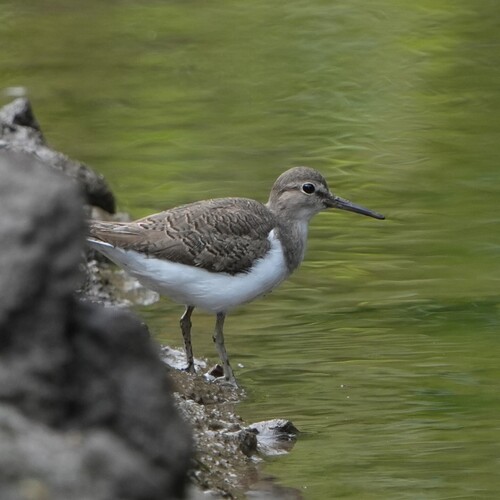 Common Sandpiper
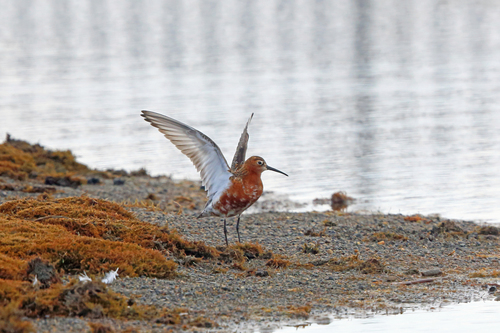 Curlew Sandpiper
In short
The most reliable field separation between Common Sandpiper and Curlew Sandpiper is the wing and rump pattern in flight: Curlew Sandpiper of all ages shows a bold white rump and a strong white wing stripe, while Common Sandpiper lacks both, instead showing a more uniform brown upperwing with only subtle barring and no white rump. On the ground, Common Sandpiper has a shorter, straighter bill with a pale base, yellowish legs, and a distinctive teetering motion, while Curlew Sandpiper is longer-legged, with a longer, downcurved black bill and dark legs. Juvenile and non-breeding birds of both species can look superficially similar in color, but the structural and flight marks are decisive. In summary: check for the white rump and wing stripe in flight for Curlew Sandpiper, and look for the teetering, short-billed, yellow-legged Common Sandpiper on the ground.
Identification tips
- White rump and wing stripe in flight: Curlew Sandpiper (all ages) shows a bold white rump and a strong white wing stripe in flight; Common Sandpiper lacks both, showing a plain brown rump and upperwing with only subtle barring. This is the single most reliable field mark when birds are flushed or flying.
- Bill shape and length: Curlew Sandpiper has a long, slender, downcurved black bill, while Common Sandpiper has a shorter, straighter bill with a pale base and dark tip. This is especially useful when birds are side-by-side or seen at close range.
- Leg color: Common Sandpiper has short, dark yellowish legs and feet; Curlew Sandpiper has longer, dark grey to black legs. Leg color can be hard to see in muddy conditions but is helpful when visible.
- Body shape and posture: Curlew Sandpiper is longer-legged and more elongated, often standing taller and feeding by probing. Common Sandpiper is compact, crouched, and often teeters its rear end up and down while foraging.
- Facial pattern: Curlew Sandpiper (especially juveniles and non-breeding adults) shows a distinct white supercilium (eyebrow) and a more mottled, scaly face. Common Sandpiper is plainer-faced, with less contrast around the eye.
- Juvenile upperwing pattern: Juvenile Common Sandpiper is heavily barred above with buff edges to the wing feathers; juvenile Curlew Sandpiper is more evenly scaly and buff-tinged, with a white eyebrow and slim tail feathers. The upperwing of Curlew Sandpiper always shows the white stripe, even in juveniles.
- Breeding plumage: Adult Curlew Sandpiper in breeding plumage is reddish below and on the head—unmistakable and never matched by Common Sandpiper. However, most confusion occurs in non-breeding or juvenile plumages.
- Tail pattern: Curlew Sandpiper has a white rump and tail underside, sometimes with red barring in adults; Common Sandpiper has a plain brown rump and tail.
- Feeding behavior: Common Sandpiper habitually bobs its tail and head while foraging; Curlew Sandpiper does not teeter and feeds by probing with its long bill.
- Flight style: Common Sandpiper flies low over water with stiff, shallow wingbeats; Curlew Sandpiper has a more typical wader flight, often in flocks, with longer, more flexible wingbeats.
- Habitat preference: Curlew Sandpiper prefers open, muddy or saline flats; Common Sandpiper is more often found along freshwater edges, including rivers and lakes.
- Size and structure: Curlew Sandpiper is larger and bulkier, with a longer wingspan and bill. Common Sandpiper is smaller and more compact.
- Pitfalls: In dull light, both species can appear similarly grey-brown above and white below, but the structural and flight marks remain reliable. Beware of distant or lone Curlew Sandpipers on freshwater, and of Common Sandpipers on open mudflats during migration.
- Group behavior: Curlew Sandpiper is more likely to be in flocks, especially on migration; Common Sandpiper is typically solitary or in small groups.
- When in doubt: If you see a white rump and wing stripe in flight, it's Curlew Sandpiper. If the bird teeters and has yellowish legs and a short, straight bill, it's Common Sandpiper.
Size
Curlew Sandpiper is the larger of the two: adults measure 18–23 cm in length with a 38–46 cm wingspan and weigh 44–117 g [wikipedia]. Common Sandpiper is smaller, at 18–20 cm long with a 32–35 cm wingspan [wikipedia]. The difference is most apparent in wingspan and overall bulk, but there is some overlap in length. Curlew Sandpiper also has a proportionally longer bill and legs, giving it a more elongated look compared to the compact, short-billed Common Sandpiper.
Plumage
For birds in flight, the most diagnostic difference is the rump and wing pattern: Curlew Sandpiper (all ages and plumages) shows a large white rump patch and a strong white wing stripe, both visible from above and below. Common Sandpiper lacks these, showing a plain brown rump and upperwing, with only subtle barring on the wings that is more obvious in juveniles and winter adults but never forms a bold stripe. Juvenile Common Sandpiper is heavily barred above with buff-edged wing feathers, while juvenile Curlew Sandpiper is more evenly scaly and buff-tinged, with a white eyebrow and slim tail feathers. In non-breeding plumage, both species have grey-brown upperparts and white underparts, but Curlew Sandpiper often appears paler and more mottled, with a distinct white supercilium, while Common Sandpiper is plainer-faced. In breeding plumage, Curlew Sandpiper is unmistakable with extensive reddish underparts (not shown by Common Sandpiper), but most confusion arises in non-breeding or juvenile plumages.
Behaviour
Common Sandpiper is usually seen singly or in small groups, often teetering its body and bobbing its tail as it forages along shorelines. Its flight is low over water, stiff-winged, and direct. Curlew Sandpiper is more likely to be found in flocks, especially on migration, and does not show the same constant tail-bobbing behavior. On the ground, Curlew Sandpiper feeds by probing with its long, downcurved bill, while Common Sandpiper picks at the surface with a shorter, straighter bill.
Habitat
Curlew Sandpiper favors open tidal mudflats, saltpans, and coastal wetlands, especially during migration and winter. Common Sandpiper is more often found along the edges of freshwater lakes, rivers, and streams, as well as sheltered coasts. While both can occur in similar wetland habitats, Curlew Sandpiper is rarely found away from open, muddy or saline flats, whereas Common Sandpiper is more versatile and often seen along rocky or vegetated freshwater margins.