

Common Reed Warbler vs Clamorous Reed Warbler
Acrocephalus scirpaceus versus Acrocephalus stentoreus
Play a quiz with Common Reed Warbler and Clamorous Reed Warbler
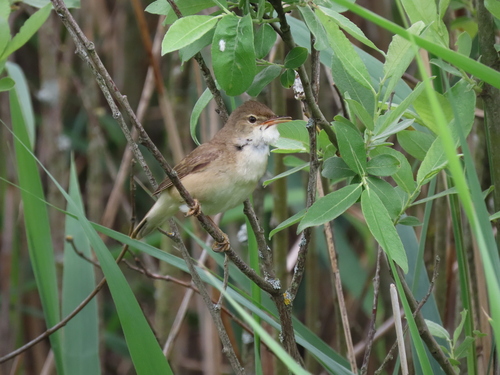 Common Reed Warbler
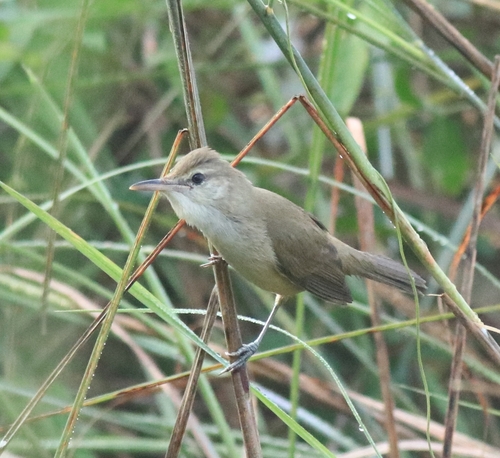 Clamorous Reed Warbler
In short
The most reliable way to separate Common Reed Warbler from Clamorous Reed Warbler is by size: Clamorous is much larger, approaching thrush size, while Common is a small, slim warbler. Both species have plain brown backs and pale underparts, but Clamorous is bulkier and paler below, while Common appears more compact and warmer buff underneath, especially in juveniles. Structural differences—especially overall length and jizz—are key, as plumage is very similar. Voice can be helpful, but both have slow, chattering songs with mimicry, so size and structure remain the best field clues.
Identification tips
- Size is the most reliable field mark: Clamorous Reed Warbler is much larger (18–20 cm) than Common Reed Warbler (13 cm). If the bird looks thrush-sized among reeds, it's likely Clamorous.
- Structure: Clamorous Reed Warbler appears bulkier, with a heavier bill and larger head. Common Reed Warbler is slimmer and more delicate overall.
- Underpart color: Adult Common Reed Warbler has buff underparts (richer in juveniles), while Clamorous Reed Warbler is paler and more whitish below. This is subtle and can be affected by light.
- Upperparts: Both have plain brown backs, but Clamorous may show slightly richer or darker brown in some races. Not a strong field mark.
- Supercilium: Both lack a strong supercilium; do not use this as a separator.
- Bill: Clamorous has a proportionally larger and heavier bill, but this is best judged with direct comparison or experience.
- Flight appearance: Clamorous looks broad-winged and heavy in flight; Common is more compact and agile. No distinctive wing panels or age-specific flight marks are noted for either species.
- Juvenile plumage: Young Common Reed Warblers are warmer buff below, but this is not always obvious in the field. No unique juvenile marks for Clamorous are noted.
- Song: Clamorous's song is louder and more forceful, but both species' songs are slow, chattering, and include mimicry. Use with caution.
- Habitat: Both are reedbed specialists; habitat is not a separator where ranges overlap.
- Range: In Europe and western Palearctic, expect Common Reed Warbler; in Egypt to SE Asia, expect Clamorous. Vagrants are possible, so always check size and structure.
- Behavior: Clamorous may appear more ponderous and less agile than Common, but both are typically skulking and reed-bound.
- Context: If seen with other Acrocephalus warblers, compare directly for size and structure.
- Sexes: Both species are sexually monomorphic; sex is not a separator.
- Pitfalls: Do not rely on subtle plumage shades or song alone—size and structure are the most dependable clues, especially in poor light or brief views.
Size
Clamorous Reed Warbler is substantially larger than Common Reed Warbler. Common Reed Warbler is about 13 cm in length and weighs around 12 g, making it a typical small Acrocephalus. Clamorous Reed Warbler, by contrast, is 18–20 cm long—almost the size of a Song Thrush—and noticeably bulkier. This size difference is usually apparent even at a distance or in mixed flocks. If you see a reed warbler that seems unusually large, especially compared to nearby warblers, suspect Clamorous. The bill and head are also proportionally larger and heavier in Clamorous.
Plumage
Both species have unstreaked brown backs and pale underparts, with a flattened forehead and strong, pointed bill. Adult Common Reed Warbler shows buff underparts, especially rich in juveniles, while Clamorous Reed Warbler has whitish underparts as an adult. There is no mention of distinctive juvenile or immature upperwing patterns for either species, so age-specific flight marks are not helpful. Subtle differences in underpart tone may help: Common Reed Warbler is warmer and buffier below, especially in young birds, while Clamorous is paler and more washed-out. Both lack strong supercilia and have similar plain faces. Regional variation exists in Clamorous, with some races showing darker or richer brown upperparts, but these are subtle and not always reliable in the field.
Behaviour
Both species are skulking reedbed warblers, often seen clambering among reeds or making short flights between stems. Clamorous Reed Warbler, being larger and heavier, may appear less agile and more ponderous in movement compared to the more active, nimble Common Reed Warbler. In flight, Clamorous's larger size and broader wings are apparent, while Common Reed Warbler looks slimmer and more delicate. Both species perch upright with a flattened forehead, but Clamorous may seem more robust overall.
Habitat
Both species are reedbed specialists, typically found in dense stands of reeds near water. However, their ranges do not overlap much: Common Reed Warbler breeds across Europe and the western Palearctic, while Clamorous Reed Warbler is found from Egypt east through South and Southeast Asia. In regions where both might occur as vagrants or on migration, habitat preference is not a reliable separator, as both favor similar wetland environments.
Voice
Both species have slow, chattering songs with acrocephaline whistles and mimicry. The Common Reed Warbler's song is a slow, chattering 'jit-jit-jit,' while Clamorous Reed Warbler's is a loud, far-carrying 'kereet-kereet-kereet.' Clamorous's song is less raucous than that of the Great Reed Warbler but is generally louder and more forceful than Common Reed Warbler. However, in the field, the difference may be subtle, and both can be confusingly similar to inexperienced listeners.
Common Reed Warbler · Clamorous Reed Warbler · My Tricky Birds