
Common Redshank vs Spotted Redshank
Tringa totanus versus Tringa erythropus
Play a quiz with Common Redshank and Spotted Redshank
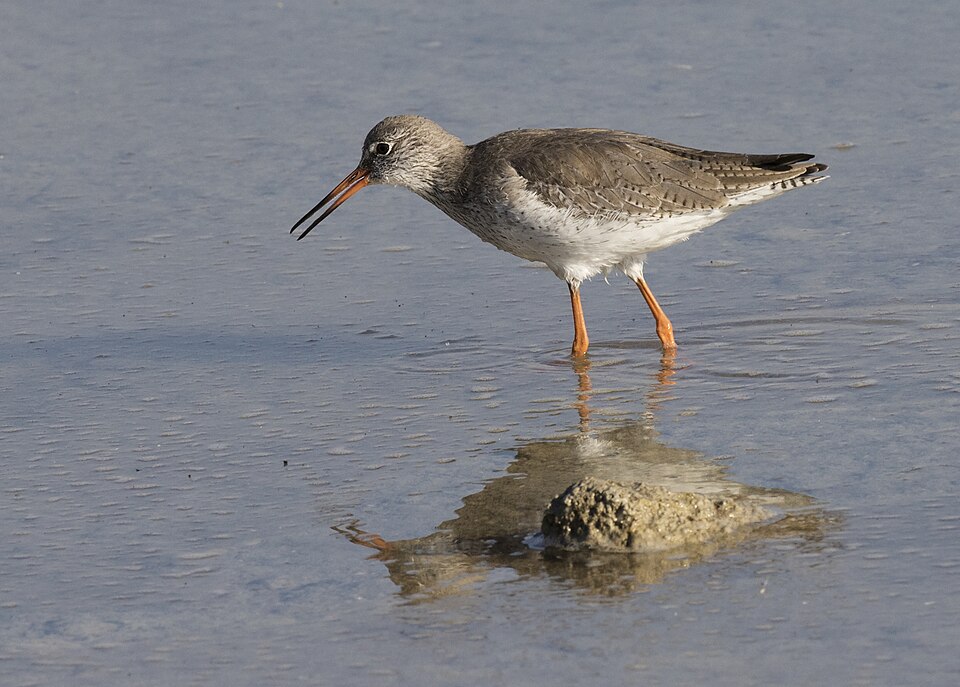 Common Redshank
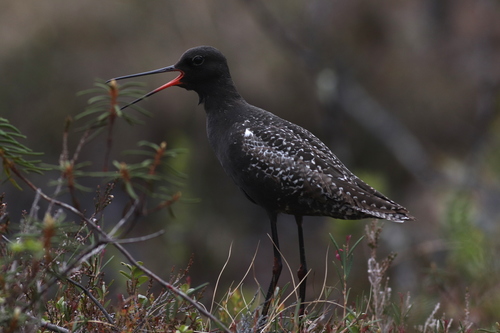 Spotted Redshank
In short
The most reliable field mark between Common Redshank and Spotted Redshank is their striking difference in breeding plumage: Spotted Redshank adults turn almost entirely black, while Common Redshank remains marbled brown. In winter and juvenile plumages, both become paler and more similar, but Spotted Redshank is generally paler and more finely marked, with a longer bill and legs. In flight, both show white on the back, but the Spotted Redshank's white is more oval-shaped, while Common Redshank shows a strong white wedge up the back and broad white wing stripes. Juvenile Spotted Redshank is more finely speckled above and barred below than juvenile Common Redshank. Structural differences (longer, finer bill and legs in Spotted Redshank) are helpful, especially when plumage is ambiguous.
Identification tips
- Breeding plumage (spring/summer adults): Spotted Redshank is almost entirely black with white spots, especially on the underparts, while Common Redshank is never black, remaining marbled brown above and lighter below. This is the most clear-cut separation.
- Juvenile/first-winter birds: Juvenile Spotted Redshank is grey-brown above, finely speckled with white, and has pale, finely barred underparts. Juvenile Common Redshank is more marbled brown with diffuse brownish spots on the breast and neck. Look for the finer, crisper patterning on Spotted Redshank juveniles.
- Winter adults: Both become paler, but Spotted Redshank is very pale overall (almost silvery), while Common Redshank is plain greyish-brown above and whitish below. When in doubt, rely on structure and flight pattern.
- Bill structure: Spotted Redshank has a longer, finer, and straighter bill than Common Redshank, which has a shorter, slightly upturned bill with a more obvious black tip. This is visible at close range or in good profile views.
- Leg length: Spotted Redshank's legs are longer and appear more slender, often extending well beyond the tail in flight or when wading deeper water. Common Redshank's legs are shorter and stouter.
- Flight pattern: Both show white on the back, but Spotted Redshank has a neat white oval, while Common Redshank shows a strong white wedge up the back and broad white wing stripes. These marks are visible in all ages and seasons and are among the best in-flight clues.
- General jizz: Spotted Redshank appears more elegant and elongated, with a more upright stance and longer proportions. Common Redshank is chunkier and more compact, often with a hunched posture.
- Leg color: Both have red legs, but in breeding plumage, Spotted Redshank's legs turn dark grey. In non-breeding plumage, both are reddish, so this is not always reliable.
- Bill color: Both have red at the base of the bill, but Spotted Redshank's bill is longer and finer, with less obvious black at the tip than Common Redshank.
- Underpart pattern: In juveniles, Spotted Redshank is more finely barred below, while Common Redshank is more diffusely spotted. In adults, only Spotted Redshank ever appears black below (breeding plumage).
- Habitat context: If seen in northern bogs in summer, Spotted Redshank is more likely. In lowland marshes or estuaries, especially in western Europe, Common Redshank is usually the default.
- Vocalization: If you hear a creaking 'teu-it' or 'kyip-kyip-kyip', suspect Spotted Redshank, but beware that calls can be variable and are not always diagnostic.
- Moult timing: Spotted Redshank adults moult completely between July and October, with body plumage changing in spring (March–May). Juveniles have a partial moult August–February. This may affect the clarity of plumage marks in late summer/autumn.
- Pitfalls: In dull winter light or at distance, both species can appear similar. Use a combination of structure (bill, legs), flight pattern, and any available plumage detail to confirm ID.
- When in doubt: Prioritize flight marks (white oval vs wedge/wing stripes), bill and leg length, and overall jizz, especially outside the breeding season when plumage is less distinctive.
Size
Spotted Redshank is slightly larger and heavier than Common Redshank (average adult mass 151.5g vs 129.0g), but this difference is subtle in the field. Spotted Redshank also appears longer-legged and longer-billed, contributing to a more elegant, elongated impression compared to the chunkier, shorter-legged Common Redshank.
Plumage
- Juvenile/First-winter: Juvenile Spotted Redshank is grey-brown above, finely speckled with white, and has pale, finely barred underparts. Juvenile Common Redshank is more marbled brown above, with less fine spotting and more diffuse brownish spots on the breast and neck. Both species are paler below, but Spotted Redshank is generally cleaner and more crisply marked.
- Adult breeding: Spotted Redshank is almost entirely black with white spots, including the underparts, while Common Redshank is marbled brown above and lighter below, never black. In this season, confusion is unlikely.
- Adult winter: Both species become paler and less patterned. Common Redshank is plain greyish-brown above and whitish below, while Spotted Redshank is very pale overall, often appearing silvery or whitish. Bill and leg color are similar (red), but Spotted Redshank's bill and legs are longer and finer.
- Flight: Both show white on the back, but Spotted Redshank has a white oval, while Common Redshank shows a strong white wedge up the back and broad white wing stripes. These flight marks are useful for all ages.
Behaviour
Both species are active waders, often seen probing mud or shallow water. Spotted Redshank tends to appear more graceful and upright, often wading deeper due to its longer legs. Common Redshank is more likely to be seen in a hunched posture and may appear more nervous, frequently bobbing and flicking its tail.
Habitat
Both species use similar wetland habitats, but Spotted Redshank breeds farther north (taiga bogs) and is more likely to be a passage or winter visitor in temperate zones, while Common Redshank is widespread in lowland marshes, estuaries, and wet grassland. In winter, both may overlap in coastal or inland wetlands.
Voice
Spotted Redshank gives a creaking whistle 'teu-it', reminiscent of a roseate tern, and an alarm call 'kyip-kyip-kyip'. Common Redshank's call is not described in the notes, so vocal differences are not reliably diagnostic here.