
Common Redshank vs Ruddy Turnstone
Tringa totanus versus Arenaria interpres
Play a quiz with Common Redshank and Ruddy Turnstone
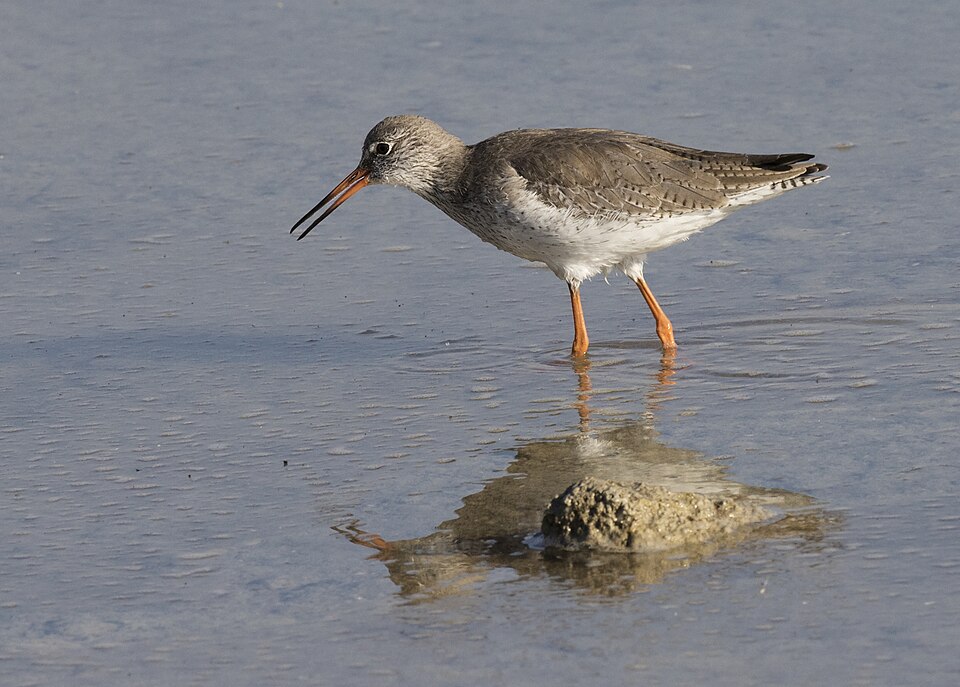 Common Redshank
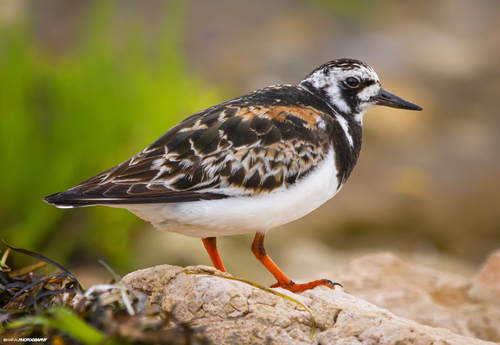 Ruddy Turnstone
In short
The most reliable separation between Common Redshank and Ruddy Turnstone is their distinctive flight and perched plumage: redshank shows a bold white wedge up the back and broad white wing stripes, while turnstone flashes a striking white lower back, rump, and tail with a white wingbar and black tail bands. Juvenile turnstones have a scaly upperpart pattern, while young redshanks are more diffusely mottled. Structurally, redshank is longer-legged and slimmer with a straight, red-based bill; turnstone is stockier, shorter-legged, and has a dark, wedge-shaped bill. Turnstone’s harlequin black-and-white face and breast pattern is unique, especially in breeding plumage, while redshank is more subdued and plain. Both can be found on coasts, but redshank is more likely inland or in marshes, while turnstone is almost always on rocky or seaweed-strewn shorelines.
Identification tips
- Flight pattern (all ages): Look for a bold white wedge up the back and broad white trailing edge to the wings (redshank) versus a white wingbar, white lower back/rump/tail, and black tail bands (turnstone).
- Juvenile upperparts: Juvenile turnstones have a scaly, checkered look from pale fringes on the upperpart feathers; juvenile redshanks are more diffusely mottled brown above.
- Leg color and length: Redshank has long, bright red legs; turnstone has shorter, bright orange legs. In direct comparison, redshank stands taller and more upright.
- Bill shape and color: Redshank's bill is straight, medium-length, red at the base with a black tip. Turnstone's bill is shorter, dark, wedge-shaped, and slightly upturned—adapted for flipping stones.
- Face and breast pattern (breeding): Turnstone has a harlequin face: white head with black streaks/crown and bold black mask, plus a mostly black breast with a white patch on the sides. Redshank is plain-faced and only lightly spotted on the breast.
- Non-breeding plumage: Redshank becomes plain grey-brown above and whitish below; turnstone is darker above, with a dark head and less white, but still shows a strong white wingbar and rump in flight.
- Sex differences: Female turnstones are slightly duller and browner on the head; redshank sexes are similar.
- Structure/jizz: Redshank is taller, slimmer, and longer-legged; turnstone is compact, short-legged, and robust.
- Feeding behavior: Turnstone is often seen flipping stones, seaweed, or debris, sometimes hammering at prey; redshank probes mud or shallow water and rarely manipulates objects.
- Habitat: Turnstone is almost always on rocky or seaweed-strewn coasts; redshank is more likely in marshes, mudflats, or even inland wetlands.
- Group behavior: Turnstones are often in tight, active groups on the shore; redshanks are more solitary or loosely grouped, especially away from the coast.
- Vocalizations: If heard, turnstone gives a rattling or chattering call, especially in the breeding season; redshank's call is not described here.
- Pitfalls: In dull winter plumage, both species lose some color, but turnstone retains its bold white and black flight pattern and scaly juvenile look, while redshank remains plain and shows a strong white wedge up the back in flight.
- When marks fail: If only the legs or bill are visible, beware: leg color can look similar in poor light. Always try for a flight view or a good look at the face and upperparts.
- Quiz tip: If you see a scaly-backed, short-legged wader flipping stones on a rocky shore, it's a turnstone. A plain, red-legged wader with a white wedge up the back in flight is a redshank.
Size
Common Redshank is slightly heavier on average (body mass about 129 g [wikidata]), with a longer-legged, taller stance. Ruddy Turnstone is more compact and stocky, with a body mass ranging from 85–150 g [wikipedia], but is generally shorter-legged and appears chunkier. In direct comparison, redshank stands taller and looks more elegant, while turnstone is squat and robust.
Plumage
- Juvenile/immature birds: Juvenile Ruddy Turnstones have pale brown heads and upperparts with pale fringes, giving a distinctly scaly or checkered look. Juvenile Common Redshanks are more diffusely mottled brown above, lacking the sharp scaly pattern.
- Flight pattern (all ages): Redshank shows a strong white wedge up the back, broad white trailing edge to the wings, and a white rump. Turnstone in flight reveals a white wingbar, white patch at the wing base, and a bright white lower back, rump, and tail with dark tail bands—creating a more banded appearance.
- Breeding plumage: Redshank is marbled brown above, lighter below, with red legs and a red-based bill. Turnstone is much more patterned: reddish-brown upperparts with black markings, a mainly white head with black streaks and a bold black face pattern, and a mostly black breast with a white patch on the sides.
- Non-breeding plumage: Redshank becomes plainer grey-brown above and whitish below; turnstone dulls to dark grey-brown upperparts with black mottling and a dark head with little white, but still shows a strong white wingbar and rump in flight.
- Sex differences: Female turnstones are slightly duller and browner on the head than males; redshank shows little sexual dimorphism.
Behaviour
Redshank feeds by probing in soft mud or shallow water, often in marshes or estuaries, and moves with a steady, upright gait. Turnstone is highly active and distinctive in its foraging: it flips stones, seaweed, and debris with its bill, bulldozes through piles, and pecks or hammers at prey. Turnstones are often seen in small, tight groups on rocky coasts, while redshanks are more solitary or loosely grouped, especially inland. Turnstone's aggressive, dominant postures (hunched, lowered tail) are sometimes visible when feeding in flocks.
Habitat
Common Redshank is found in a wide range of wetland habitats: freshwater and brackish marshes, mudflats, estuaries, and sometimes inland lakes and flooded fields. Ruddy Turnstone is almost always coastal, favoring rocky shores, seaweed-covered beaches, and tidal debris lines. If you see a bird flipping stones or seaweed on a rocky coast, it's almost certainly a turnstone; a wader in a muddy estuary or inland marsh is more likely a redshank.
Voice
Turnstone gives a staccato, rattling call and a chattering alarm, mainly in the breeding season. Redshank's call is not described in the notes, so is not diagnostic here.