
Motmot

Common Pauraque vs Purple Martin

Nyctidromus albicollis versus Progne subis

Play a quiz with Common Pauraque and Purple Martin
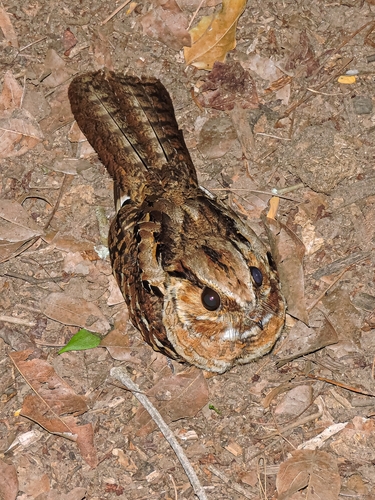
Common Pauraque (Nyctidromus albicollis) Common Pauraque
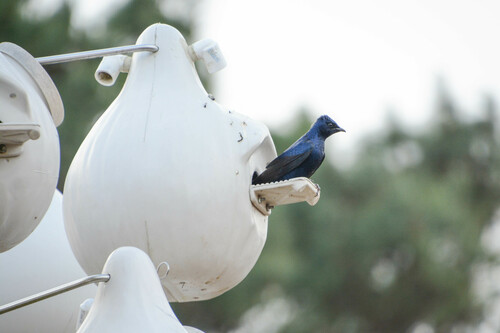
Purple Martin (Progne subis) Purple Martin

Media

Loading…

In short

The most reliable way to separate Common Pauraque from Purple Martin is by overall structure and flight style: Pauraque is a broad-winged, long-tailed nightjar with cryptic, mottled brown or rufous plumage, while Purple Martin is a large swallow with a sleeker, more streamlined body and a slightly forked tail. In flight, Pauraque shows rounded wings and may reveal white patches (especially on adult males), whereas Purple Martin has pointed wings and a uniform, glossy appearance in adult males or paler underparts in females and immatures. Pauraque is strictly nocturnal and often seen on the ground or low perches at dusk or night, while Purple Martin is active by day, always aerial, and rarely perches on the ground. If you see a bird resting on a road or running when disturbed, it's a Pauraque; a bird swooping high overhead in daylight is a Purple Martin.

Identification tips

  1. Flight style and time of activity: Pauraque is strictly nocturnal and flushes from the ground at dusk or night; Purple Martin is diurnal and always seen flying high in daylight. If you see a bird flying at night or flushed from a road, it's almost certainly a Pauraque.
  2. Perched posture: Pauraque sits lengthwise on the ground or low branches, appearing long and flat with a broad head and long tail. Purple Martin perches upright on wires or boxes, rarely on the ground.
  3. Wing and tail shape: Pauraque has broad, rounded wings and a long, rounded tail (with white outer feathers in males); Purple Martin has long, pointed wings and a slightly forked tail with no white.
  4. Plumage gloss and color: Adult male Purple Martins are glossy steel-blue-black all over, never mottled or brown. Pauraque is always cryptically mottled brown or rufous, never glossy or blue. Female and immature martins are dark above and pale below, but still lack the mottled, camouflaged look of Pauraque.
  5. Facial markings: Pauraque shows a buff eye-ring and facial stripe, contrasting with reddish facial sides. Purple Martin lacks any facial stripes or eye-rings.
  6. White wing and tail patches: Adult male Pauraque shows a white band near the wing tips and mostly white outer tail feathers, visible in flight or when spread. Female Pauraque has less white. Purple Martin never shows white in these areas.
  7. Bill shape: Pauraque has a short, broad bill adapted for nightjar feeding; Purple Martin has a typical swallow bill, short and slightly hooked but less broad.
  8. Legs and movement: Pauraque has relatively long legs for a nightjar and may run when disturbed. Purple Martin has short legs and is rarely seen walking or running.
  9. Habitat context: Pauraque is found in mixed woodland, scrub, and open ground with cover, often at ground level. Purple Martin is found in open areas near water, often near human habitation, and forages high in the air.
  10. Vocalizations: Pauraque calls at night with whistled and whip-like sounds; Purple Martin chatters and chirps by day. If you hear a bird at dusk or night, it's likely Pauraque.
  11. Seasonal presence: In North America, Pauraque is resident in southern Texas and southward; Purple Martin is present in spring and summer across much of the US and Canada, absent in winter.
  12. Sex and age confusion: Immature and female Purple Martins may be confused with other swallows but not with Pauraque due to their upright posture, aerial habits, and lack of cryptic plumage. Pauraque sexes differ in extent of white in wings/tail, but both are cryptic and never swallow-like.
  13. Flock size: Purple Martins often form large flocks, especially outside breeding; Pauraque is solitary or in pairs.
  14. Response to disturbance: Pauraque may run or flush at close range; Purple Martin flies off rapidly and rarely allows close approach on the ground.
  15. Common pitfalls: At dusk, a Pauraque flushed from a road may seem swallow-like in brief flight, but look for the broad wings, long tail, and cryptic plumage. A Purple Martin will never be seen on the ground or at night.

Size

Both species are similar in mass (Pauraque ~53g, Purple Martin ~48g [wikidata]), but Pauraque is longer (22–28 cm vs. 19–20 cm) and appears bulkier and longer-tailed in the field. Purple Martin, though North America's largest swallow, is more compact, with a shorter body and longer wingspan (39–41 cm vs. Pauraque's unlisted but proportionally shorter wings). Pauraque's long tail and broad wings give it a larger, more sprawling look, especially when perched or flushed. Purple Martin is more streamlined and slender, with a slightly forked tail.

Plumage

No distinctive juvenile or immature upperwing pattern is described for either species, so age-specific flight marks are not diagnostic here. For adults, Pauraque is cryptically colored in mottled greyish-brown or rufous-brown, with a buff eye-ring and facial stripe, and in males, a white band near the wing tips and white outer tail feathers (females have less white). Purple Martin adult males are glossy steel-blue-black all over, unique among North American swallows; adult females are dark above with some blue sheen and pale below. Immature martins resemble duller females, lacking the blue gloss and with browner backs. Pauraque's plumage is always camouflaged and never glossy or blue. In flight, Pauraque's white wing and tail patches (males) can be seen at close range, but Purple Martin shows no such markings, only a uniform dark or two-tone (female/immature) pattern.

Behaviour

Pauraque is nocturnal, terrestrial, and often flushes from the ground or low cover, sometimes running rather than flying when disturbed. It frequently rests on roads or tracks and is rarely seen flying in daylight. Purple Martin is highly aerial, diurnal, and rarely if ever lands on the ground; it feeds by catching insects on the wing, often high above the ground, and is agile and fast in flight, sometimes diving steeply toward nest sites. Martins form large flocks outside the breeding season, while Pauraque is solitary or in pairs.

Habitat

Pauraque prefers mixed habitats with dense cover for daytime roosting (forest, scrub, woodland edges) and open areas for nocturnal hunting, including roadsides and fields. It is more tolerant of secondary growth and some habitat disturbance but avoids heavily urbanized or completely cleared areas. Purple Martin breeds in open areas near water, often around human habitation where nest boxes are provided, and forages high over open country. It is rarely found in dense forest or on the ground, and is absent from the Pauraque's preferred dense cover.

Voice

Pauraque's vocalizations are varied, including a whistled 'weeeow wheeooo' ("who-r-you"), soft 'puk puk', and a whip-like call during courtship flights. These are given at dusk or night. Purple Martin has a series of liquid, chattering notes and chirps, mostly heard during the day around colonies. The two species' vocalizations are not similar and are given at different times of day, so confusion by sound is unlikely.

Submit a better description

Use the same sections as the comparison. Your text is published immediately.

The most reliable way to separate Common Pauraque from Purple Martin is by overall structure and flight style: Pauraque is a broad-winged, long-tailed nightjar with cryptic, mottled brown or rufous plumage, while Purple Martin is a large swallow with a sleeker, more streamlined body and a slightly forked tail. In flight, Pauraque shows rounded wings and may reveal white patches (especially on adult males), whereas Purple Martin has pointed wings and a uniform, glossy appearance in adult males or paler underparts in females and immatures. Pauraque is strictly nocturnal and often seen on the ground or low perches at dusk or night, while Purple Martin is active by day, always aerial, and rarely perches on the ground. If you see a bird resting on a road or running when disturbed, it's a Pauraque; a bird swooping high overhead in daylight is a Purple Martin.

  1. Flight style and time of activity: Pauraque is strictly nocturnal and flushes from the ground at dusk or night; Purple Martin is diurnal and always seen flying high in daylight. If you see a bird flying at night or flushed from a road, it's almost certainly a Pauraque.
  2. Perched posture: Pauraque sits lengthwise on the ground or low branches, appearing long and flat with a broad head and long tail. Purple Martin perches upright on wires or boxes, rarely on the ground.
  3. Wing and tail shape: Pauraque has broad, rounded wings and a long, rounded tail (with white outer feathers in males); Purple Martin has long, pointed wings and a slightly forked tail with no white.
  4. Plumage gloss and color: Adult male Purple Martins are glossy steel-blue-black all over, never mottled or brown. Pauraque is always cryptically mottled brown or rufous, never glossy or blue. Female and immature martins are dark above and pale below, but still lack the mottled, camouflaged look of Pauraque.
  5. Facial markings: Pauraque shows a buff eye-ring and facial stripe, contrasting with reddish facial sides. Purple Martin lacks any facial stripes or eye-rings.
  6. White wing and tail patches: Adult male Pauraque shows a white band near the wing tips and mostly white outer tail feathers, visible in flight or when spread. Female Pauraque has less white. Purple Martin never shows white in these areas.
  7. Bill shape: Pauraque has a short, broad bill adapted for nightjar feeding; Purple Martin has a typical swallow bill, short and slightly hooked but less broad.
  8. Legs and movement: Pauraque has relatively long legs for a nightjar and may run when disturbed. Purple Martin has short legs and is rarely seen walking or running.
  9. Habitat context: Pauraque is found in mixed woodland, scrub, and open ground with cover, often at ground level. Purple Martin is found in open areas near water, often near human habitation, and forages high in the air.
  10. Vocalizations: Pauraque calls at night with whistled and whip-like sounds; Purple Martin chatters and chirps by day. If you hear a bird at dusk or night, it's likely Pauraque.
  11. Seasonal presence: In North America, Pauraque is resident in southern Texas and southward; Purple Martin is present in spring and summer across much of the US and Canada, absent in winter.
  12. Sex and age confusion: Immature and female Purple Martins may be confused with other swallows but not with Pauraque due to their upright posture, aerial habits, and lack of cryptic plumage. Pauraque sexes differ in extent of white in wings/tail, but both are cryptic and never swallow-like.
  13. Flock size: Purple Martins often form large flocks, especially outside breeding; Pauraque is solitary or in pairs.
  14. Response to disturbance: Pauraque may run or flush at close range; Purple Martin flies off rapidly and rarely allows close approach on the ground.
  15. Common pitfalls: At dusk, a Pauraque flushed from a road may seem swallow-like in brief flight, but look for the broad wings, long tail, and cryptic plumage. A Purple Martin will never be seen on the ground or at night.

Both species are similar in mass (Pauraque ~53g, Purple Martin ~48g [wikidata]), but Pauraque is longer (22–28 cm vs. 19–20 cm) and appears bulkier and longer-tailed in the field. Purple Martin, though North America's largest swallow, is more compact, with a shorter body and longer wingspan (39–41 cm vs. Pauraque's unlisted but proportionally shorter wings). Pauraque's long tail and broad wings give it a larger, more sprawling look, especially when perched or flushed. Purple Martin is more streamlined and slender, with a slightly forked tail.

No distinctive juvenile or immature upperwing pattern is described for either species, so age-specific flight marks are not diagnostic here. For adults, Pauraque is cryptically colored in mottled greyish-brown or rufous-brown, with a buff eye-ring and facial stripe, and in males, a white band near the wing tips and white outer tail feathers (females have less white). Purple Martin adult males are glossy steel-blue-black all over, unique among North American swallows; adult females are dark above with some blue sheen and pale below. Immature martins resemble duller females, lacking the blue gloss and with browner backs. Pauraque's plumage is always camouflaged and never glossy or blue. In flight, Pauraque's white wing and tail patches (males) can be seen at close range, but Purple Martin shows no such markings, only a uniform dark or two-tone (female/immature) pattern.

Pauraque is nocturnal, terrestrial, and often flushes from the ground or low cover, sometimes running rather than flying when disturbed. It frequently rests on roads or tracks and is rarely seen flying in daylight. Purple Martin is highly aerial, diurnal, and rarely if ever lands on the ground; it feeds by catching insects on the wing, often high above the ground, and is agile and fast in flight, sometimes diving steeply toward nest sites. Martins form large flocks outside the breeding season, while Pauraque is solitary or in pairs.

Pauraque prefers mixed habitats with dense cover for daytime roosting (forest, scrub, woodland edges) and open areas for nocturnal hunting, including roadsides and fields. It is more tolerant of secondary growth and some habitat disturbance but avoids heavily urbanized or completely cleared areas. Purple Martin breeds in open areas near water, often around human habitation where nest boxes are provided, and forages high over open country. It is rarely found in dense forest or on the ground, and is absent from the Pauraque's preferred dense cover.

Pauraque's vocalizations are varied, including a whistled 'weeeow wheeooo' ("who-r-you"), soft 'puk puk', and a whip-like call during courtship flights. These are given at dusk or night. Purple Martin has a series of liquid, chattering notes and chirps, mostly heard during the day around colonies. The two species' vocalizations are not similar and are given at different times of day, so confusion by sound is unlikely.

Discard your changes?

You have unsaved edits. If you leave now, those changes will be lost.

Common Pauraque · Purple Martin · My Tricky Birds