
Common Hawk-Cuckoo vs Lesser Cuckoo
Hierococcyx varius versus Cuculus poliocephalus
Play a quiz with Common Hawk-Cuckoo and Lesser Cuckoo
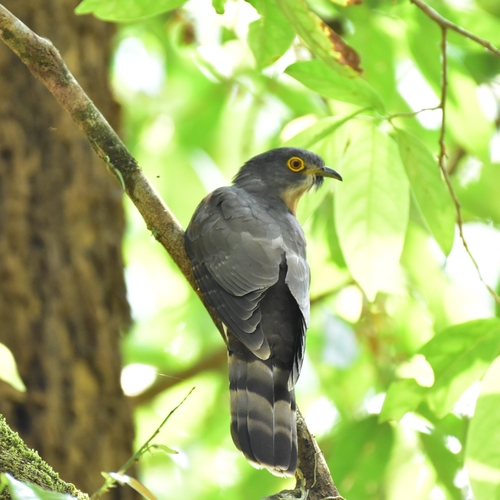 Common Hawk-Cuckoo
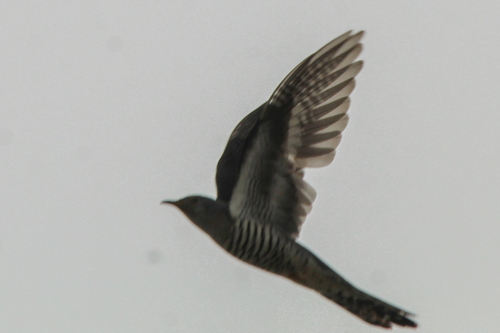 Lesser Cuckoo
In short
The most reliable way to separate Common Hawk-Cuckoo from Lesser Cuckoo is by their structure and plumage: Common Hawk-Cuckoo is distinctly larger, bulkier, and has a broad, barred tail and a striking yellow eye-ring, while Lesser Cuckoo is smaller, slimmer, and lacks the strong hawk-like jizz. Juvenile Common Hawk-Cuckoo shows bold chevron marks on the belly and a streaked breast, which Lesser Cuckoo lacks. In flight, Common Hawk-Cuckoo's flap-and-glide style and resemblance to a small accipiter are strong clues, especially when combined with alarm reactions from other birds. Voice is also a major separator: Common Hawk-Cuckoo's repeated, rising 'brainfever' call is unmistakable, while Lesser Cuckoo gives a very different, more melodious song.
Identification tips
- Size and bulk: Common Hawk-Cuckoo is much larger and bulkier than Lesser Cuckoo; if the bird looks pigeon-sized or noticeably robust, favor Hawk-Cuckoo.
- Tail pattern: Look for a broad, strongly barred tail in Common Hawk-Cuckoo (all ages); Lesser Cuckoo's tail is slimmer and less boldly marked.
- Yellow eye-ring: A prominent yellow eye-ring is a key field mark of Common Hawk-Cuckoo (adults and immatures); Lesser Cuckoo lacks this feature.
- Underpart markings (immatures): Juvenile Common Hawk-Cuckoo shows bold brown chevrons on the belly and a streaked breast, with a pale chin; Lesser Cuckoo juveniles do not show this combination.
- Breast and belly (adults): Adult Common Hawk-Cuckoo has brown cross-barring on whitish underparts; Lesser Cuckoo is plainer below.
- Flight style: Common Hawk-Cuckoo uses a flap-and-glide flight, closely resembling a small accipiter (like Shikra); Lesser Cuckoo's flight is more typical of cuckoos, less hawk-like.
- Perched behavior: After landing, Common Hawk-Cuckoo often shakes its tail from side to side; this behavior is less typical of Lesser Cuckoo.
- Alarm response: If small birds or squirrels are mobbing or giving alarm calls, suspect Common Hawk-Cuckoo, as its hawk-like jizz triggers these reactions.
- Vocalizations: The repeated, rising 'brainfever' call is diagnostic for Common Hawk-Cuckoo; Lesser Cuckoo's song is more melodious and less repetitive.
- Habitat and season: In peninsular India, Common Hawk-Cuckoo is the expected species; Lesser Cuckoo is more likely in the Himalayas or as a migrant in Sri Lanka.
- Host association: If seen near babbler flocks (Turdoides), especially during the breeding season, Common Hawk-Cuckoo is more likely.
- Sex differences: Both species are sexually monomorphic in plumage, so do not rely on sex for separation.
- Overlap caution: In areas of range overlap (e.g., Sri Lanka, Himalayas), use a combination of size, tail pattern, eye-ring, and voice for confident identification.
- Confusion risk: Both can be confused with other cuckoos or with small hawks (especially Shikra); always check for the combination of hawk-like jizz, yellow eye-ring, and underpart pattern for Common Hawk-Cuckoo.
- When in doubt: If the bird is small, plain, and lacks a yellow eye-ring or strong barring, Lesser Cuckoo is more likely, especially outside the main range of Common Hawk-Cuckoo.
Size
Common Hawk-Cuckoo is about the size of a pigeon (ca. 34 cm), making it noticeably larger and bulkier than Lesser Cuckoo, which is a smaller, more slender species. The difference in size is apparent both perched and in flight, with Common Hawk-Cuckoo showing a more robust body and longer, broader tail. Lesser Cuckoo appears more delicate and compact by comparison. Both sexes of Common Hawk-Cuckoo are similar in size, though males may be slightly larger.
Plumage
- Juvenile/immature birds: Common Hawk-Cuckoo immatures have a streaked breast and large brown chevron marks on the belly, as well as a pale chin. These marks are bold and diagnostic for young birds. Lesser Cuckoo immatures do not show this combination of bold chevrons and streaks; their underparts are generally less strongly marked.
- Adults: Common Hawk-Cuckoo adults are ashy grey above and whitish below with brown cross-barring, and a broad, strongly barred tail. The yellow eye-ring is prominent. Lesser Cuckoo adults are generally plainer, lacking the hawk-like barring and the strong yellow eye-ring. Both species have similar upperpart coloration, but the underpart barring and tail pattern are more pronounced in Common Hawk-Cuckoo.
- Flight views: Common Hawk-Cuckoo's broad, barred tail and overall hawk-like appearance are evident in flight, while Lesser Cuckoo appears slimmer and less accipiter-like.
Behaviour
Common Hawk-Cuckoo is famous for its hawk-like behavior: it uses a flap-and-glide flight style, often shakes its tail from side to side after landing, and frequently triggers alarm calls from small birds and squirrels, who mistake it for a raptor. Lesser Cuckoo does not mimic hawk behavior to the same degree and is less likely to provoke such alarm responses. Common Hawk-Cuckoo is also more likely to be seen perching conspicuously, especially during the breeding season when calling.
Habitat
Both species can occur in similar wooded and scrubby habitats, but Common Hawk-Cuckoo is a widespread resident in the Indian subcontinent, while Lesser Cuckoo is a migrant, breeding in East Asia and the Himalayas and wintering in Africa and Sri Lanka. During the breeding season, Common Hawk-Cuckoo is closely associated with the presence of babbler hosts (Turdoides spp.), while Lesser Cuckoo is less tied to a specific host or habitat type. Overlap is possible in the Himalayas and Sri Lanka, but Common Hawk-Cuckoo is more likely in central and southern India.
Voice
Common Hawk-Cuckoo's call is a loud, repeated, three-note 'brainfever' phrase, rising in pitch and ending abruptly, often delivered persistently throughout the day and even at night. This call is very distinctive and easily separates it from Lesser Cuckoo, which has a more melodious, less insistent song. Female Common Hawk-Cuckoo gives a series of grating notes, which are also unlike the Lesser Cuckoo's vocalizations.