

Common Ground Dove vs Ruddy Ground Dove
Columbina passerina versus Columbina talpacoti
Play a quiz with Common Ground Dove and Ruddy Ground Dove
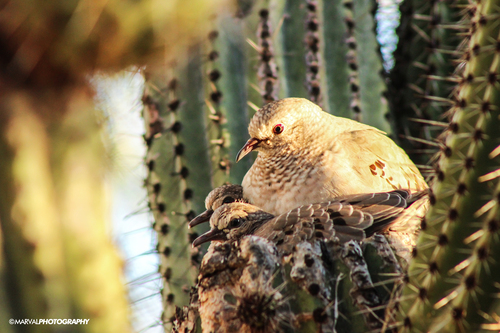 Common Ground Dove
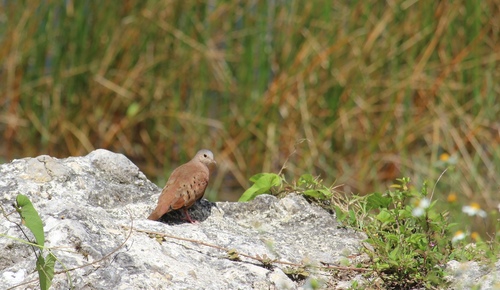 Ruddy Ground Dove
In short
The most reliable field mark to separate Common Ground Dove from Ruddy Ground Dove is size and structure: Common Ground Dove is distinctly smaller and more compact, with a noticeably shorter tail and a yellow-based bill with a black tip. In flight, Common Ground Dove shows chestnut primaries and wing borders, while Ruddy Ground Dove reveals cinnamon and black underwings. Adult male Ruddy Ground Doves have a richer rufous body and pale gray head, contrasting with the more uniformly brown and scaly Common Ground Dove. Females of both species are browner, but Common Ground Dove retains a scaled appearance on the head and breast. Both species can be found on the ground in open habitats, but Ruddy Ground Dove is bulkier and more likely to be seen in urban or agricultural settings.
Identification tips
- Size and structure: Common Ground Dove is noticeably smaller and lighter (26–40 g) than Ruddy Ground Dove (typically 46.5 g). Look for a compact, short-tailed appearance in Common Ground Dove.
- Tail shape and length: Common Ground Dove has a very short tail that is similar in color to the back; Ruddy Ground Dove's tail is longer and edged with black.
- Bill color: Common Ground Dove has a yellow-based bill with a black tip, visible at close range. Ruddy Ground Dove's bill is not distinctly bicolored.
- Head and breast scaling: Common Ground Dove shows a scaly pattern on the head and upper breast in all plumages; Ruddy Ground Dove lacks this, appearing smooth-headed.
- Male plumage: Adult male Ruddy Ground Dove is rich rufous above with a pale gray head, while male Common Ground Dove has slate-gray on the crown and pink-gray underparts, but is overall less rufous and more evenly colored.
- Female plumage: Female Common Ground Dove is gray-brown and scaly; female Ruddy Ground Dove is plain brown, lacking the scaly effect.
- Wing coverts: Both species have black spots on the wing coverts, but this is not diagnostic alone—use in combination with other marks.
- Flight pattern and wing color: In flight, Common Ground Dove flashes chestnut primaries and wing borders; Ruddy Ground Dove shows cinnamon and black underwings and a black-edged tail. These flight marks are best seen when the bird is flushed.
- Underparts: Common Ground Dove's underparts are pink-gray (male) or grayish (female); Ruddy Ground Dove's are paler brown, with less contrast between head and body in females.
- Habitat context: In urban or agricultural settings in South America, Ruddy Ground Dove is more likely. In the southern US, Common Ground Dove is the default small ground-dove.
- Behavior: Ruddy Ground Dove is more likely to be seen in groups and can be aggressive, especially males displaying by raising a wing. Common Ground Dove is more solitary or in pairs and less aggressive.
- Voice: Listen for a series of rising whoops (Common Ground Dove) versus a soft cur-WOO (Ruddy Ground Dove).
- Geographic range: Ruddy Ground Dove is only a rare winter visitor to the southwestern US; Common Ground Dove is a resident in the southern US.
- Subspecies variation: Some Common Ground Dove subspecies are paler or darker, but the core field marks above remain reliable.
- Pitfalls: Females and immatures of both species can appear similar brown with black-spotted wings, but the scaly head and short tail of Common Ground Dove are key. Always check for bill color and overall size when in doubt.
Size
Common Ground Dove is the smallest dove in the United States, with a length of 15–18 cm and a mass of 26–40 g [wikipedia]. Ruddy Ground Dove is larger and heavier, measuring 12–18 cm in length but typically weighing 46.5 g (range 35–56 g) [wikidata]. The difference in mass is significant: Ruddy Ground Dove is about 50% heavier than Common Ground Dove. In the field, Common Ground Dove appears daintier, with a shorter tail and more compact body, while Ruddy Ground Dove looks bulkier and longer-tailed.
Plumage
Juvenile and adult Common Ground Doves show a distinctive scaled appearance on the head and upper breast, with brown upperparts and black-spotted wing coverts. In flight (all ages), Common Ground Dove displays chestnut primaries and wing borders, which are diagnostic. Ruddy Ground Dove, in contrast, has black-spotted wing coverts in both sexes and ages, but adult males are rich rufous above with a pale gray head, and females are plain brown without the scaly effect. In flight, Ruddy Ground Dove shows cinnamon and black underwings and a tail edged in black. Both species have short tails, but Common Ground Dove's tail is even shorter and matches the back color, while Ruddy Ground Dove's tail is more distinctly edged black. Bill color is also useful: Common Ground Dove has a yellow base with a black tip, while Ruddy Ground Dove's bill is not described as bicolored.
Behaviour
Both species spend much of their time on the ground, feeding in open areas. Common Ground Dove is generally unobtrusive and less aggressive, while Ruddy Ground Dove is described as more aggressive, especially males, which may threaten each other by jumping and raising a wing. Ruddy Ground Dove often feeds in groups, sometimes with feral pigeons, and can be quite approachable. Common Ground Dove is more likely to be seen singly or in pairs and is less likely to be found in large urban flocks.
Habitat
Common Ground Dove prefers open, dry habitats such as scrub, fields, and woodland edges in the southern United States, Central America, the Caribbean, and northern South America. Ruddy Ground Dove is more adaptable to human-modified environments, being common in open country, cultivated land, and urban centers from Mexico south to Argentina. In the US, Ruddy Ground Dove is only a rare winter visitor to the extreme southwest, while Common Ground Dove is a resident in the southern US. If you see a small ground-dove in a city park or agricultural field in South America, Ruddy Ground Dove is more likely; in the southern US, Common Ground Dove is expected.
Voice
Common Ground Dove gives a series of soft whoops that rise in pitch and are repeated, while Ruddy Ground Dove produces a soft cooing cur-WOO. The calls are distinct, but both are soft and may be overlooked in noisy environments. If you hear a rising whoop, think Common Ground Dove; a soft cur-WOO fits Ruddy Ground Dove.