

Common Ground Dove vs Plain-breasted Ground Dove
Columbina passerina versus Columbina minuta
Play a quiz with Common Ground Dove and Plain-breasted Ground Dove
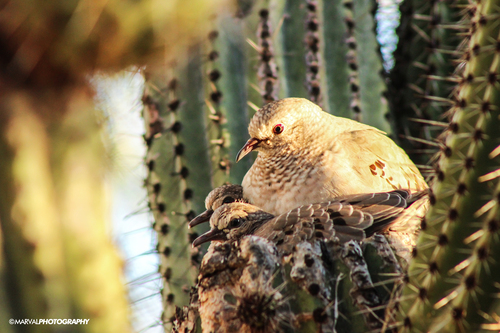 Common Ground Dove
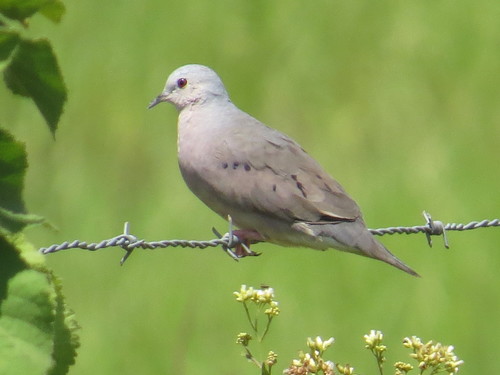 Plain-breasted Ground Dove
In short
The most reliable field mark to separate Common Ground Dove from Plain-breasted Ground Dove is the presence or absence of scaly (scaled) feathering on the head and upper breast: Common Ground Dove always shows a distinct scaled pattern, while Plain-breasted Ground Dove lacks this and appears smooth-breasted. In flight, Common Ground Dove flashes chestnut along the primaries and wing borders, visible on both perched and flying birds, whereas Plain-breasted Ground Dove shows rufous mostly on the underwing and has paler wings with dark violet spots. Both species are tiny, ground-dwelling doves, but Common Ground Dove is slightly larger and more abundant in the US and Caribbean. Careful attention to head and breast feather texture, as well as wing color in flight, is key to avoiding confusion, especially with immatures.
Identification tips
- Check for scaly feathering on head and upper breast: If you see a scaled or scaly texture, it's Common Ground Dove. If the head and breast are smooth and unmarked, it's Plain-breasted Ground Dove. This is the single most reliable mark for all ages and sexes.
- Look for chestnut in the wings during flight: Common Ground Dove flashes chestnut along the primaries and wing borders when flying or stretching. Plain-breasted Ground Dove lacks this, instead showing rufous mostly on the underwing and paler upperwings with dark violet spots. This is best seen in good light or when the bird is startled into flight.
- Bill color: Common Ground Dove has a yellow bill with a black tip; Plain-breasted Ground Dove has a plain grey bill. This is subtle but can help at close range.
- Facial color and eye: Common Ground Dove has pink feathers around the bill; Plain-breasted Ground Dove has reddish eyes and pink legs, which may be visible at close range.
- Tail length: Common Ground Dove has a very short tail matching the back; Plain-breasted Ground Dove's tail is not described as distinctive, so tail length is only a weak clue.
- Sex differences: Male Common Ground Doves have a slate-gray crown and pink-gray belly; females are grayer and more evenly colored. Plain-breasted Ground Dove shows only subtle sex differences, so don't rely on this unless very familiar with both.
- Overall color and pattern: Common Ground Dove is brown above with black spotting on the wings; Plain-breasted Ground Dove is dark grey to brown with paler wings and dark violet spots, but never has the scaly head and breast.
- Flight jizz: Both are small and fast, but if you see chestnut in the wings, it's Common Ground Dove. If the wings look paler with rufous underneath, consider Plain-breasted Ground Dove.
- Voice: If you hear soft, rising whoops, it's Common Ground Dove. Lack of vocalization is not diagnostic for Plain-breasted Ground Dove.
- Habitat and abundance: In the US and Caribbean, Common Ground Dove is more likely and more abundant. Plain-breasted Ground Dove is rare or absent in these areas.
- Size: Both are tiny, but Common Ground Dove is slightly larger and more robust; Plain-breasted Ground Dove is marginally smaller and lighter, but this is rarely useful in the field.
- Avoid confusion with other Columbina: Both can be confused with Ruddy Ground Dove (C. talpacoti), but that species is duller and lacks the reddish or chestnut tones.
- Juvenile confusion: Even young Common Ground Doves show some scaling on the head and breast, so this mark is reliable across all ages.
- Lighting and distance: At a distance or in poor light, both may appear plain and brownish; always try to get a good look at the head and upper breast texture.
- Subspecies variation: Some Common Ground Dove subspecies are paler or darker, but all retain the scaled head and breast. Plain-breasted Ground Dove remains smooth-breasted throughout its range.
Size
Common Ground Dove is slightly larger, measuring 15–18 cm in length and weighing 26–40 g, while Plain-breasted Ground Dove is 14.5–16 cm long and weighs 24–42 g. The difference is subtle and not always reliable in the field, but Common Ground Dove is generally the smallest dove in the US, with Plain-breasted Ground Dove only marginally smaller or similar in mass. Both are noticeably small and compact compared to other doves.
Plumage
- Juvenile/Immature/Non-breeding: The most diagnostic difference is the feather texture on the head and upper breast. Common Ground Dove (all ages and sexes) shows a clear scaled appearance here, with each feather edged paler, creating a scaly effect. Plain-breasted Ground Dove never shows this scaling and always appears smooth-breasted and plain-headed, even in young birds.
- Adult flight pattern: In flight, Common Ground Dove reveals chestnut primaries and wing borders, a feature not present in Plain-breasted Ground Dove. Instead, Plain-breasted Ground Dove shows mostly rufous underwings and paler upperwings with dark violet spots. The tail of Common Ground Dove is very short and matches the back in color, while tail color is not highlighted as distinctive in Plain-breasted Ground Dove.
- Sexual dimorphism: Both species show subtle differences between sexes, but Common Ground Dove males have a slate-gray crown and pink-gray belly, while females are grayer and more evenly toned. Plain-breasted Ground Dove's sexes are similar, with only subtle differences.
- Bill and facial color: Common Ground Dove has a yellow bill with a black tip and pink feathers around the bill, while Plain-breasted Ground Dove has a grey bill, pink legs, and reddish eyes.
Behaviour
Both species are ground-dwelling and spend most of their time foraging on the ground, but Common Ground Dove is noted for being particularly terrestrial. Both can fly well when flushed, but their flight style is not described as diagnostic between the two. Both are typically seen singly or in small groups.
Habitat
Common Ground Dove is widespread in the southern United States, Central America, the Caribbean, and northern South America, and is the smallest dove in the US. Plain-breasted Ground Dove overlaps in some parts of Central and South America but is less abundant in the US and Caribbean. Both species prefer open, grassy, or scrubby areas, but Common Ground Dove is more likely in disturbed or semi-urban habitats in the US.
Voice
Common Ground Dove gives a series of soft, rising-pitch whoops, often repeated and distinctive. No vocalization is described for Plain-breasted Ground Dove in the provided notes, so voice is only useful for confirming Common Ground Dove if heard.
Common Ground Dove · Plain-breasted Ground Dove · My Tricky Birds