

Common Bulbul vs White-browed Sparrow-Weaver
Pycnonotus barbatus versus Plocepasser mahali
Play a quiz with Common Bulbul and White-browed Sparrow-Weaver
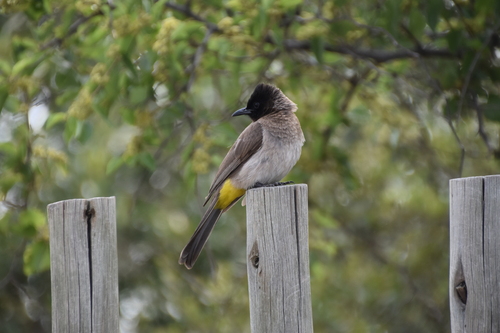 Common Bulbul
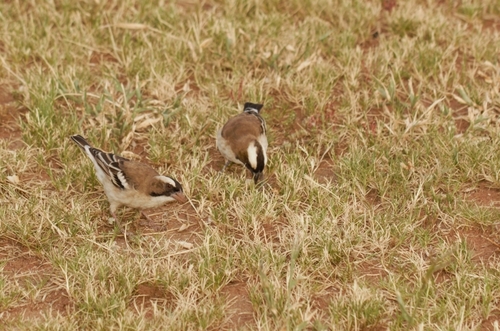 White-browed Sparrow-Weaver
In short
The most reliable field mark to separate Common Bulbul from White-browed Sparrow-Weaver is the presence of a bold white eyebrow and white rump in the sparrow-weaver, features entirely lacking in the bulbul. In flight, the sparrow-weaver’s white rump flashes distinctly, while the bulbul’s tail and rump remain uniformly dark. Bill color is also key: Common Bulbul always has a black, slender, slightly downcurved bill, while the sparrow-weaver’s bill varies by sex and age (black in males, horn or pinkish in females and juveniles). Both are brownish birds, but the bulbul is sleeker and darker-headed, while the sparrow-weaver is chunkier with a more obvious face pattern. If you see a group of birds, sparrow-weaver is much more likely, as bulbuls are usually solitary or in pairs.
Identification tips
- White eyebrow (supercilium): Only White-browed Sparrow-Weaver has a bold, broad white eyebrow; Common Bulbul’s face is plain and dark. This is the single most useful mark at any distance.
- White rump in flight: Sparrow-weaver shows a conspicuous white rump patch when flying; bulbul’s rump and tail are uniformly dark brown.
- Bill color and shape: Bulbul always has a short, thin, slightly downcurved black bill. Sparrow-weaver’s bill is heavier and conical: black in adult males, horn-colored in females, and pinkish-brown in juveniles. Bill color is especially useful for separating females and juveniles.
- Face pattern: Bulbul’s face is plain, with a dark eye and no obvious eye-ring or eyebrow. Sparrow-weaver’s face is strikingly patterned with a white eyebrow and often a pale throat.
- Underparts: Bulbul’s underparts are dull grey, sometimes with yellow undertail coverts (in some subspecies). Sparrow-weaver’s underparts are white, sometimes with faint brown spotting (notably in Zimbabwe).
- Tail and rump: Bulbul has a long, uniformly dark tail; sparrow-weaver’s tail is shorter, and the white rump is a key field mark in flight.
- Group size: Sparrow-weaver is almost always seen in groups; bulbul is usually solitary or in pairs.
- Overall build: Bulbul is slender and thrush-like, with a longer tail. Sparrow-weaver is chunkier, with a heavier bill and more sparrow-like proportions.
- Leg and foot color: Not diagnostic between these two, as both have dark legs and feet (unlike yellow-throated petronia, which is not in this comparison).
- Juvenile marks: Juvenile sparrow-weavers have a pinkish-brown bill, while juvenile bulbuls look like adults. This can help if you see a group with mixed bill colors.
- Vocalization: If you hear the repeated 'doctor-quick' call, it is a bulbul. Sparrow-weaver’s calls are not described as similar.
- Habitat clues: Both can occur in open country, but sparrow-weaver is more likely in drier, savanna habitats and is less likely in gardens or very wet areas.
- Behavior: Sparrow-weavers often perch upright and conspicuously, sometimes on wires, while bulbuls are more furtive and less likely to be seen in the open for long.
- Subspecies variation: Some bulbuls have yellow undertail coverts, but this is never as bold or as extensive as the sparrow-weaver’s white rump.
- Sex and age pitfalls: Remember that sparrow-weaver bill color varies with sex and age; do not rely on bill color alone unless you can see the eyebrow and rump as well.
Size
White-browed Sparrow-Weaver is noticeably heavier (49.0g vs 35.05g) and slightly shorter in length (17–19 cm vs 18–20 cm), but its bulkier build and heavier bill make it look larger and more robust in the field. The bulbul is slimmer, with a longer tail and more delicate proportions. In direct comparison, the sparrow-weaver appears chunkier and more sparrow-like, while the bulbul is more slender and thrush-like.
Plumage
- Juvenile/immature plumage: No distinctive juvenile upperwing or flight marks are described for either species, but juvenile sparrow-weavers have a pinkish-brown bill, while young bulbuls look like adults.
- Adult plumage: Common Bulbul is overall brown with a dark brown head, brown upperparts, dull grey underparts, and (in some subspecies) yellow undertail coverts. The face is plain, with a dark eye and no obvious eye-ring or eyebrow. White-browed Sparrow-Weaver is brown above, but with a conspicuous broad white eyebrow and a white rump (especially visible in flight). The underparts are white, sometimes with faint brown spotting (notably in Zimbabwe). Bill color is black in adult males, horn-colored in females, and pinkish-brown in juveniles. The sparrow-weaver’s face pattern and rump contrast sharply with the bulbul’s plain, dark face and uniform tail/rump.
Behaviour
White-browed Sparrow-Weaver is highly social, typically seen in groups of 2–11 birds, often foraging together or moving as a unit. Common Bulbul is usually solitary or in pairs, rarely forming large groups. The sparrow-weaver often perches upright on exposed branches or wires, while the bulbul is more likely to be seen flitting through foliage or perching less conspicuously. In flight, sparrow-weavers show a flash of white from the rump, while bulbuls have a steady, undramatic flight with no white in the rump or wings.
Habitat
Both species can be found in open or semi-open habitats, but Common Bulbul is much more widespread and adaptable, occurring in gardens, woodland edges, and a wide range of habitats across Africa (and recently southern Spain). White-browed Sparrow-Weaver is more restricted to central and north-central southern Africa, favoring drier savanna and open woodland. If you are in a very arid area, bulbul is less likely. The sparrow-weaver’s tendency to form groups and nest communally is also a clue to its identity.
Voice
Common Bulbul gives a loud, distinctive 'doctor-quick doctor-quick be-quick be-quick' call. No specific vocal description is given for White-browed Sparrow-Weaver here, but its calls are not mentioned as similar to the bulbul’s. If you hear the bulbul’s characteristic call, it is diagnostic.
Common Bulbul · White-browed Sparrow-Weaver · My Tricky Birds