
Cinnamon Bittern vs Schrenck's Bittern
Botaurus cinnamomeus versus Botaurus eurhythmus
Play a quiz with Cinnamon Bittern and Schrenck's Bittern
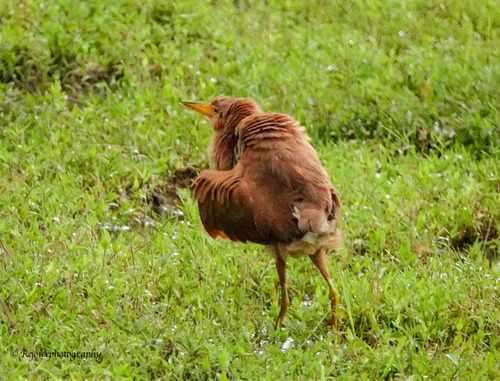 Cinnamon Bittern
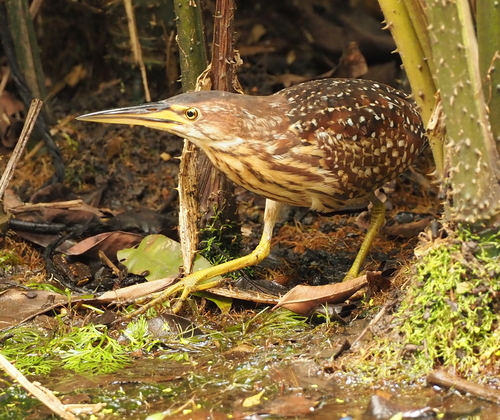 Schrenck's Bittern
In short
The most reliable field mark between Cinnamon Bittern and Schrenck's Bittern is the presence of black flight feathers and tail visible in flight on Schrenck's Bittern of all ages, which Cinnamon Bittern lacks. For perched birds, adult males of both species are similar above, but females and especially juveniles differ: Cinnamon Bittern juveniles are heavily streaked below, while Schrenck's are streaked but also show white speckles above. Cinnamon Bittern is slightly larger and longer-necked. Both species can freeze in classic bittern posture, making separation tricky unless you see the wings or underparts clearly.
Identification tips
- Black flight feathers and tail (Schrenck's only): In any age or sex, Schrenck's Bittern shows black flight feathers and tail in flight, a clear separation from Cinnamon Bittern, which has uniformly cinnamon or brownish wings.
- Juvenile underparts: Cinnamon Bittern juveniles are heavily streaked brown below but lack white speckling above. Schrenck's juveniles are chestnut with white speckles above and white streaks below.
- Female upperparts: Female Cinnamon Bittern has a brown (not chestnut) back and crown, while Schrenck's female is chestnut all over with white speckles above.
- Male upperparts: Both adult males are rich chestnut/cinnamon above and buff below, but Schrenck's has chestnut on the wing coverts and black in the wings (visible in flight), while Cinnamon Bittern is more uniformly cinnamon above.
- Perched birds: In the classic bittern pose, check for the color and pattern of the back, crown, and underparts. Speckling above (Schrenck's) vs. plain brown (Cinnamon) helps, especially in females and juveniles.
- Bill and legs: Both have longish bills, but Schrenck's is described as yellow, which may help in good light. Leg color is not a strong separator in these notes.
- Size: Cinnamon Bittern is slightly larger and bulkier, but this is subtle and unreliable unless both are seen together.
- Range and season: Cinnamon Bittern is resident in much of tropical Asia; Schrenck's is migratory, breeding further north and wintering south. In Southeast Asia during migration/winter, both can occur together.
- Habitat: Both use reedbeds and marshes; habitat is not a reliable separator where ranges overlap.
- Behavior: Both freeze in the classic bittern posture when alarmed; behavior is not a separator.
- Sex differences: Female and juvenile plumages are more distinct between the two species than adult males. Focus on upperpart color (brown vs. chestnut), speckling, and underpart streaking.
- Flight views: Always try to see the upperwing and tail in flight; black in these areas is diagnostic for Schrenck's.
- On-guard posture: Both species assume the upright, neck-stretched pose, so do not rely on this for ID.
- Plumage pitfalls: Adult males are the most similar; rely on flight marks or subtle differences in chestnut tone and wing covert color if possible.
- Voice: No diagnostic vocal differences are noted in the sources.
Size
Cinnamon Bittern is slightly larger (38–41 cm length, 49.5 cm wingspan, 89.5–164 g) than Schrenck's Bittern (33–39 cm length). Both have short necks and longish bills, but Cinnamon Bittern averages a bit bulkier and longer. In the field, this difference is subtle and may not be reliable unless both species are seen side by side.
Plumage
- In flight (all ages): Schrenck's Bittern always shows black flight feathers and tail, a strong contrast with the chestnut or cinnamon upperparts. Cinnamon Bittern lacks this black; its wings are uniformly cinnamon or brownish above.
- Adult males: Both are rich chestnut/cinnamon above and buff below, but Schrenck's has chestnut on the wing coverts as well, and the black in the wings is diagnostic in flight.
- Females: Cinnamon Bittern females have brown backs and crowns, buff below; Schrenck's females are chestnut all over with white speckles above and white streaks below.
- Juveniles: Cinnamon Bittern juveniles are like females but heavily streaked brown below (no speckling above). Schrenck's juveniles are chestnut with white speckles above and white streaks below, and also show black in the wings and tail in flight.
- Perched: Both species can appear similar in the classic bittern pose, but look for the speckling and streaking patterns, and if possible, the color of the back and crown.
Behaviour
Both species freeze with necks stretched and bills pointed skyward when alarmed, blending into reeds. There is no strong behavioral difference noted in the sources, though Cinnamon Bittern is described as more resident, while Schrenck's Bittern is migratory. In the field, their behavior when flushed or disturbed is similar.
Habitat
Both species occupy reedbeds and marshy wetlands, but their ranges overlap mainly in East and Southeast Asia. Cinnamon Bittern is more widespread in tropical and subtropical Asia (India to Indonesia), usually resident. Schrenck's Bittern breeds further north (Siberia, China, Korea, Japan) and winters further south (Malay Peninsula, Greater Sundas, Sulawesi, Philippines). In migration or winter, both may occur together in Southeast Asia, so habitat alone is not diagnostic.