

Cinereous-breasted Spinetail vs Spix's Spinetail
Synallaxis hypospodia versus Synallaxis spixi
Play a quiz with Cinereous-breasted Spinetail and Spix's Spinetail
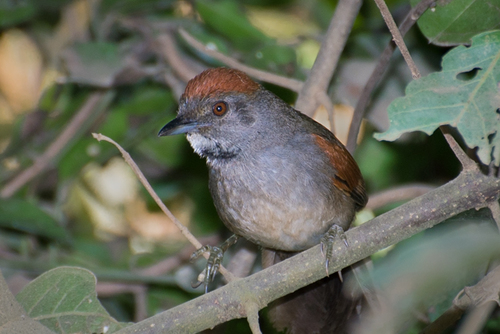 Cinereous-breasted Spinetail
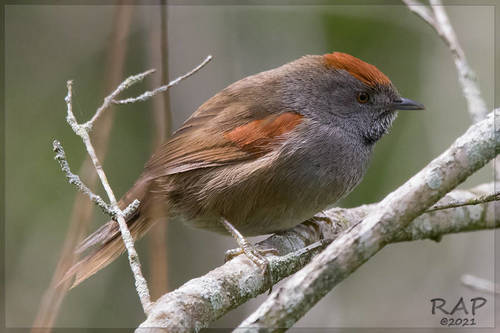 Spix's Spinetail
In short
The most reliable way to separate Cinereous-breasted Spinetail from Spix's Spinetail is by carefully studying the head pattern and throat: Cinereous-breasted shows a faint gray supercilium and a mostly whitish throat with a less bold blackish patch, while Spix's has a paler, more distinct supercilium and a grayish white throat with a sharper black patch. Juveniles of both species are similar, but Cinereous-breasted juveniles are more ochraceous below and have a less distinct throat patch. Tail shape and color, as well as subtle differences in wing coverts and underparts, can also help, but are best used in combination. Both species are small, brownish spinetails with rufous in the wings and tail, so careful, close observation is needed, especially in overlapping ranges.
Identification tips
- Supercilium (Eyebrow): Spix's Spinetail has a paler, more distinct gray supercilium, while Cinereous-breasted's is faint and less obvious. This is visible in both adults and juveniles.
- Crown Color: Spix's has a rufous crown, contrasting with a grayish brown face; Cinereous-breasted's crown and nape are chestnut-rufous but the forecrown is darker gray-brown, giving a less clean contrast.
- Throat Pattern: Cinereous-breasted shows a mostly whitish chin and throat with blackish lower throat feathers edged whitish, often appearing less sharply marked than Spix's, which has a grayish white throat with a distinct black patch bordered by grayish edges. This is a key mark in good light.
- Juvenile Underparts: Juvenile Cinereous-breasted is more ochraceous clay-brown below, while Spix's juvenile is ochraceous brown but may appear slightly grayer. Both have less distinct throat patches than adults, but Cinereous-breasted's is especially faint.
- Tail Shape: Spix's Spinetail has pointed central tail feathers, while Cinereous-breasted's tail feathers are rounded at the tips. This is subtle but can be seen on perched birds with fanned tails.
- Tail Color: Both have dark brown, graduated tails, but Cinereous-breasted's tail is a darker brown than its back, while Spix's tail is similarly dark but not as distinctly darker than the back.
- Wing Coverts: Both species show rufous in the wing coverts, but Cinereous-breasted's are chestnut-rufous, while Spix's has rufous lesser coverts and dark brown median/greater coverts with broad rufous edges. This is a minor difference and hard to use in the field.
- Breast and Belly: Cinereous-breasted has a brownish gray, ash-colored breast and a whitish belly; Spix's breast is also brownish gray but the belly is a paler brownish gray, not as white. Flanks are browner in Spix's.
- Face Color: Cinereous-breasted's face is gray-brown, while Spix's is grayish brown, but this is subtle and best used with other marks.
- Bill and Legs: Both have dark maxilla and paler mandible, with leg color ranging from olive to grayish olive or brownish yellow (Cinereous-breasted) and gray to greenish gray (Spix's). Not reliably separable by these features.
- Habitat Preference: In overlapping regions, Cinereous-breasted is more likely in open, wet, or grassy areas near water; Spix's is more likely in dense, shrubby second growth or forest edge.
- Vocalizations: If heard, the rapid, chattering call of Cinereous-breasted is quite different from the bubbling, musical song of Spix's. Use voice as a primary clue when possible.
- Geographic Range: If outside the overlap zone (e.g., Peru or Argentina), range can help, but in Brazil and Paraguay both may occur, so do not rely solely on location.
- Behavior: Both species are secretive and forage low in pairs, so behavior is not a strong separator.
- Size: Spix's is slightly longer but lighter; this is not a practical field mark.
Size
Spix's Spinetail is slightly longer (16–17 cm) but lighter (about 13 g) than Cinereous-breasted Spinetail (15–16 cm, 15–18 g). In the field, this difference is subtle and not a reliable identification feature, as both appear similarly small and slender. Bill and leg coloration are also similar and not diagnostic.
Plumage
- Juveniles: Both species' juveniles have a grayish brown crown and ochraceous to clay-brown underparts, but Cinereous-breasted juveniles are described as having a more ochraceous clay-brown below and an even less distinct throat patch than Spix's. This makes juvenile Cinereous-breasted look warmer and duller below, while Spix's is ochraceous brown but may appear a touch grayer.
- Adults: Cinereous-breasted has a faint gray supercilium, a dark gray-brown forecrown, chestnut-rufous crown/nape, and a mostly whitish chin and throat with blackish lower throat feathers edged whitish. Its breast is brownish gray (ash-colored), belly whitish, and flanks brownish. Spix's has a paler, more obvious gray supercilium, a rufous crown, and a grayish white throat with a sharper black patch bordered by grayish edges. Its breast is brownish gray, belly paler brownish gray, and flanks/undertail coverts browner. Both have rufous in the wing coverts and a dark brown, graduated tail, but Spix's central tail feathers are pointed, while Cinereous-breasted's are rounded.
Behaviour
Both species are typically seen in pairs, foraging low in dense vegetation or shrubby areas. They tend to stay 1–2 meters above the ground, gleaning arthropods from foliage and branches. Neither is known for conspicuous behavior, and both can be quite skulking, making visual identification challenging. There is no evidence of significant behavioral differences useful for field separation.
Habitat
Cinereous-breasted Spinetail favors open, seasonally wet grasslands, scrub, campina, and savannah, especially near water, and is found in Bolivia, Brazil, Paraguay, and Peru. Spix's Spinetail is more closely tied to the Atlantic Forest biome, occupying a variety of dense, shrubby habitats including fields, pastures, gallery forest, savanna, and brushy second growth, and ranges from southeast Brazil through Paraguay, Uruguay, and into Argentina. Where their ranges overlap (notably in Brazil and Paraguay), habitat can provide a clue: Cinereous-breasted is more likely in open, wet or semi-open areas, while Spix's prefers dense, low woody vegetation, especially in second growth or forest edge.
Voice
Cinereous-breasted Spinetail gives a hurried, loud chatter on a single pitch, sometimes accelerating at the end, or a sharp 'tut-Drrrrrrruh' with a staccato, slightly descending finish. Spix's Spinetail sings a five-syllable phrase with a bubbling quality ('sweet! bee bee bee bee') or a repeated 'wee'tiddledidee', and also gives a 4–5 noted 'wuh-wididit'. The vocalizations are quite different in rhythm and tone, so a clear recording or attentive listening can be diagnostic.
Cinereous-breasted Spinetail · Spix's Spinetail · My Tricky Birds