

Chukar vs Black-bellied Sandgrouse
Alectoris chukar versus Pterocles orientalis
Play a quiz with Chukar and Black-bellied Sandgrouse
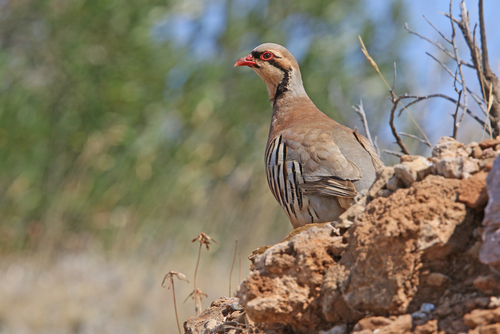 Chukar
 Black-bellied Sandgrouse
In short
The most reliable field mark to separate Chukar from Black-bellied Sandgrouse is the Chukar’s bold black-and-white face pattern and black necklace, versus the sandgrouse’s small pigeon-like head and plain grey or brown face. In flight, Black-bellied Sandgrouse show striking white underwings and a black belly, while Chukar have rounded wings and lack these contrasting flight marks. Chukar is a heavier, rounder partridge with rufous-barred flanks and a coral-red bill; sandgrouse are more streamlined, with long pointed wings and a fast, direct flight. Both species occur in dry, open country, but Chukar prefers rocky uplands and hillsides, while sandgrouse are found on open plains. Voice and flocking behavior also differ markedly.
Identification tips
- Face pattern is key: Chukar has a bold white face with a sharply defined black necklace (gorget) running from the forehead through the eye and enclosing the throat. Black-bellied Sandgrouse has a plain, small, pigeon-like head with no bold facial markings.
- Flight marks: In flight, Black-bellied Sandgrouse shows striking white underwings and a solid black belly, visible in all ages and sexes. Chukar lacks these features, showing uniform underparts and rounded wings.
- Body shape: Chukar is round-bodied and heavy, with a thick coral-red bill and red legs. Sandgrouse is more streamlined, with a smaller bill, long pointed wings, and a compact, pigeon-like body.
- Upperparts: Chukar’s back is light brown, sometimes with a yellowish tinge to the foreneck, and the flanks are boldly barred with black and white. Sandgrouse upperparts are golden-brown with dark markings, and males have a chestnut throat patch.
- Sex differences: Chukar sexes are similar, with females slightly smaller and lacking a spur. In sandgrouse, females are browner and more finely marked above, but both sexes share the black belly and white underwing.
- Leg color: Chukar has red legs; sandgrouse legs are less conspicuous and not described as red.
- Bill color: Chukar’s bill is coral red; sandgrouse has a smaller, less colorful bill.
- Tail: Chukar’s tail is short and rounded with 14 feathers; sandgrouse has a longer, more pointed tail suited to fast flight.
- Flight style: Chukar flies short distances, often downhill, with rounded wings and a rapid, whirring flight. Sandgrouse fly in flocks, fast and direct, often over long distances to water.
- Habitat context: Chukar is more likely in rocky uplands and hillsides; sandgrouse is found on open plains and avoids steep, rocky terrain.
- Flocking: Sandgrouse are highly gregarious, often seen in flocks, especially at dawn near water. Chukar forms coveys outside breeding season but is less likely to be seen in large, tight flocks in flight.
- Voice: Chukar’s loud, repeated 'chukar-chukar' is very different from the sandgrouse’s soft, rolling 'chowrrr'.
- Behavior when flushed: Chukar prefers to run and only flies when pressed, while sandgrouse take off readily and fly long distances.
- Pitfalls: At a distance, both can appear as chunky, brownish birds in open country. Always check for the Chukar’s face pattern and the sandgrouse’s white underwing/black belly in flight.
- When marks fail: In poor light or at extreme range, rely on flight style (short, whirring and downhill for Chukar; long, fast, direct for sandgrouse) and flocking behavior (solitary or small groups for Chukar, larger flocks for sandgrouse).
Size
Chukar is the heavier and bulkier of the two, averaging about 607.5 g [wikidata], compared to the Black-bellied Sandgrouse’s 405.5 g. Both are similar in length (Chukar: 32–35 cm; Sandgrouse: 33–39 cm [wikipedia]), but Chukar appears more rotund and partridge-like, while sandgrouse are more compact and streamlined, with longer, pointed wings and a smaller head relative to body size. Chukar’s bill is thicker and coral-red, while sandgrouse have a smaller, pigeon-like bill.
Plumage
No age-specific upperwing patterns are described for either species, but in flight, Black-bellied Sandgrouse of all ages show diagnostic white underwings and a sharply defined black belly—these are visible even at a distance and are not matched by Chukar. Chukar, in contrast, shows a uniform light brown back, grey breast, buff belly, and rufous-barred flanks, with a sharply defined black necklace enclosing a white throat and face. The sandgrouse male has a grey head, neck, and breast, golden-brown upperparts with dark markings, and a chestnut throat patch; the female is browner and more finely marked above. Both sexes of sandgrouse have the same black belly and white underwing. Chukar sexes are similar, with females slightly smaller and lacking a spur. The face pattern is the most reliable perched mark: Chukar’s white face and black gorget versus sandgrouse’s plain, small head. Sandgrouse have long, pointed wings and a fast, direct flight, while Chukar’s wings are rounded and flight is short and often downhill.
Behaviour
Chukar tends to run rather than fly when disturbed, flying only short distances (often downhill) on rounded wings and calling after landing. They are often found in small coveys outside the breeding season, and pairs in summer. Sandgrouse are highly gregarious, forming flocks that fly fast and directly to watering holes at dawn. Their flight is longer, more sustained, and direct compared to Chukar’s short, rapid bursts. Chukar is more terrestrial and prefers rocky slopes, while sandgrouse spend more time in open air and on flat ground.
Habitat
Both species favor dry, open habitats, but Chukar is typically found in rocky uplands, hillsides, and valleys, often descending to fields in winter. Black-bellied Sandgrouse breeds on dry open plains, avoiding areas completely lacking vegetation, and is more associated with flat, open country. Sandgrouse are less likely to be found in rocky or steep terrain preferred by Chukar.
Voice
Chukar’s call is a loud, repeated 'chuck-chuck-chukar-chukar', often given in series and especially at dawn and dusk. Sandgrouse have a much softer, rolling 'chowrrr rrrr-rrrr' call. Chukar’s voice is more raucous and carries further, while sandgrouse calls are more subdued and less likely to be heard at a distance.