

Chotoy Spinetail vs Spix's Spinetail
Schoeniophylax phryganophilus versus Synallaxis spixi
Play a quiz with Chotoy Spinetail and Spix's Spinetail
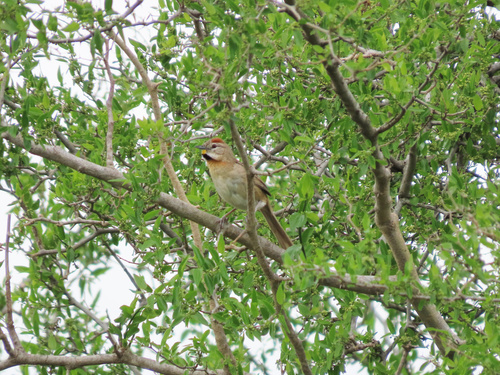 Chotoy Spinetail
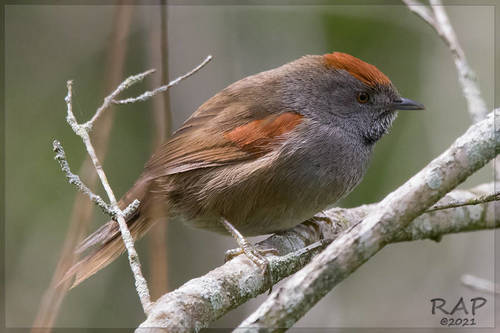 Spix's Spinetail
In short
The most reliable way to separate Chotoy Spinetail from Spix's Spinetail is by focusing on throat and face pattern: Chotoy shows a bright yellow chin and upper throat with a crisp black square lower throat patch, while Spix's has a grayish white throat with a less distinct, more diffuse blackish patch. Chotoy is also noticeably larger and longer-tailed, with a paler, streaked back and a bold white supercilium. Juveniles of both species have duller, less distinct throat patches, but Chotoy juveniles still show a paler chin and less sharp streaking above. Structure and tail shape, as well as habitat preferences, can help when plumage is obscured.
Identification tips
- Throat and Chin Color (All Ages): Chotoy Spinetail always shows a bright yellow chin and upper throat, with a crisp black square patch on the lower throat, surrounded by white. Spix's Spinetail has a grayish white throat with a less distinct, diffuse blackish patch—never yellow. This is the single best field mark at any age.
- Supercilium and Face: Chotoy has a bold white supercilium and light brown ear coverts, while Spix's has a pale gray supercilium on a grayish brown face. Chotoy's face looks more contrasting and open.
- Crown and Back: Chotoy's crown is chestnut with faint brown streaks, and its back is sandy brown with obvious dark brown streaks. Spix's has a rufous crown (unstreaked) and a dark brown back, lacking the bold streaking of Chotoy.
- Tail Structure: Chotoy's tail is long, light brown, and fairly uniform with blackish shafts. Spix's tail is shorter, dark brown, graduated (steps down), and the central feathers are pointed. In flight or perched, Chotoy looks longer-tailed and more elongated.
- Underparts: Chotoy shows an apricot upper breast, buffy white lower breast, and whitish belly, with brownish buff flanks. Spix's is brownish gray throughout, with paler brownish gray belly and browner flanks—never apricot or buffy white.
- Juvenile Differences: Juvenile Chotoy has a brown crown, whitish chin, and a faint black throat patch, with less sharp streaking above. Juvenile Spix's has a grayish brown crown, ochraceous brown underparts, and a less distinct throat patch, but the throat remains grayish, not yellowish.
- Wing and Shoulder Color: Chotoy's wings are mostly light brown with a chestnut shoulder, while Spix's lesser wing coverts are rufous and the rest of the wing is dark brown with wide rufous edges. In poor light, Spix's wing may look darker and more contrasting.
- Bill and Legs: Both have similar bill and leg color, so these are not useful for separation in the field.
- Size and Structure: Chotoy is noticeably larger (20–22 cm vs 16–17 cm) and heavier (15–22.5 g vs 13 g). It appears lankier and longer-tailed, while Spix's is compact and short-tailed. Use this only when you have a good sense of scale.
- Habitat Preference: In open or semi-open scrub, gallery forest edge, or marsh edge, suspect Chotoy. In dense, shrubby second growth or Atlantic Forest undergrowth, Spix's is more likely. However, both can overlap in some edge habitats.
- Behavior: Chotoy is more likely to perch up and be conspicuous, while Spix's is more secretive, staying low in thick cover.
- Vocalizations: Chotoy's song is a series of low-pitched "cho" notes, deeper and more resonant than Spix's. Spix's song is higher-pitched, musical, and bubbling. If you hear a deep, churring song, think Chotoy; if it's a sweet, bubbling series, think Spix's.
- Iris Color: Both can show reddish to brown irises, so this is not a reliable field mark.
- Season and Range: Both species are present year-round in much of their range, but Chotoy is more widespread in open country, while Spix's is more tied to the Atlantic Forest and higher elevations.
- Pitfalls: In poor light or with brief views, the throat color and tail shape are most reliable. Juveniles of both can look duller, but Chotoy juveniles still show a paler chin and less sharp streaking above than Spix's.
Size
Chotoy Spinetail is significantly larger, measuring 20–22 cm in length and weighing 15–22.5 g, while Spix's Spinetail is smaller at 16–17 cm and about 13 g. In the field, Chotoy appears lankier and longer-tailed, often looking more elongated than the compact Spix's. If seen side by side, the size difference is obvious, but beware that lone birds can be misleading without a direct comparison.
Plumage
- Juveniles: Chotoy juveniles have a brown crown, a whitish chin, and a poorly defined black throat patch, with less sharp streaking above. Spix's juveniles show a grayish brown crown, ochraceous brown underparts, and a less distinct throat patch, but their throat remains grayish rather than yellowish.
- Adults: Chotoy adults are distinctive with a white supercilium, light brown ear coverts, a chestnut crown with faint streaks, sandy brown back with bold dark streaks, and a long, light brown tail. The throat is diagnostic: bright yellow chin/upper throat, a crisp black square lower throat patch surrounded by white, and an apricot upper breast. Spix's adults have a pale gray supercilium, rufous crown, dark brown back and tail, and a grayish white throat with blackish lower throat feathers edged gray. Their underparts are brownish gray, lacking the apricot or buffy tones of Chotoy. Spix's tail is dark brown, graduated, and the central feathers are pointed, unlike the long, pale, and more uniform tail of Chotoy.
Behaviour
Both species forage in pairs and are active in shrubby or edge habitats. Chotoy Spinetail is often more conspicuous, moving through open or semi-open areas and perching higher, while Spix's Spinetail tends to stay low in dense undergrowth and is more skulking. Chotoy may be easier to spot in flight or perched up, whereas Spix's is more likely to be glimpsed briefly as it moves through thick cover.
Habitat
Chotoy Spinetail prefers open to semi-open landscapes such as treed savanna, gallery forest edges, thickets along watercourses, monte woodlands, and marsh edges, usually below 500 m elevation. Spix's Spinetail is more closely tied to the Atlantic Forest biome, favoring dense, shrubby second growth, restinga, campo rupestres, and brushy habitats, and ranges up to 2,200 m. In overlapping areas, Chotoy is more likely in open scrub or edge, Spix's in dense, low vegetation.
Voice
Chotoy Spinetail's song is a distinctive series of low-pitched "cho" notes, sounding surprisingly deep for its size, and can include a complex, chattering series. Spix's Spinetail gives a five-syllable phrase with a bubbling quality ("sweet! bee bee bee bee"), and a repeated "wee'tiddledidee". Chotoy's song is lower and more resonant, while Spix's is higher-pitched and more musical. Calls are not described in detail for Spix's, but Chotoy's call is hurried and distinctive.