

Chestnut-bellied Sandgrouse vs Spotted Sandgrouse
Pterocles exustus versus Pterocles senegallus
Play a quiz with Chestnut-bellied Sandgrouse and Spotted Sandgrouse
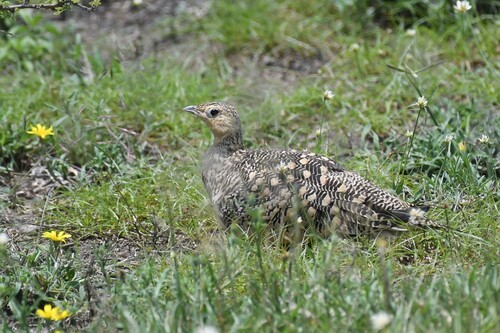 Chestnut-bellied Sandgrouse
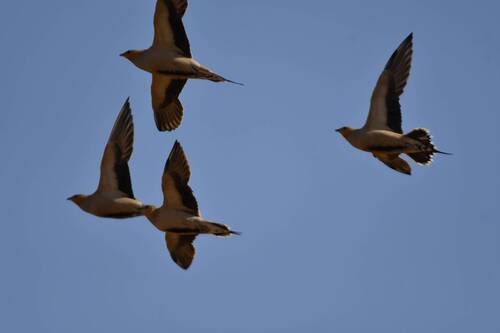 Spotted Sandgrouse
In short
The most reliable field mark to separate Chestnut-bellied Sandgrouse from Spotted Sandgrouse is the underpart and belly pattern in flight: Chestnut-bellied shows a rich chestnut or chocolate belly with a sharply defined black center (especially in males), while Spotted Sandgrouse has a paler belly with a distinct dark stripe and extensive spotting on the body. In perched birds, look for the chestnut or chocolate lower breast and belly of Chestnut-bellied versus the overall spotted, greyish-brown plumage of Spotted. Both species have elongated central tail feathers, but Spotted's are less pronounced. Females of both can be confusing, but Spotted always shows more extensive fine spotting and a duller, greyer tone overall. In flight, Spotted Sandgrouse shows pale primaries with dark trailing edges, while Chestnut-bellied is more uniform above. Use these contrasts, especially in flocks or at waterholes, to avoid common mix-ups.
Identification tips
- Belly pattern in flight (all ages): Chestnut-bellied Sandgrouse shows a rich chestnut or chocolate belly with a sharply defined black center in males; females have barred underparts. Spotted Sandgrouse has a pale belly with a distinct dark stripe and is otherwise heavily spotted—this is visible even at a distance.
- Upperwing pattern (adults/immatures): In Spotted Sandgrouse, look for pale primaries with a dark trailing edge; Chestnut-bellied's upperwing is more uniform buff or ochreous-buff, lacking the strong contrast.
- Breast and throat color (adults): Chestnut-bellied males have a vinous-buff upper breast with a narrow black-and-white band; Spotted males have a grey breast, orange throat, and a pale grey collar. Females of both are duller, but Spotted always has an orange throat patch.
- Upperparts (all ages): Chestnut-bellied is more uniform sandy or isabelline above, with some streaking or barring in females. Spotted is always densely spotted and pinkish-grey above, with small dark markings throughout.
- Tail shape: Both have elongated central tail feathers, but Spotted's are less pronounced—useful if seen well on perched birds.
- Head and face (males): Spotted has a small reddish-brown nape with a pale grey collar extending to the bill, while Chestnut-bellied males have a dull yellow-ochre face and throat, sometimes with an orange-buff tinge.
- Female pattern: Chestnut-bellied females are streaked and barred, especially on the underparts, but Spotted females are more extensively spotted and lack the sharp barring.
- Flight jizz: Both species fly fast and direct, but Spotted often shows more contrast on the upperwing and a more obvious dark belly stripe.
- Perched jizz: Both appear short-legged and compact, but Chestnut-bellied may look more uniform and less patterned at rest.
- Voice: If you hear a musical 'queeto-queeto' or 'queet-queet-queet' call, it's Spotted Sandgrouse. Chestnut-bellied is quieter or less distinctive vocally.
- Habitat context: If the area is extremely barren and open desert, Spotted is more likely; Chestnut-bellied tolerates a wider range of arid habitats.
- Subspecies variation: Chestnut-bellied has several subspecies with varying tones (from greyer to more olive or buff), but none are as densely spotted as Spotted Sandgrouse.
- Waterhole behavior: Both species visit waterholes, but if you see a male soaking his belly feathers and hear loud calls, it's likely Spotted.
- Pitfalls: Females and immatures of both can be confusing, but Spotted's overall spotted appearance and pale/dark belly contrast are reliable. Chestnut-bellied females are more barred than spotted.
- When marks fail: In poor light or at great distance, rely on the belly pattern in flight and overall upperpart spotting as your best clues.
Size
Chestnut-bellied Sandgrouse is a small to medium-sized sandgrouse with a body mass around 210g [wikidata]. Spotted Sandgrouse is similar in size, reaching about 33 cm in length [wikipedia], but no direct mass figure is available. In the field, size is not a strong separator between these two; both appear compact with short legs and elongated tails, though Spotted may look slightly longer due to its tail and overall proportions.
Plumage
Juvenile and immature birds are rarely described in detail, but for adults and older immatures, the key difference is the underpart and belly pattern in flight: Chestnut-bellied Sandgrouse males have a vinous-buff upper breast, a narrow black-and-white band, and a chocolate or black belly center, while females show heavy barring below. Spotted Sandgrouse, in both sexes, has a paler grey breast, orange throat, and a dark belly stripe, with the rest of the underparts and upperparts densely spotted and mottled. On the upperwing, Spotted shows pale primaries with a dark trailing edge, a feature not present in Chestnut-bellied, which has more uniform buff or ochreous-buff wings. The upperparts of Chestnut-bellied are more uniform sandy or isabelline, while Spotted is noticeably spotted and pinkish-grey. Female Chestnut-bellied is streaked and barred above, but not as densely spotted as Spotted. Both have elongated central tail feathers, but Spotted's are less extreme.
Behaviour
Both species are ground-dwelling, wary, and gregarious outside the breeding season, typically seen in flocks at waterholes or feeding on open ground. Spotted Sandgrouse is noted for its rapid, direct flight with a rapid wingbeat and daily waterhole visits, where males soak their belly feathers to carry water to chicks—a behavior not specifically noted for Chestnut-bellied. Both species stretch their necks when alert and freeze when threatened, relying on camouflage. Spotted Sandgrouse is particularly known for its musical flight calls and high vigilance.
Habitat
Both species occur in arid and semi-arid regions of northern and eastern Africa, the Middle East, and into Asia. Chestnut-bellied Sandgrouse has a broader range, including parts of India and central Africa, and can be sedentary or nomadic depending on conditions. Spotted Sandgrouse is more strictly associated with desert and semi-desert habitats, often in the driest areas with sparse vegetation. Overlap is common, but Spotted is more likely in the most barren, open deserts, while Chestnut-bellied may be found in slightly less extreme habitats.
Voice
Spotted Sandgrouse is distinctive in flight by its musical, repeated 'queeto-queeto' or 'queet-queet-queet' calls, especially as males return from waterholes. Chestnut-bellied Sandgrouse's vocalizations are less described in the sources, so voice is a useful separator if Spotted's call is heard.
Chestnut-bellied Sandgrouse · Spotted Sandgrouse · My Tricky Birds