

Central American Pygmy-Owl vs Burrowing Owl
Glaucidium griseiceps versus Athene cunicularia
Play a quiz with Central American Pygmy-Owl and Burrowing Owl
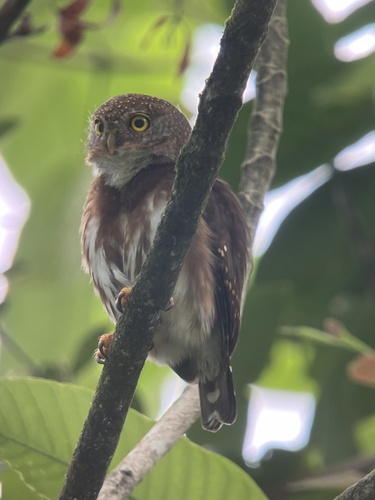 Central American Pygmy-Owl
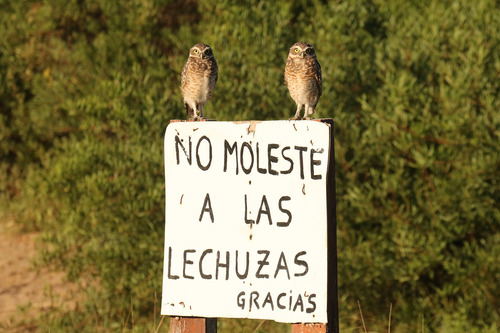 Burrowing Owl
In short
The most reliable field mark is overall structure: Burrowing Owl is much larger and longer-legged, with a terrestrial, upright stance, while Central American Pygmy-Owl is tiny, compact, and perches in trees. Juvenile plumage is also distinctive: young Burrowing Owls show a buff bar across the upperwing and lack most white spotting above, while juvenile Central American Pygmy-Owls have a plain gray crown and sooty 'false eyes' on the nape. In adults, Burrowing Owl's prominent white eyebrows and chin contrast with the pygmy-owl's spotted crown and streaked underparts. Habitat is a strong clue—Burrowing Owl is found on open ground, often in grasslands or disturbed sites, while Central American Pygmy-Owl stays in forested or wooded areas. Size alone is a major separator: Burrowing Owl is more than twice as heavy and much longer.
Identification tips
- Size is a primary clue: Burrowing Owl is much larger and bulkier than Central American Pygmy-Owl. If the bird is robin-sized or bigger, rule out pygmy-owl.
- Leg length and posture: Burrowing Owl has long, grayish legs and stands upright, often on the ground. Central American Pygmy-Owl is short-legged and perches horizontally in trees.
- Juvenile wing pattern: Juvenile Burrowing Owls show a buff bar across the upperwing and lack most white spotting above; pygmy-owl juveniles have a plain gray, unspotted crown and sooty 'false eyes' on the nape.
- Facial markings: Burrowing Owl has bold white eyebrows and a white chin patch, especially obvious when the bird bobs its head. Central American Pygmy-Owl lacks these, instead showing a spotted crown and nape 'false eyes.'
- Underpart pattern: Burrowing Owl adults have white underparts with brown spots or bars; pygmy-owl has whitish underparts with reddish-brown streaks (not spots or bars).
- Crown and nape: Central American Pygmy-Owl adults have a grayish-brown, spotted crown and dark 'false eyes' on the nape. Burrowing Owl's crown is brown with white spots but lacks the nape 'eyes.'
- Tail pattern: Pygmy-owl has pale bars across a rich brown tail; Burrowing Owl's tail is not specifically described but is less distinctly barred.
- Habitat context: Open ground, grassland, or urban lawns point to Burrowing Owl. Forest or woodland, especially mid-level perches, indicate pygmy-owl.
- Behavior: Burrowing Owl is active on the ground, often near burrows or low perches. Pygmy-owl is arboreal and rarely seen on the ground.
- Flight style: Burrowing Owl flies low and direct over open ground; pygmy-owl is more fluttery and maneuverable in wooded settings.
- Voice: Central American Pygmy-Owl gives rhythmic hoots followed by a rapid series; Burrowing Owl's calls are higher-pitched and chattering.
- Sexual dimorphism: Both species show little visible difference between sexes; do not rely on sex for ID.
- Sun-bleaching: Adult male Burrowing Owls may appear paler due to sun exposure, but still show the same structural and facial features.
- Perch choice: A small owl perched on a wire, fencepost, or on the ground is likely Burrowing Owl; in trees, especially in forest, suspect pygmy-owl.
- Pitfall: At a distance, a perched Burrowing Owl can look compact, but the long legs and white facial marks are usually visible with binoculars. Juvenile pygmy-owls never show the buff wing bar of young Burrowing Owls.
Size
Burrowing Owl is substantially larger, measuring 19–28 cm in length and weighing 140–240 g, with a wingspan of 50.8–61 cm. Central American Pygmy-Owl is tiny by comparison, at 13–18 cm and 50–59 g. Even at a distance, Burrowing Owl's size (about that of an American Robin or larger) and long legs are obvious, while the pygmy-owl appears petite and compact. There is some overlap in length at the smallest Burrowing Owl and largest pygmy-owl, but mass and bulk are always much greater in Burrowing Owl.
Plumage
- Juvenile/immature birds: Juvenile Burrowing Owls lack most white spotting above and brown barring below, but show a buff bar across the upperwing and may have a buff (not white) breast. Juvenile Central American Pygmy-Owls have a plain gray, unspotted crown and sooty 'false eyes' on the nape—no buff wing bar or pale eyebrows.
- Adults: Central American Pygmy-Owl adults have a grayish-brown, spotted crown, rich brown upperparts, pale bars on the tail, and whitish underparts with reddish-brown streaks. Burrowing Owl adults have brown heads and wings with white spots, prominent white eyebrows, a white chin patch, and white underparts with variable brown spotting or barring.
- Key contrasts: Only Burrowing Owl shows strong white eyebrows and chin, and only pygmy-owl has a spotted crown and streaked (not spotted/banded) underparts. Both lack ear tufts.
Behaviour
Burrowing Owl is highly terrestrial, often seen standing upright on the ground or perched on low posts, with a tendency to bob its head and display its white chin patch when agitated. Its long legs are always visible. Central American Pygmy-Owl is arboreal, perching quietly in trees, often at mid-levels, and rarely comes to the ground. In flight, Burrowing Owl is direct and low over open ground, while pygmy-owl moves through forest or woodland and appears more compact and rounded.
Habitat
Burrowing Owl is strictly an open-country species, found in grasslands, rangelands, deserts, agricultural fields, and even urban lawns or golf courses—always where vegetation is low and burrows are available. Central American Pygmy-Owl is a forest or woodland bird, found in a wide range of wooded habitats from Mexico to Ecuador, but not in open grasslands. If you see a small owl on open ground, it is almost certainly a Burrowing Owl; in forest or dense woodland, pygmy-owl is much more likely.
Voice
Central American Pygmy-Owl gives a series of 2–4 evenly spaced hoots, then a pause, followed by a rapid series of 6–18 similar notes ('huu-huu, huu-huu-huu...'), sometimes with trills. Burrowing Owl's typical calls are not described in the provided notes, but are generally higher-pitched, chattering or rattling, and lack the rhythmic hooting pattern of pygmy-owl. Vocalizations are unlikely to be confused if heard well.
Central American Pygmy-Owl · Burrowing Owl · My Tricky Birds