

Cassin's Vireo vs Cerulean Warbler
Vireo cassinii versus Setophaga cerulea
Play a quiz with Cassin's Vireo and Cerulean Warbler
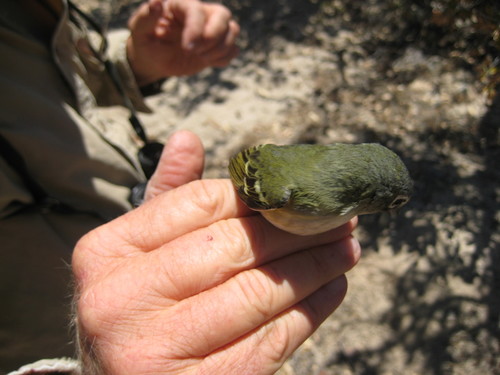 Cassin's Vireo
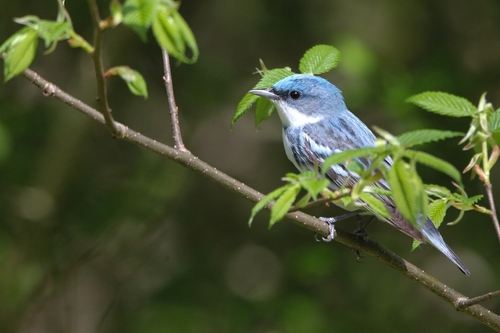 Cerulean Warbler
In short
The most reliable way to separate Cassin's Vireo from Cerulean Warbler is by focusing on facial pattern and overall coloration: Cassin's Vireo of any age shows bold, uninterrupted white 'spectacles' around the eye and a grayish-olive head, while Cerulean Warbler (especially adult males) has a blue-and-white pattern with a thin pale supercilium, not spectacles. Juvenile and female Cerulean Warblers show a greenish-blue back and yellowish underparts, never the gray-olive and white of Cassin's. Both species have two white wingbars, but Cassin's Vireo is chunkier and heavier-billed, and tends to forage lower in the canopy. Cerulean Warbler is much more delicate, with a thinner, pointed bill and a more active, warbler-like foraging style high in the treetops. Vocalizations are also quite different: Cassin's Vireo gives slow, questioning phrases, while Cerulean Warbler sings a buzzy, accelerating trill.
Identification tips
- White spectacles (Cassin's Vireo): Look for bold, continuous white arcs above and below the eye, forming 'spectacles'—present in all ages and sexes of Cassin's Vireo, absent in Cerulean Warbler.
- Supercilium (Cerulean Warbler): Cerulean Warbler shows a thin, pale eyebrow (supercilium) above the eye, not a full spectacle; most obvious in females and immatures.
- Overall color: Cassin's Vireo is grayish-olive above and white below, with no blue or yellow tones. Cerulean Warbler males are blue above and white below, with black streaks; females/immatures are blue-green above, yellowish below.
- Breast band and streaking (Cerulean Warbler male): Adult male Cerulean Warblers have a dark blue or black necklace and black flank streaks—never seen in Cassin's Vireo.
- Wingbars: Both species have two white wingbars, but Cerulean Warbler also has white tail spots (visible in flight or when tail is spread), which Cassin's lacks.
- Bill shape: Cassin's Vireo has a thicker, more hooked bill typical of vireos; Cerulean Warbler's bill is thin, straight, and sharply pointed.
- Body shape: Cassin's Vireo is chunkier and heavier-bodied; Cerulean Warbler is smaller, slimmer, and more delicate.
- Foraging style: Cassin's Vireo moves slowly and methodically, often pausing; Cerulean Warbler is quick, agile, and moves actively through the canopy.
- Perch height: Cassin's Vireo is usually in the middle to lower canopy; Cerulean Warbler is almost always high in the treetops.
- Voice: Cassin's Vireo sings slow, questioning phrases ('cha-cha-cha'); Cerulean Warbler gives a fast, buzzy trill ('zray zray zray zray zeeee').
- Geographic range: Cassin's Vireo is western (Pacific states, mountains); Cerulean Warbler is eastern (hardwood forests). Overlap is extremely rare.
- Habitat: Cassin's prefers open, drier woodlands; Cerulean Warbler is found in mature, moist deciduous forests.
- Seasonal context: If seen in the West during breeding season, it's almost certainly Cassin's Vireo; in the East, especially high in the canopy, Cerulean Warbler is more likely.
- Sex/age pitfalls: Female and immature Cerulean Warblers may look duller and could be confused with vireos, but always lack spectacles and have a yellowish wash below.
- Tail pattern: If you glimpse white tail spots in flight, it's Cerulean Warbler; Cassin's Vireo lacks this feature.
Size
Cassin's Vireo is noticeably heavier and more robust, with a body mass of about 14.6 g [wikidata], compared to the Cerulean Warbler's much lighter build (8–10 g) [wikipedia]. Both are similar in length (about 11–14 cm), but Cassin's appears bulkier, with a thicker bill and a less delicate structure overall. Cerulean Warbler is one of the smallest Setophaga warblers, with a slim, pointed bill and a more compact, agile appearance. In the field, Cassin's Vireo often looks stocky and slow-moving, while Cerulean Warbler is quick and light.
Plumage
- Juvenile/immature birds: Cerulean Warbler immatures resemble adult females, with blue-green upperparts, a pale supercilium (eyebrow), yellowish underparts, and two white wingbars. They lack the strong facial spectacles of Cassin's Vireo. Cassin's Vireo of all ages shows grayish-olive upperparts, white underparts, and bold, continuous white spectacles around the eye, plus white wingbars.
- Adult males: Cerulean Warbler males are strikingly blue above with a black or blue breast band and black streaks on the flanks, white below, and two white wingbars. Cassin's Vireo males never show blue or black streaking, instead having a grayish-olive head and back, and no breast band.
- Adult females: Cerulean Warbler females are blue-green above, yellowish below, with a pale eyebrow and no streaking or breast band. Cassin's Vireo females look like males, with gray-olive above, white below, and bold spectacles.
- Wing pattern: Both species have two white wingbars at all ages, but Cerulean Warbler also shows white tail spots (not present in Cassin's Vireo).
Behaviour
Cassin's Vireo forages methodically in the middle to lower canopy, moving slowly and deliberately as it searches for insects among leaves and branches. It often pauses to sing and is less active than most warblers. Cerulean Warbler is much more active and agile, foraging high in the canopy, often among the outermost branches. Its movements are quick and darting, typical of Setophaga warblers. Cassin's Vireo tends to stay in one area for longer periods, while Cerulean Warbler is restless and covers more ground.
Habitat
Cassin's Vireo breeds in open woodlands and forests of the western mountains and foothills (from southern British Columbia through the western US), often at mid-elevations and in more open, drier habitats. Cerulean Warbler breeds in mature deciduous forests of eastern North America, especially in large tracts of hardwoods, and winters in South American subtropical forests. In migration, Cerulean is rarely found in the far West, while Cassin's is not found in the East. Habitat context can be a strong clue: seeing a 'vireo' in the high canopy of an eastern hardwood forest in summer is much more likely to be Cerulean Warbler.
Voice
Cassin's Vireo sings a series of short, rough-whistled phrases, often alternating between high and low endings, with a 'question-and-answer' rhythm and a 'cha-cha-cha' quality. Its song is persistent and slow-paced. Cerulean Warbler's song is a buzzy, accelerating trill: 'zray zray zray zray zeeee', and its call is a sharp, metallic 'zzee'. Cerulean's song is higher-pitched, faster, and more insect-like compared to Cassin's. In the field, the difference in song tempo and tone is usually obvious.