

Carrion Crow vs Hooded Crow
Corvus corone versus Corvus cornix
Play a quiz with Carrion Crow and Hooded Crow
 Carrion Crow
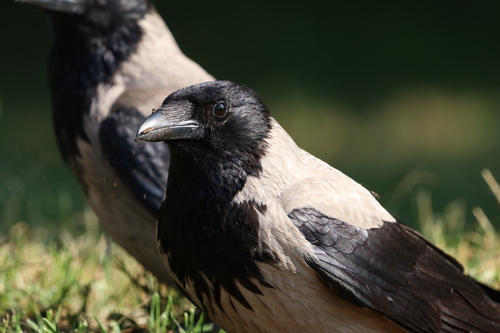 Hooded Crow
In short
The most reliable way to separate Carrion Crow from Hooded Crow in the field is by overall plumage: Carrion Crow is entirely black with a greenish or purplish gloss, while Hooded Crow has a sharply contrasting ashy-grey body with black head, wings, tail, and thighs. This contrast is visible at all ages except for very young juveniles, which are darker but still show some difference. Both species are similar in size and structure, but Carrion Crow is often slightly stockier. Juvenile Carrion Crows may appear browner with blue eyes, while juvenile Hooded Crows are duller than adults but still show the grey-and-black pattern. Voice and behavior are similar, but subtle differences in calls and social habits can help in ambiguous cases.
Identification tips
- Overall plumage is the key field mark: Carrion Crow is all black with a green or purple gloss; Hooded Crow has a contrasting ashy-grey body with black head, wings, tail, and thighs. This is visible in all lighting and at all ages except the youngest juveniles.
- Juvenile differences: Young Carrion Crows are brownish with blue eyes, but still lack any grey; juvenile Hooded Crows are duller but retain the grey-and-black pattern, except for newly hatched chicks which are blacker than adults.
- Flight views: In flight, Hooded Crow shows a clear contrast between pale grey body and black wings and tail, while Carrion Crow is uniformly black above and below.
- No distinctive upperwing or trailing edge patterns: Neither species shows age-specific wing panels or trailing edge marks that are diagnostic; rely on overall coloration.
- Bill, legs, and feet: Both species have black bills and legs; these are not useful for separation.
- Iris color: Hooded Crow has dark brown irises, while Carrion Crow's are darker, but this is rarely visible in the field.
- Structure: Carrion Crow may appear slightly stockier and heavier-billed, but this is subtle and unreliable for most observers.
- Size: Both species are similar in length and mass; size is not a reliable separator except that Carrion Crow may look a bit bulkier.
- Voice: Both give deep croaking calls; Carrion Crow's is described as slightly deeper and more guttural, but this is not a strong field mark.
- Behavior: Carrion Crow is more often solitary, while Hooded Crow can be seen in pairs or small groups, but both can join mixed corvid flocks.
- Range: In western Europe, an all-black crow is almost always Carrion Crow; in northern and eastern Europe, a grey-and-black crow is Hooded Crow. In contact zones, hybrids may occur and can show intermediate plumage.
- Habitat: Both species use similar habitats; do not rely on habitat for separation where both occur.
- Season and sex: No seasonal or sexual plumage differences are useful for separation; both sexes look alike in both species, though male Hooded Crows may be slightly larger.
- Hybrid caution: In overlap zones, beware of birds with intermediate or patchy black/grey plumage, which may be hybrids.
- Common pitfalls: Do not confuse Carrion Crow with Rook (which has a pale bill base and shaggier thighs) or with Raven (which is much larger with a heavier bill and wedge-shaped tail). Hooded Crow is unique among European crows for its grey-and-black pattern.
Size
Both species are very close in size, with lengths of 48–52 cm (19–20 in) for both. Carrion Crow has a wingspan of 84–100 cm and weighs 400–600 g, while Hooded Crow averages a wingspan of 105 cm and a typical weight of about 510 g. Carrion Crow may appear a bit stockier, but this is subtle and not always reliable in the field. Sexes are similar in both, though male Hooded Crows tend to be slightly larger than females.
Plumage
- Juveniles: Juvenile Carrion Crows are browner overall with blue eyes, darkening as they age; Hooded Crow juveniles are duller than adults but still show the characteristic grey-and-black pattern, though newly hatched birds are much blacker than their parents.
- Adults: Carrion Crow is entirely black, including bill, legs, and feet, with a green or purple sheen. Hooded Crow has a distinctive ashy-grey body with black head, throat, wings, tail, and thighs. The grey areas on Hooded Crow have dark feather shafts, giving a streaked look. Both have black bills and legs, but Hooded Crow's iris is dark brown, while Carrion Crow's is darker.
- Flight views: The contrasting grey and black of Hooded Crow is visible in flight from above and below, while Carrion Crow remains uniformly black. No distinctive upperwing or trailing edge patterns are described for either species beyond this overall coloration.
Behaviour
Carrion Crow is generally more solitary, often seen alone or in pairs, though it can be sociable in winter roosts. Hooded Crow is similar in behavior, but both species may feed together with other corvids. Both are intelligent, opportunistic foragers, and may be seen using tools or caching food. Carrion Crow is sometimes tamer near humans, while Hooded Crow is also adaptable and common in urban areas. No major behavioral differences are noted that are diagnostic in the field.
Habitat
Both species occupy a wide range of habitats, including cities, forests, farmland, and coastal areas. Their ranges are largely allopatric in Europe, with Carrion Crow in western Europe and Hooded Crow in northern, eastern, and southeastern Europe, as well as parts of the Middle East. Where their ranges meet, hybrids can occur, but in most areas only one species is present. Habitat preference is not a reliable field mark for separating the two where both occur.
Voice
Both species have similar deep, croaking calls. Carrion Crow's call is described as a guttural, slightly vibrant, deeper 'kraa', usually given in short series with pauses. Hooded Crow's voice is similar, and no distinctive vocal differences are emphasized in the sources. Voice may help separate these from other corvids (like the higher-pitched rook), but is not a strong separator between Carrion and Hooded Crow.