
Carola's Parotia vs Wahnes's Parotia
Parotia carolae versus Parotia wahnesi
Play a quiz with Carola's Parotia and Wahnes's Parotia
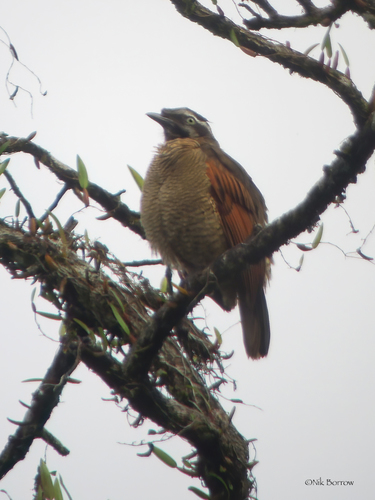 Carola's Parotia
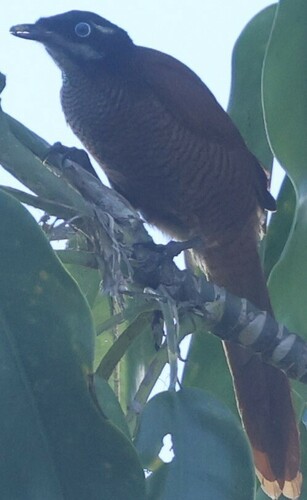 Wahnes's Parotia
In short
The most reliable field mark between Carola's Parotia and Wahnes's Parotia is overall size and tail length: Wahnes's Parotia is much larger and has a notably longer, wedge-shaped tail, while Carola's Parotia is more compact with a shorter tail. Males of both species show iridescent breast shields and three wire-like head plumes behind each eye, but Carola's Parotia males are smaller, with a jet-black head and more extensive coppery and magenta iridescence, while Wahnes's Parotia males are bulkier with a yellow-green breast shield and less ornate head feathering. Females differ in head and underpart pattern: Carola's Parotia females have a brownish head with pale supercilium and barred underparts, while Wahnes's Parotia females are richer brown with a blackish head and lack strong barring. Both species inhabit New Guinea mountain forests, but their ranges do not overlap. Immature and female birds are most likely to cause confusion, so focus on size, tail length, and head/underpart pattern for separation.
Identification tips
- Size and Tail Length: Wahnes's Parotia is much larger and longer-tailed (about 43 cm) than Carola's Parotia (up to 26 cm). This is often the quickest field clue, especially when seen perched or in flight. Applies to all ages and sexes.
- Tail Shape: Wahnes's Parotia has a long, wedge-shaped tail, while Carola's Parotia's tail is shorter and less wedge-shaped. Female Carola's Parotia has a relatively longer tail than the male but is still not as long or wedge-shaped as Wahnes's.
- Male Head Ornamentation: Both males have three wire-like occipital plumes behind each eye, but Carola's Parotia's are relatively shorter with small spatulate tips, while Wahnes's Parotia's are longer and more prominent. Look for the frontal crest in Carola's Parotia, which is absent or less developed in Wahnes's.
- Male Breast Shield: Carola's Parotia males have a highly iridescent breast shield that can appear bronzed yellow-green, magenta, or pink, often with visible jet-black feather bases. Wahnes's Parotia's breast shield is iridescent yellow-green but less variable in color.
- Male Face Pattern: Carola's Parotia males show a coppery-gold eyering and a narrow iridescent nuchal bar, with jet-black feathering on the head and face. Wahnes's Parotia males have coppery-bronzed nasal tuft feathers but lack the strong eyering and nuchal bar.
- Male Flank Plumes: Carola's Parotia males have extensive, cotton-white, inwardly curving flank plumes, which are more conspicuous than in Wahnes's Parotia.
- Female Head Pattern: Carola's Parotia females have a brownish to grey-brown head with a broad pale supercilium and pale moustachial stripes. Wahnes's Parotia females have a richer brown body with a blackish head and lack the strong supercilium and pale facial stripes.
- Female Underparts: Carola's Parotia females show buff underparts with strong blackish-brown barring, while Wahnes's Parotia females are more uniformly brown below without strong barring.
- Iris Color: Carola's Parotia females and immatures can have pale grey, cream, or yellow irises (possibly age-related), while Wahnes's Parotia iris color is not described as distinctive.
- Plumage of Immatures: Immature Carola's Parotia males are like females but with a pale grey iris and patchy acquisition of adult male features. Use size and tail length as primary clues for immature birds.
- Habitat and Range: If in the Huon Peninsula or Adelbert Mountains, Wahnes's Parotia is the only expected parotia; elsewhere in central New Guinea, expect Carola's Parotia. This is a strong separator when locality is known.
- Flight Jizz: Wahnes's Parotia appears bulkier and longer-tailed in flight, while Carola's Parotia is more compact. This is subtle but can help with distant or brief views.
- Bill and Leg Color: Carola's Parotia has a black bill and blackish-grey legs; Wahnes's Parotia's bill and leg color are not distinctive in the field.
- Courtship Display: Both species perform elaborate ground displays, but if seen, the bulkier, longer-tailed dancer is Wahnes's Parotia.
- When in Doubt: For ambiguous or distant birds, prioritize size, tail length/shape, and female/immature head and underpart pattern for best separation.
Size
Wahnes's Parotia is significantly larger (about 43 cm long) than Carola's Parotia (up to 26 cm long) [wikipedia]. This size difference is especially apparent in the field when both species are seen perched or in flight. Wahnes's Parotia also has a much longer, wedge-shaped tail, while Carola's Parotia is more compact with a relatively shorter tail. Female Carola's Parotia is smaller than the male and has a longer tail relative to its body, but still does not approach the overall size or tail length of Wahnes's Parotia. Bill size is not a strong separator in the field.
Plumage
-
Juvenile/Immature: Juvenile Carola's Parotia is undescribed, but immature males resemble adult females with a pale grey iris, gradually acquiring adult male features. Subadult males are patchy, with some adult male feathers on a female-like body. Wahnes's Parotia juvenile/immature plumage is not described, but likely follows a similar pattern of female-like plumage before acquiring adult male features.
-
Adult Male: Carola's Parotia males are jet-black with a coppery-bronze sheen, a short erectile frontal crest, three wire-like occipital plumes behind each eye (with small spatulate tips), and a highly iridescent breast shield that can show bronzed yellow-green, magenta, or pink. The face is marked by a coppery-gold eyering and a narrow iridescent nuchal bar. Flank plumes are cotton-white and strongly curved inward. Wahnes's Parotia males are larger, with an iridescent yellow-green breast shield, elongated black plumes, three erectile spatule head wires behind each eye, coppery-bronzed nasal tuft feathers, and a long, wedge-shaped tail. The overall impression is bulkier and less compact than Carola's Parotia.
-
Adult Female: Carola's Parotia females are brownish to grey-brown on the head with a broad pale supercilium, dirty white moustachial and submoustachial stripes, and buff underparts with blackish-brown barring. Wahnes's Parotia females are richer brown overall, with a blackish head and lack the strong pale supercilium or barring on the underparts seen in Carola's Parotia. The tail is longer and more wedge-shaped in Wahnes's Parotia females.
Behaviour
Both species are polygamous and perform elaborate courtship displays on the forest floor, with males dancing and displaying their iridescent breast shields and head plumes. Wahnes's Parotia's courtship dance is described as spectacular, but otherwise, little is known about differences in foraging or general behavior between the two. Both feed mainly on fruits and arthropods. In the field, Carola's Parotia may appear more compact and active, while Wahnes's Parotia is bulkier and may seem more deliberate in movement, but this is subtle and not a primary field mark.
Habitat
Carola's Parotia inhabits mid-mountain forests of central New Guinea, while Wahnes's Parotia is restricted to the mountain forests of the Huon Peninsula and Adelbert Mountains in northeast Papua New Guinea [wikipedia]. Their ranges do not overlap, so precise locality can be a strong clue. Both species are found in similar forest types (mid-montane to montane), but if you are in the Huon or Adelbert ranges, Wahnes's Parotia is the expected species; elsewhere in central New Guinea, look for Carola's Parotia.