

Caribbean Elaenia vs Grey Kingbird
Elaenia martinica versus Tyrannus dominicensis
Play a quiz with Caribbean Elaenia and Grey Kingbird
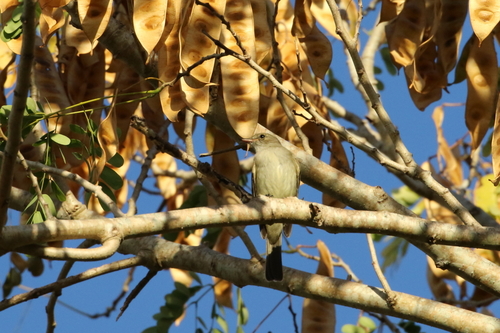 Caribbean Elaenia
 Grey Kingbird
In short
The most reliable field mark to separate Caribbean Elaenia from Grey Kingbird is overall size and structure: Grey Kingbird is much larger, with a robust, heavy bill and a longer tail, while Caribbean Elaenia is smaller, bushier-crested, and more compact. In all plumages, Grey Kingbird shows a strong dark mask through the eye and crisp white underparts, while Caribbean Elaenia has a faint eyering, bushy crest with a pale central stripe, and yellowish wash on the belly and undertail. Juvenile Grey Kingbirds may show rufous edges on the wings and tail, which Caribbean Elaenia lacks. Both species can be found in overlapping habitats, but their size, head pattern, and bill shape are consistently diagnostic with binocular views.
Identification tips
- Size and structure: Grey Kingbird is nearly twice as heavy and much longer than Caribbean Elaenia. If the bird looks large, long-tailed, and robust, especially compared to other flycatchers, it is likely a kingbird. Elaenia is compact and small.
- Bill shape: Grey Kingbird has a thick, heavy, deep-based bill that appears almost shrike-like. Caribbean Elaenia's bill is finer, shorter, and less deep.
- Crest and head shape: Caribbean Elaenia has a bushy, often raised crest with a pale central stripe (sometimes visible in good light), giving it a peaked look. Grey Kingbird's crown is smooth, with a concealed yellow stripe rarely seen in the field.
- Facial pattern: Grey Kingbird always shows a bold, dusky mask through the eye, contrasting with its pale gray face. Caribbean Elaenia has a faint whitish eyering and lores, but no mask; its face is mottled gray-brown and much softer in appearance.
- Wing pattern (juveniles): Juvenile Grey Kingbirds have rufous edges on wing coverts, rump, and tail. Caribbean Elaenia of all ages lacks these rufous tones, showing instead yellowish to whitish edges on the flight feathers and two pale wingbars.
- Underparts color: Grey Kingbird is white below with a slight gray chest. Caribbean Elaenia is pale gray on the breast, but the belly and undertail are distinctly yellowish to dull yellow, especially in some subspecies.
- Upperparts color: Grey Kingbird is plain gray above with brownish wings and tail. Caribbean Elaenia is dull olive to brownish olive above, sometimes with a greenish tinge, and lacks the kingbird's clean gray look.
- Tail: Grey Kingbird's tail is longer and darker, often appearing slightly forked when spread. Caribbean Elaenia's tail is dusky but shorter and more squared.
- Iris, legs, and feet: Both have dark irises and black legs/feet, so these are not helpful for separation.
- Behavior: Grey Kingbird is bold, upright, and often perches in the open, sallying for insects and mobbing larger birds. Caribbean Elaenia is more retiring, foraging within foliage and flicking its crest.
- Habitat: While both can overlap, Grey Kingbird favors open, coastal, or urban areas with exposed perches; Caribbean Elaenia prefers denser, shrubby, or wooded habitats.
- Voice: If you hear a loud, rolling 'pipiri, pipiri,' it's Grey Kingbird. Caribbean Elaenia's call is not described here, so use kingbird's voice as a positive ID.
- Sexes: Both species are sexually monomorphic, so sex does not affect field marks.
- Season: Juvenile Grey Kingbirds (rufous-edged wings/tail) may be confused with elaenias, but the size, bill, and mask remain diagnostic. Elaenia's yellowish belly is present year-round in most subspecies.
- Pitfalls: Distant or backlit views may obscure the kingbird's mask or the elaenia's crest; always try for a side view of the head and a sense of size. Beware of juvenile kingbirds with rufous tones, but remember the structural differences.
Size
Grey Kingbird is substantially larger and heavier (body mass ~43.8 g, length 23 cm) than Caribbean Elaenia (body mass ~21.3 g, length 14–18 cm). The kingbird's size is obvious even at a distance, with a longer body, tail, and especially a much more robust, deep-based bill. Caribbean Elaenia is noticeably smaller, with a more compact, rounded appearance and a finer bill. In mixed flocks or when seen near each other, the size gap is striking.
Plumage
Juvenile Grey Kingbirds have rufous edges to the wing coverts, rump, and tail, a feature not present in any age of Caribbean Elaenia. Adult Grey Kingbirds are gray above with a strong dusky mask through the eye, a concealed yellow crown stripe, brownish wings and tail, and white underparts with a grayish chest. Caribbean Elaenia adults of all subspecies show a bushy olive or brownish-olive crest with a pale central stripe, a faint whitish eyering, and dull olive to brownish upperparts. Their wings are dusky with two pale wingbars and yellowish to whitish edges on the flight feathers. Underparts are pale gray to yellowish, especially on the belly and undertail. The kingbird's underparts are always white (with a slight gray chest), while the elaenia's are dingier and often yellowish. The kingbird's mask and heavier bill contrast with the elaenia's softer facial pattern and finer bill.
Behaviour
Grey Kingbird is bold and aggressive, often seen sallying from exposed perches and actively mobbing much larger birds and mammals. It perches upright and is conspicuous in open areas. Caribbean Elaenia is more retiring, typically foraging in trees or shrubs, and is less likely to be seen openly challenging other species. Its movements are more reserved, and it often flicks its bushy crest.
Habitat
Both species occur in the West Indies and can overlap in edge, open woodland, and scrubby habitats. Grey Kingbird is more likely to be found in open areas, along coasts, roadsides, and near human habitation, often perched on wires or exposed branches. Caribbean Elaenia prefers shrubby or wooded areas, sometimes venturing into gardens but usually staying within denser vegetation. Habitat alone is not always diagnostic due to overlap.
Voice
Grey Kingbird has a loud, rolling trill described as 'pipiri, pipiri,' which is distinctive and frequently heard, especially in the breeding season. Caribbean Elaenia's vocalizations are not described in the provided notes, so voice is only diagnostic if the kingbird's characteristic call is heard.