

Motmot

Cape Robin-Chat vs White-browed Robin-Chat

Dessonornis caffer versus Cossypha heuglini

Play a quiz with Cape Robin-Chat and White-browed Robin-Chat
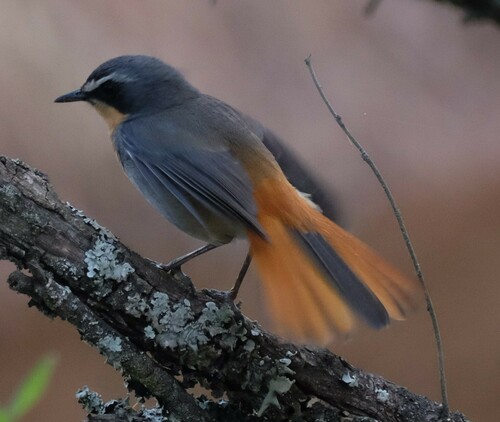
Cape Robin-Chat (Dessonornis caffer) Cape Robin-Chat
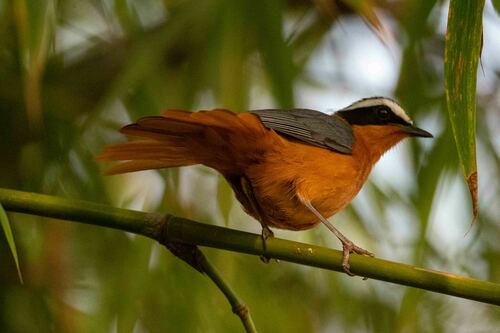
White-browed Robin-Chat (Cossypha heuglini) White-browed Robin-Chat

Media

Loading…

In short

Juvenile Cape Robin-Chat lacks a white supercilium and is heavily marked above, while juvenile White-browed Robin-Chat shows a pale throat and orange-buff below. For adults, both have a white supercilium and orange underparts, but Cape Robin-Chat is smaller, greyer above, and has a more prominent contrast between its orange rump and grey upperparts. White-browed Robin-Chat is larger, with a blacker crown and face, more extensive orange below, and a rufous rump. In the field, habitat and size can help: Cape Robin-Chat prefers upland or montane edges and gardens, while White-browed Robin-Chat is tied to riverine thickets and is bulkier. Both can occur near humans, so careful attention to head pattern and size is key.

Identification tips

  1. Juvenile plumage: Juvenile Cape Robin-Chat lacks a white supercilium and is heavily marked above with buff; look for a dark brown upper side and buffy underparts, with yellow soles to the feet (if seen). Juvenile White-browed Robin-Chat shows a pale throat, pale orange-buff breast, and pale orange belly, with rufous-brown marks on the back and a brown head.
  2. Supercilium (adults): Both species have a white supercilium, but Cape Robin-Chat's is more sharply defined and sits above blackish lores and ear coverts, while White-browed's is broader and sits above a black crown and face.
  3. Crown and face: Adult White-browed Robin-Chat has a black crown and face, giving a strong contrast with the white supercilium; Cape Robin-Chat has a grey crown and less extensive black on the face.
  4. Upperparts: Cape Robin-Chat is grey above with brownish-olive tinges, while White-browed Robin-Chat is olive-grey brown above with a rufous rump.
  5. Rump and tail: Both have orange/rufous rumps and outer tail feathers, but White-browed's is more extensive and the tail is longer and bulkier; Cape Robin-Chat's central tail feathers are greyish-brown and can obscure the rufous when the tail is closed.
  6. Underparts: Cape Robin-Chat has orange on the throat, central breast, and rump, with a pale grey to white belly and buff undertail coverts. White-browed Robin-Chat has bright orange-rufous underparts from throat to belly, with no sharp color break.
  7. Bill and legs: Both have black bills, but Cape Robin-Chat's is slightly down-curved. Leg color is variable in White-browed (pinkish-brown to dark brown), while Cape Robin-Chat's are black (adults) or pinkish-grey (juveniles).
  8. Size and structure: White-browed Robin-Chat is larger and heavier (19–20 cm, 34.9 g) than Cape Robin-Chat (16–17 cm, ~28 g). This is often visible in the field, especially in direct comparison or with experience.
  9. Behavior: Cape Robin-Chat often perches in the open, flicks its tail up, and fans it; White-browed is more skulking in dense thickets but can also be bold near humans.
  10. Habitat: Cape Robin-Chat is more likely in upland gardens, forest edges, and montane scrub, while White-browed Robin-Chat is tied to riverine forest, dense thickets, and moist habitats, especially at lower elevations.
  11. Voice: If heard, White-browed Robin-Chat's melodious, repetitive song and duets are distinctive. Cape Robin-Chat's song is not described here, so use caution unless the full White-browed song is heard.
  12. Sex differences: Both species are sexually monomorphic in plumage; female White-browed is slightly smaller, but this is not useful in the field.
  13. Pitfalls: Both species can occur in gardens and near humans, so do not rely on urban context alone. Juveniles are especially confusing; focus on supercilium, throat color, and upperpart markings.
  14. Flight views: No distinctive upperwing or flight pattern marks are described for either species, so separation in flight relies on size, tail length, and overall color impression.
  15. Seasonal variation: Cape Robin-Chat's breast orange deepens in non-breeding season, but this is subtle and not a primary field mark.

Size

White-browed Robin-Chat is distinctly larger and heavier (19–20 cm, 34.9 g) versus Cape Robin-Chat (16–17 cm, ~28 g). The difference is usually apparent in direct comparison or with experience, as White-browed appears bulkier and longer-tailed. However, size alone can be misleading at a distance or with lone birds.

Plumage

Juvenile Cape Robin-Chat is dark brown above, heavily marked with buff, and lacks any supercilium; its underparts are buff with grey-brown on the breast, and the tail is adult-like but with yellow soles to the feet. Juvenile White-browed Robin-Chat has a brown head, rufous-brown marks on the back, a pale throat, pale orange-buff breast, and pale orange belly. In adults, both species have a white supercilium, but Cape Robin-Chat's is more sharply defined above a blackish lore and ear coverts, with a grey crown and upperparts tinged brown-olive. Its orange is restricted to the throat, central breast, rump, and outer tail, with a pale grey to white belly and buff undertail. White-browed Robin-Chat adult has a black crown and face, broader white supercilium, olive-grey brown back, rufous rump, and bright orange-rufous underparts extending from throat to belly. Its underwing coverts are rufous, and the tail is more extensively orange-rufous except for the olive-brown central feathers. Sexes are similar in both, but female White-browed is slightly smaller.

Behaviour

Cape Robin-Chat is often seen singly, perching prominently and frequently flicking its tail up to 60 degrees, sometimes fanning it. It hops on the ground and roosts alone in dense cover. White-browed Robin-Chat is also territorial and can be seen near humans, but is more closely tied to riverine or thicket habitats. Both species bathe regularly. White-browed Robin-Chat may sing in duets and is more likely to defend territory aggressively.

Habitat

Cape Robin-Chat favors Afromontane forest edges, upland gardens, forest scrub, ravines, and plantations, often at higher elevations (typically above 1,500 m in much of its range). It is common in southern African gardens and parks, but avoids arid zones and lowland riverine thickets. White-browed Robin-Chat is found in riverine forests, dense thickets, and gardens, often at lower elevations (below 1,000 m south of the Limpopo, up to 2,200 m in East Africa), and is closely associated with watercourses and dense vegetation. Both can occur near humans, but Cape Robin-Chat is more likely in upland suburban settings, while White-browed is tied to moist, dense thickets.

Voice

White-browed Robin-Chat has a distinctive, melodious song with repeated phrases (e.g., 'pip-pip-uree', 'don't-you-do-it'), often sung at dawn and dusk, sometimes in duet, and with a variety of contact and alarm calls. Cape Robin-Chat's song and calls are not detailed in these notes, so voice is only diagnostic if the full song of White-browed is heard.

Submit a better description

Use the same sections as the comparison. Your text is published immediately.

Juvenile Cape Robin-Chat lacks a white supercilium and is heavily marked above, while juvenile White-browed Robin-Chat shows a pale throat and orange-buff below. For adults, both have a white supercilium and orange underparts, but Cape Robin-Chat is smaller, greyer above, and has a more prominent contrast between its orange rump and grey upperparts. White-browed Robin-Chat is larger, with a blacker crown and face, more extensive orange below, and a rufous rump. In the field, habitat and size can help: Cape Robin-Chat prefers upland or montane edges and gardens, while White-browed Robin-Chat is tied to riverine thickets and is bulkier. Both can occur near humans, so careful attention to head pattern and size is key.

  1. Juvenile plumage: Juvenile Cape Robin-Chat lacks a white supercilium and is heavily marked above with buff; look for a dark brown upper side and buffy underparts, with yellow soles to the feet (if seen). Juvenile White-browed Robin-Chat shows a pale throat, pale orange-buff breast, and pale orange belly, with rufous-brown marks on the back and a brown head.
  2. Supercilium (adults): Both species have a white supercilium, but Cape Robin-Chat's is more sharply defined and sits above blackish lores and ear coverts, while White-browed's is broader and sits above a black crown and face.
  3. Crown and face: Adult White-browed Robin-Chat has a black crown and face, giving a strong contrast with the white supercilium; Cape Robin-Chat has a grey crown and less extensive black on the face.
  4. Upperparts: Cape Robin-Chat is grey above with brownish-olive tinges, while White-browed Robin-Chat is olive-grey brown above with a rufous rump.
  5. Rump and tail: Both have orange/rufous rumps and outer tail feathers, but White-browed's is more extensive and the tail is longer and bulkier; Cape Robin-Chat's central tail feathers are greyish-brown and can obscure the rufous when the tail is closed.
  6. Underparts: Cape Robin-Chat has orange on the throat, central breast, and rump, with a pale grey to white belly and buff undertail coverts. White-browed Robin-Chat has bright orange-rufous underparts from throat to belly, with no sharp color break.
  7. Bill and legs: Both have black bills, but Cape Robin-Chat's is slightly down-curved. Leg color is variable in White-browed (pinkish-brown to dark brown), while Cape Robin-Chat's are black (adults) or pinkish-grey (juveniles).
  8. Size and structure: White-browed Robin-Chat is larger and heavier (19–20 cm, 34.9 g) than Cape Robin-Chat (16–17 cm, ~28 g). This is often visible in the field, especially in direct comparison or with experience.
  9. Behavior: Cape Robin-Chat often perches in the open, flicks its tail up, and fans it; White-browed is more skulking in dense thickets but can also be bold near humans.
  10. Habitat: Cape Robin-Chat is more likely in upland gardens, forest edges, and montane scrub, while White-browed Robin-Chat is tied to riverine forest, dense thickets, and moist habitats, especially at lower elevations.
  11. Voice: If heard, White-browed Robin-Chat's melodious, repetitive song and duets are distinctive. Cape Robin-Chat's song is not described here, so use caution unless the full White-browed song is heard.
  12. Sex differences: Both species are sexually monomorphic in plumage; female White-browed is slightly smaller, but this is not useful in the field.
  13. Pitfalls: Both species can occur in gardens and near humans, so do not rely on urban context alone. Juveniles are especially confusing; focus on supercilium, throat color, and upperpart markings.
  14. Flight views: No distinctive upperwing or flight pattern marks are described for either species, so separation in flight relies on size, tail length, and overall color impression.
  15. Seasonal variation: Cape Robin-Chat's breast orange deepens in non-breeding season, but this is subtle and not a primary field mark.

White-browed Robin-Chat is distinctly larger and heavier (19–20 cm, 34.9 g) versus Cape Robin-Chat (16–17 cm, ~28 g). The difference is usually apparent in direct comparison or with experience, as White-browed appears bulkier and longer-tailed. However, size alone can be misleading at a distance or with lone birds.

Juvenile Cape Robin-Chat is dark brown above, heavily marked with buff, and lacks any supercilium; its underparts are buff with grey-brown on the breast, and the tail is adult-like but with yellow soles to the feet. Juvenile White-browed Robin-Chat has a brown head, rufous-brown marks on the back, a pale throat, pale orange-buff breast, and pale orange belly. In adults, both species have a white supercilium, but Cape Robin-Chat's is more sharply defined above a blackish lore and ear coverts, with a grey crown and upperparts tinged brown-olive. Its orange is restricted to the throat, central breast, rump, and outer tail, with a pale grey to white belly and buff undertail. White-browed Robin-Chat adult has a black crown and face, broader white supercilium, olive-grey brown back, rufous rump, and bright orange-rufous underparts extending from throat to belly. Its underwing coverts are rufous, and the tail is more extensively orange-rufous except for the olive-brown central feathers. Sexes are similar in both, but female White-browed is slightly smaller.

Cape Robin-Chat is often seen singly, perching prominently and frequently flicking its tail up to 60 degrees, sometimes fanning it. It hops on the ground and roosts alone in dense cover. White-browed Robin-Chat is also territorial and can be seen near humans, but is more closely tied to riverine or thicket habitats. Both species bathe regularly. White-browed Robin-Chat may sing in duets and is more likely to defend territory aggressively.

Cape Robin-Chat favors Afromontane forest edges, upland gardens, forest scrub, ravines, and plantations, often at higher elevations (typically above 1,500 m in much of its range). It is common in southern African gardens and parks, but avoids arid zones and lowland riverine thickets. White-browed Robin-Chat is found in riverine forests, dense thickets, and gardens, often at lower elevations (below 1,000 m south of the Limpopo, up to 2,200 m in East Africa), and is closely associated with watercourses and dense vegetation. Both can occur near humans, but Cape Robin-Chat is more likely in upland suburban settings, while White-browed is tied to moist, dense thickets.

White-browed Robin-Chat has a distinctive, melodious song with repeated phrases (e.g., 'pip-pip-uree', 'don't-you-do-it'), often sung at dawn and dusk, sometimes in duet, and with a variety of contact and alarm calls. Cape Robin-Chat's song and calls are not detailed in these notes, so voice is only diagnostic if the full song of White-browed is heard.

Discard your changes?

You have unsaved edits. If you leave now, those changes will be lost.

Cape Robin-Chat · White-browed Robin-Chat · My Tricky Birds