

Canada Goose vs Trumpeter Swan
Branta canadensis versus Cygnus buccinator
Play a quiz with Canada Goose and Trumpeter Swan
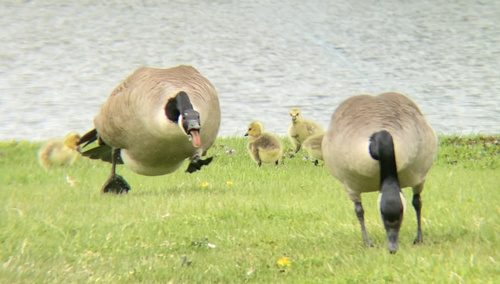 Canada Goose
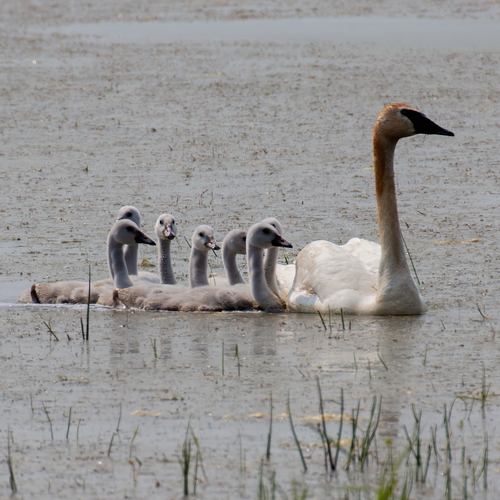 Trumpeter Swan
In short
The most reliable way to separate Canada Goose from Trumpeter Swan is by overall plumage color: adult Trumpeter Swans are entirely white, while Canada Geese have brown bodies with black necks and heads and a distinctive white chinstrap. Juvenile Trumpeter Swans are pale gray, but still much paler than any Canada Goose. Structure is also key: Trumpeter Swans are much larger, with a long, straight neck and a massive, wedge-shaped black bill, compared to the shorter neck and smaller, triangular black bill of the Canada Goose. In flight or on water, the swan's all-white appearance and sheer bulk are unmistakable, while Canada Geese show brown upperparts and a contrasting black-and-white head pattern. Both species may be found together on large water bodies, but their differences in size, shape, and coloration are striking once you know what to look for.
Identification tips
- Plumage color: Adult Trumpeter Swans are pure white; Canada Geese are brown with a black neck and head and a white chinstrap. This is the single most reliable field mark in all seasons.
- Juvenile plumage: Young Trumpeter Swans are pale gray, never brown or black; Canada Goose juveniles resemble adults but may be paler brown, never gray or white overall.
- Bill size and shape: Trumpeter Swans have a huge, wedge-shaped black bill, much longer and deeper than the small, triangular bill of Canada Goose. At close range, this is a key structural difference.
- Neck length and posture: Swans have extremely long, straight necks, often held upright; Canada Geese have shorter necks, usually held in a gentle S-curve.
- Size: Trumpeter Swans are enormous, nearly three times the mass of a Canada Goose, with a much longer body and wingspan. In mixed groups, the size difference is obvious.
- Head pattern: Canada Geese always show a white cheek patch (chinstrap) on a black head and neck; Trumpeter Swans have an all-white head with a black bill and lores, lacking any cheek patch.
- Leg color: Trumpeter Swans have gray-pink to blackish legs; Canada Geese have black legs. This is subtle but can help at close range.
- Flight silhouette: Swans show a long, straight neck and massive wings; geese have a shorter neck and proportionally shorter wings. Swans' wingbeats are slower and deeper.
- Vocalizations: Swans give a deep, trumpet-like call; geese honk or 'hrink' in flight and on water. Calls are distinctive if heard well.
- Habitat: Swans prefer undisturbed wetlands; geese are common in urban parks and fields. Context can help, but is not definitive.
- Group behavior: Canada Geese often form large, noisy flocks; Trumpeter Swans are usually in pairs or small family groups, less vocal overall.
- Leucistic individuals: Rare white or pale Canada Geese may lack typical brown or black, but usually retain some dark markings and do not match the size or bill structure of a swan.
- Bill color: Trumpeter Swans have a uniformly black bill, sometimes with a pinkish line at the mouth; Canada Geese always have a black bill with no pink.
- Wing pattern in flight: Both species have plain upperwings (brown in goose, white in swan); there are no distinctive 'W' or trailing edge marks to use for separation.
- Seasonal variation: No significant seasonal plumage change in either species that would cause confusion; both sexes are similar in each species.
Size
Trumpeter Swan is the heaviest native North American bird, averaging over 10 kg (10,850 g), nearly three times the mass of a Canada Goose (3,564 g). Swans are also much longer (138–165 cm vs. 75–110 cm for Canada Goose) and have a much greater wingspan (185–305 cm vs. 127–185 cm). Even the largest Canada Goose is dwarfed by a Trumpeter Swan. In mixed flocks, the swan's size and long neck are immediately obvious, and even at a distance, the swan's bulk and elongated silhouette stand out.
Plumage
Adult Trumpeter Swans are entirely white, with no dark markings on the body, wings, or neck. Juvenile (cygnet) swans are pale gray with pinkish legs, gradually whitening as they age, but never show the brown body or black neck of a Canada Goose. Canada Geese of all ages have a brown body, black neck and head, and a white cheek patch (chinstrap). No Canada Goose, even leucistic individuals, is ever fully white. In flight, Canada Geese show brown upperwings and a black neck, while Trumpeter Swans are white throughout. There are no age-specific upperwing patterns in either species that are diagnostic for confusion between these two. The only possible confusion is with very pale or leucistic Canada Geese, but these are rare and still show some brown or black areas.
Behaviour
Both species are often seen swimming on water or grazing on land, but Trumpeter Swans tend to hold their necks straighter and higher, giving a more upright and regal posture. Canada Geese have a more horizontal stance, with the neck often held at a gentle S-curve. In flight, swans show slow, deep wingbeats and a straight neck, while geese have faster wingbeats and a shorter neck. Swans are less likely to be seen in large, noisy flocks compared to Canada Geese, which are highly gregarious, especially during migration and winter.
Habitat
Both species use lakes, ponds, and wetlands, but Trumpeter Swans prefer more pristine, undisturbed habitats, especially for breeding, and are less tolerant of human disturbance. Canada Geese are highly adaptable and often found in urban parks, golf courses, and agricultural fields, as well as wild wetlands. In winter, both may be seen together on large, ice-free bodies of water, but Canada Geese are far more likely in developed or disturbed areas.
Voice
Trumpeter Swans have a deep, resonant, trumpet-like call that carries over long distances and is quite different from the familiar honking of Canada Geese. Canada Geese produce a two-syllable honk (males) or higher-pitched 'hrink' (females), often in chorus, especially in flight. Swans are generally quieter in flocks, while geese are highly vocal and noisy, especially when alarmed or migrating.