

Buffy Hummingbird vs Tumbes Hummingbird
Leucippus fallax versus Thaumasius baeri
Play a quiz with Buffy Hummingbird and Tumbes Hummingbird
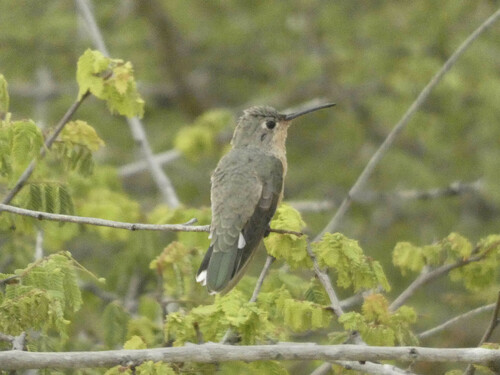 Buffy Hummingbird
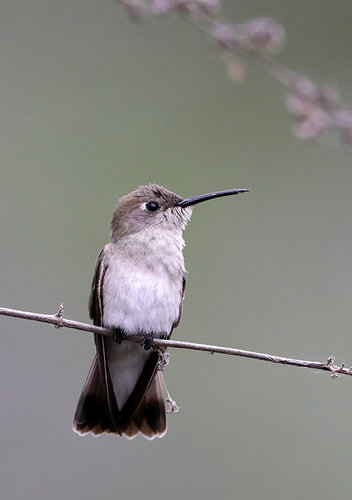 Tumbes Hummingbird
In short
The most reliable field mark to separate Buffy Hummingbird from Tumbes Hummingbird is the color of the underparts: Buffy Hummingbird shows a distinctive pale cinnamon-buff wash below, while Tumbes Hummingbird is pale grayish to white underneath. Both species are similar in size and structure, but Buffy Hummingbird has a white spot behind the eye and a more contrastingly pale lower mandible, while Tumbes Hummingbird's bill is entirely black. Tail pattern also helps: Buffy Hummingbird has a dull green tail with a gray bar and rounded tip, whereas Tumbes Hummingbird's tail is pale green with a dusky gray band and whitish or grayish tips. These differences are visible in both perched and flying birds, but underpart color and bill pattern are the most consistent in the field.
Identification tips
- Underpart color: Buffy Hummingbird always shows pale cinnamon-buff underparts, a warm tone that stands out against the cold pale grayish or white underparts of Tumbes Hummingbird. This is the most consistent field mark for all ages and sexes.
- Post-ocular spot: Look for a distinct white spot behind the eye on Buffy Hummingbird; Tumbes Hummingbird lacks this mark. This is visible in good light at close range, especially on perched birds.
- Bill color: Buffy Hummingbird has a two-toned bill: black upper mandible and pale lower mandible with a black tip. Tumbes Hummingbird’s bill is entirely black. This is diagnostic at close range or in photos.
- Tail pattern: Buffy Hummingbird’s tail is dull green with a gray bar and a rounded tip. Tumbes Hummingbird’s tail is pale green, with inner feathers showing bronzy tips and outer feathers with a dusky gray band near the end and pale (whitish or grayish) tips. The tail differences are subtle but can be seen when the tail is spread.
- Upperparts color: Buffy Hummingbird has dull green upperparts, while Tumbes Hummingbird is paler and more golden-green above. This is a supporting mark, best used in combination with underpart color.
- Belly and undertail coverts: Buffy Hummingbird’s belly and undertail coverts are white, contrasting with the buffy breast. Tumbes Hummingbird’s belly is white, but the transition from grayish breast is more gradual and lacks the buffy tone.
- Sex differences: Both species show minimal sexual dimorphism, but Buffy Hummingbird females are less bright. Do not rely on sex for separation.
- Age differences: No distinctive juvenile or immature upperwing/flight marks are described for either species, so age does not complicate separation.
- Habitat context: Buffy Hummingbird is more likely in cactus-rich dry scrub in northern South America; Tumbes Hummingbird is restricted to Ecuador and Peru. Use range and habitat as supporting context.
- Feeding behavior: If seen feeding on cactus fruit flesh or juice, Buffy Hummingbird is more likely, as this behavior is not noted for Tumbes Hummingbird.
- Perched vs. in flight: All main field marks (underpart color, bill pattern, post-ocular spot, tail pattern) are visible on perched birds. In flight, underpart color and tail pattern are most useful.
- Size: Both species are similar in size; do not use overall length or weight as a separator in the field.
- Voice: No diagnostic vocal differences are described; do not use voice for separation.
- Pitfalls: Beware of lighting effects on underpart color—Buffy Hummingbird’s buffy wash may appear paler in harsh light, but should still contrast with the cold grayish-white of Tumbes Hummingbird. The post-ocular spot on Buffy Hummingbird is a reliable backup if underpart color is ambiguous.
- Quiz context: If you encounter a hummingbird with a buffy wash below and a white spot behind the eye, it is Buffy Hummingbird. If the underparts are cold grayish-white with no eye spot and the bill is all black, it is Tumbes Hummingbird.
Size
Both species are very similar in size, with Buffy Hummingbird measuring 8.5–9 cm in length and Tumbes Hummingbird ranging from 8 to 11 cm. Tumbes Hummingbird may appear slightly longer at the upper end of its range, but there is significant overlap, and size alone is not a reliable separator. Both are typical small hummingbirds and should not be separated by bulk or length in the field. [wikipedia][avonet]
Plumage
- Juvenile/immature plumage: No specific age-related upperwing or flight pattern differences are described for either species, so separation relies on body and tail plumage at all ages.
- Buffy Hummingbird: Both sexes are similar, but females are less bright. The back and upperparts are dull green, underparts are pale cinnamon-buff, belly and undertail coverts are white. Tail is dull green with a transverse gray bar and rounded tip. Notable white spot behind the eye. Bill is straight, upper mandible black, lower mandible pale with black tip. [wikipedia]
- Tumbes Hummingbird: Both sexes alike. Upperparts are pale golden green, underparts pale grayish becoming white on the belly. Tail is pale green; inner feathers have bronzy tips, outer feathers have a dusky gray band near the end and tips that are whitish (male) or grayish (female). Bill is nearly straight and entirely black. No mention of a post-ocular spot. [wikipedia]
- Key contrasts: Buffy Hummingbird shows a warm buffy wash below and a white post-ocular spot, while Tumbes Hummingbird is cold grayish-white below and lacks the eye spot. Buffy’s tail is dull green with a gray bar and rounded tip; Tumbes’ tail is pale green with a gray band and pale tips.
Behaviour
Both species feed on nectar and small arthropods, often defending flower patches. Buffy Hummingbird is noted for feeding on cactus fruit flesh and juice, which is unusual among hummingbirds. Tumbes Hummingbird forages from the understory to mid-strata, but specific foraging behaviors are not detailed. In the field, both may be seen hovering at flowers or sallying for insects, but Buffy Hummingbird may be more often seen at cacti. [wikipedia]
Habitat
Buffy Hummingbird inhabits dry forest and scrubland in northern South America, often associated with cacti. Tumbes Hummingbird is found in Ecuador and Peru, also in dry habitats but with a range limited to the Tumbes region. While both favor arid or semi-arid environments, Buffy’s range is further north and more closely tied to cactus-dominated landscapes. [wikipedia][ebird]