

Buff-browed Foliage-gleaner vs Russet-mantled Foliage-gleaner
Syndactyla rufosuperciliata versus Syndactyla dimidiata
Play a quiz with Buff-browed Foliage-gleaner and Russet-mantled Foliage-gleaner
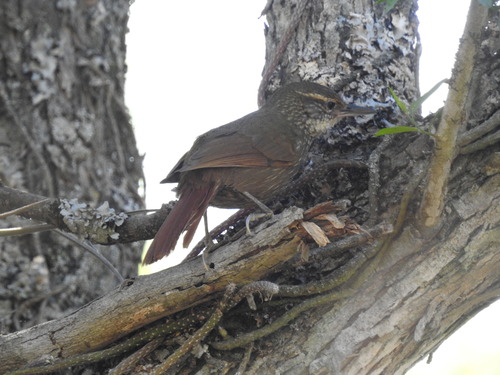 Buff-browed Foliage-gleaner
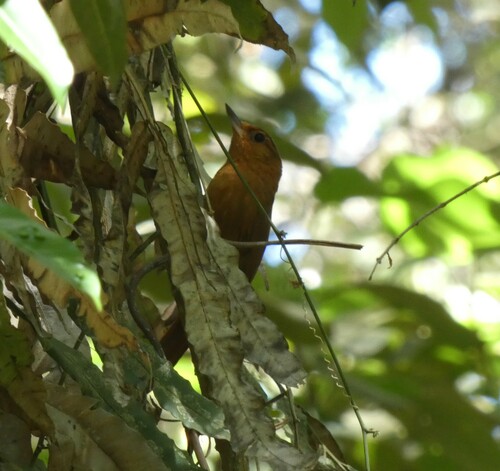 Russet-mantled Foliage-gleaner
In short
The most reliable field mark between Buff-browed and Russet-mantled Foliage-gleaners is the strong, pale buff supercilium of Buff-browed versus the deep rufescent-orange face and supercilium of Russet-mantled. Buff-browed shows a streaked or spotted pattern on the underparts (depending on age), while Russet-mantled is mostly unmarked ochraceous rufous below, with only faint breast streaks in adults and brown barring in juveniles. Bill shape and color also differ subtly, with Buff-browed having a thick, slightly upcurved bill and Russet-mantled a longer, pointed one. Both species overlap in range in Brazil and Paraguay, but Buff-browed is much more widespread. In the field, focus on face pattern and underpart markings for the clearest separation.
Identification tips
- Face pattern is key: Buff-browed shows a pale buff supercilium and eye ring, contrasting with a brownish face; Russet-mantled has a deep rufescent-orange face and supercilium, with darker ear coverts. This is the most reliable mark in all ages.
- Underpart markings: Buff-browed adults have streaked or scalloped underparts, especially on the breast and belly; juveniles are spotted. Russet-mantled adults are mostly unmarked ochraceous rufous below, with only faint pale breast streaks; juveniles have brown bars on the breast and a whitish throat.
- Bill shape: Buff-browed's bill is thick and slightly upcurved, while Russet-mantled's is longer and more pointed. This can be subtle but is useful in good views.
- Crown and upperparts: Buff-browed has a dull olive-brown crown with vague whitish streaks and plain olive-brown back; Russet-mantled has a bright rufescent brown crown and upperparts with a cinnamon tinge.
- Tail color: Buff-browed's tail is dull rufous; Russet-mantled's is richer rufous-chestnut, sometimes with a chestnut wash on the uppertail coverts.
- Throat color: Buff-browed has a whitish throat with brownish feather tips; Russet-mantled adults have an unmarked ochraceous rufous throat, while juveniles have a whitish throat.
- Breast and belly: Look for the wide, blurry buffy-whitish streaks on Buff-browed's belly, fading toward the rear; Russet-mantled is mostly plain below.
- Juvenile marks: If you see a bird with a spotted (not streaked) breast, it's a juvenile Buff-browed; if the breast is barred and the throat is whitish, it's a juvenile Russet-mantled.
- Supercilium extension: Buff-browed's pale supercilium extends to the nape; Russet-mantled's is deeper rufescent and does not extend as far.
- Leg color: Both have olive to brownish gray legs, not a strong separator.
- Habitat context: In Brazil and Paraguay, Buff-browed is more widespread and tolerant of disturbed forest; Russet-mantled is rarer and prefers less disturbed, closed forest or gallery forest in the cerrado.
- Vocalization: If you hear a series of ascending 'tsjek' notes with stuttering, suspect Russet-mantled; Buff-browed's voice is not described in the sources.
- Range: Outside Brazil and eastern Paraguay, any Syndactyla is almost certainly Buff-browed.
- Mixed flocks: Both species join mixed flocks, so context is not a separator.
- Sexes similar: Both species show no sexual dimorphism in plumage, so do not rely on sex for identification.
Size
Both species are medium-sized foliage-gleaners, but Russet-mantled is slightly heavier (average 29.0 g vs. 25.6 g for Buff-browed) and similar in length (about 17–18 cm for both). This size difference is subtle and not usually diagnostic in the field, but Russet-mantled may appear a bit more robust, especially with its longer, pointed bill.
Plumage
- Juveniles: Buff-browed juveniles show spotted underparts, while Russet-mantled juveniles have a whitish throat and brown bars on the breast. These differences are most obvious in fresh juvenile plumage.
- Adults: Buff-browed has a tawny-buff eye ring and a pale supercilium extending to the nape, with a brownish face and vague crown streaks. Underparts are streaked or scalloped with buffy-whitish and olive-brown, especially on the breast and belly. Russet-mantled adults have a deep rufescent-orange face, especially on the supercilium and ear coverts, and a bright rufescent brown crown and upperparts. Their underparts are mostly unmarked ochraceous rufous, with only faint pale streaks on the breast and an olive cast on the flanks. The tail of Buff-browed is dull rufous, while Russet-mantled's is richer rufous-chestnut. Subtle differences in wing color exist, but are less useful than face and underpart patterns.
Behaviour
Both species forage in the forest understory to mid-story, often in pairs or as part of mixed-species flocks. Russet-mantled is noted for not tolerating very disturbed forest and is considered rare across its range, while Buff-browed is more widespread and may be encountered in a wider range of forest types. Foraging behavior is otherwise similar and not diagnostic.
Habitat
Buff-browed Foliage-gleaner has a much broader range, found from Argentina and Bolivia through Brazil, Paraguay, Peru, Ecuador, and Uruguay, and is adaptable to various forested habitats. Russet-mantled (Planalto) Foliage-gleaner is restricted to Brazil and eastern Paraguay, mainly in lowland tropical evergreen forest, gallery forest, and woodlands within the cerrado, from 100 to 1200 m elevation. In areas of overlap, habitat alone is not diagnostic, but Russet-mantled is more sensitive to disturbance and less likely in heavily altered forests.
Voice
Russet-mantled's song is described as a short or very long series of 'tsjek' notes, ascending and stuttering at the start and end, and its contact call is a loud, nasal 'cheh'. No vocal details are provided for Buff-browed in the sources, so voice is not a reliable separator unless Russet-mantled's distinctive song is heard.
Buff-browed Foliage-gleaner · Russet-mantled Foliage-gleaner · My Tricky Birds