

Buff-breasted Wren vs Grey-breasted Wood-Wren
Cantorchilus leucotis versus Henicorhina leucophrys
Play a quiz with Buff-breasted Wren and Grey-breasted Wood-Wren
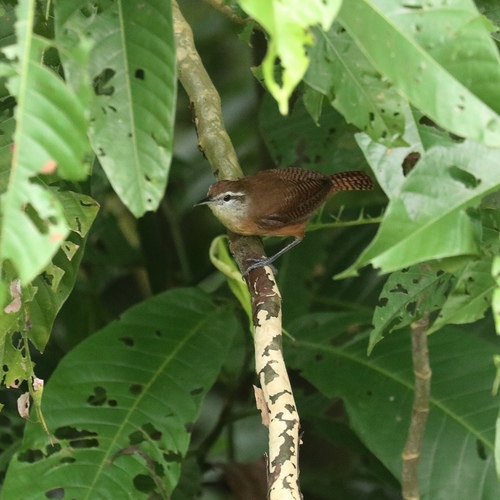 Buff-breasted Wren
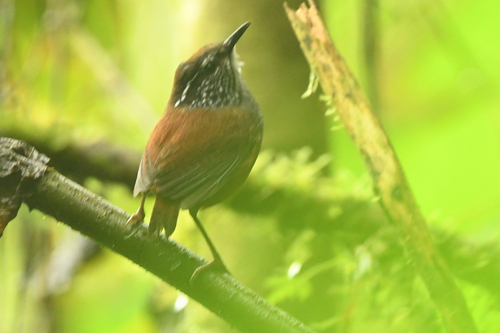 Grey-breasted Wood-Wren
In short
The most reliable field mark between Buff-breasted Wren and Grey-breasted Wood-Wren is the color of the underparts: Buff-breasted Wren shows a distinctly buffy to cinnamon chest and belly, while Grey-breasted Wood-Wren is gray-breasted with only the flanks showing some buff. Juveniles of Buff-breasted Wren are paler and duller but still show a buff chest, while Grey-breasted Wood-Wren juveniles resemble adults in their gray underparts. Both species have barred tails, but the Buff-breasted Wren’s tail is more heavily and broadly barred. Structurally, Buff-breasted Wren is slightly larger and stockier, with more rufescent upperparts, while Grey-breasted Wood-Wren is smaller, shorter-tailed, and has a more contrasting facial pattern. Habitat can also help: Buff-breasted Wren favors lowland thickets and forest edges, while Grey-breasted Wood-Wren is more often in humid montane forests.
Identification tips
- Underpart color is the most consistent mark: Buff-breasted Wren has a buffy to cinnamon chest and belly, while Grey-breasted Wood-Wren is gray-breasted with only the flanks showing buff. This works for all ages and sexes.
- Juvenile plumage: Juvenile Buff-breasted Wrens are duller but still show a pale buff chest, while juvenile Grey-breasted Wood-Wrens are gray-breasted, matching adults.
- Tail pattern: Both have barred tails, but Buff-breasted Wren’s tail is more heavily and broadly barred, while Grey-breasted Wood-Wren’s tail is chestnut with finer blackish bars.
- Facial pattern: Grey-breasted Wood-Wren has a strong gray-white supercilium, a wide black post-ocular stripe, and black cheeks streaked with pale gray, giving a more contrasting face. Buff-breasted Wren’s face is plainer, with a less distinct supercilium and less contrast overall.
- Upperparts: Buff-breasted Wren is rufescent to grayish-brown above; Grey-breasted Wood-Wren is darker olive-brown on the nape and shoulders, with a chestnut rump and tail.
- Size and structure: Buff-breasted Wren is larger and bulkier, with a longer tail. Grey-breasted Wood-Wren is smaller, more compact, and shorter-tailed. This is subtle and best used in direct comparison.
- Perched posture: Buff-breasted Wren often perches more upright and may be seen singing in the open, while Grey-breasted Wood-Wren is more skulking and stays low in dense cover.
- Habitat: Buff-breasted Wren prefers lowland thickets, forest edge, and secondary growth. Grey-breasted Wood-Wren is typical of humid montane forest and cloud forest understory.
- Foraging behavior: Grey-breasted Wood-Wren may follow army ant swarms and forages close to the ground; Buff-breasted Wren is more likely to be seen in pairs or family groups foraging in low, dense vegetation.
- Range context: If you are in the Amazon Basin or Guianas lowlands, Buff-breasted Wren is expected. In montane forests from Mexico to Bolivia, Grey-breasted Wood-Wren is the likely candidate.
- Sex differences: Both species are sexually monomorphic in plumage, so sex is not a useful field mark.
- Nest structure is not a field mark: Both species build domed nests, but this is not useful for field identification.
- Voice is not detailed in the notes, so rely on plumage and structure.
- Seasonal variation is minimal: Both species show little seasonal plumage change, so focus on age and habitat.
- When in doubt, prioritize underpart color and facial contrast, then habitat and range.
Size
Buff-breasted Wren is the larger of the two: males weigh 18.5–22.8 g and females 16.0–19.5 g [wikipedia]. Grey-breasted Wood-Wren is smaller, at 13.5–17.7 g [wikipedia]. In the field, Buff-breasted Wren often looks bulkier and longer-tailed, while Grey-breasted Wood-Wren appears more compact and short-tailed. Both are small wrens, but the size difference is subtle and best used as a supporting mark.
Plumage
Juveniles: Buff-breasted Wren fledglings are duller overall than adults, but still show a paler buff chest, which is diagnostic against the always gray-breasted juvenile Grey-breasted Wood-Wren. In both ages, Buff-breasted Wren shows rufescent to grayish-brown upperparts and a heavily barred tail, while Grey-breasted Wood-Wren has a darker olive-brown nape and shoulders, chestnut rump and tail, and a tail with blackish bars. The face pattern is more striking in Grey-breasted Wood-Wren, with a long gray-white supercilium, wide black post-ocular stripe, and black cheeks streaked pale gray. Buff-breasted Wren’s face is plainer, with a whitish to gray-brown supercilium and less contrast. Underparts are the key: Buff-breasted Wren has a buffy chest and cinnamon belly, while Grey-breasted Wood-Wren is gray-breasted with only the lower flanks and sides of the belly showing dark buff. These differences hold for adults and immatures.
Behaviour
Buff-breasted Wren is often seen in pairs or family groups, foraging low in dense thickets or edge vegetation, sometimes perching up to sing. Grey-breasted Wood-Wren forages singly or in small groups, usually close to the ground or up to 2 m in dense understory, and is known to follow army ant swarms. Both species are active and secretive, but Buff-breasted Wren may be more likely to perch in the open to sing, while Grey-breasted Wood-Wren tends to stay hidden in thick cover.
Habitat
Buff-breasted Wren is found in lowland Amazonian and Guianan forests, as well as non-Amazonian regions of Venezuela, Colombia, and eastern Panama, favoring dense thickets, forest edges, and secondary growth. Grey-breasted Wood-Wren ranges from Mexico to Bolivia, but is most often found in humid montane forests, cloud forests, and dense undergrowth at higher elevations. If you are in lowland thickets, Buff-breasted Wren is more likely; in humid mountain forest, expect Grey-breasted Wood-Wren.
Buff-breasted Wren · Grey-breasted Wood-Wren · My Tricky Birds