

Buff-banded Rail vs Australasian Swamphen
Gallirallus philippensis versus Porphyrio melanotus
Play a quiz with Buff-banded Rail and Australasian Swamphen
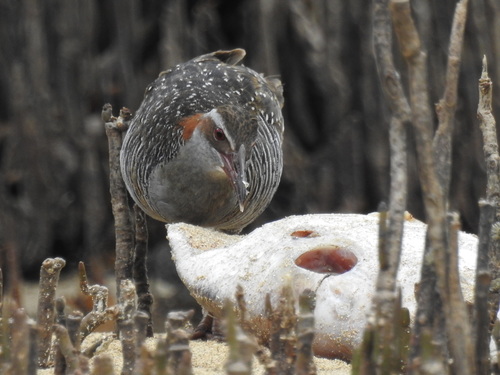 Buff-banded Rail
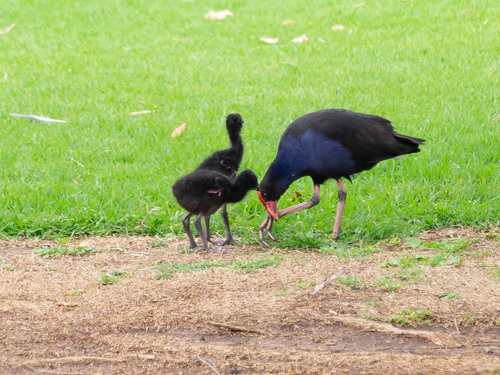 Australasian Swamphen
In short
The most reliable way to separate Buff-banded Rail from Australasian Swamphen is by overall structure and plumage: Buff-banded Rail is a compact, medium-sized rail with brown upperparts, bold black-and-white barring below, a white eyebrow, and a distinctive buff breast band, while Australasian Swamphen is much larger, with a striking blue-purple body, bright red bill and frontal shield, and long red legs. In flight or on the ground, Swamphen's size and vivid coloration are unmistakable next to the more cryptic, earth-toned rail. Juvenile and adult Buff-banded Rails both show the same basic banded underparts and chestnut nape, while Swamphens of all ages lack these patterns. Swamphens are often seen in open wetlands or paddocks, walking upright, whereas Buff-banded Rails skulk in dense cover and are much shyer.
Identification tips
- Size and structure: Swamphen is much larger and bulkier, with a longer neck and legs, and a more upright stance. Buff-banded Rail is compact, with shorter legs and a crouched posture. Size alone is often enough at a distance.
- Bill and frontal shield: Swamphen has a thick, bright red bill and a prominent red frontal shield above the bill. Buff-banded Rail has a more modest, brownish bill with no shield.
- Leg color: Swamphen's legs are long and bright red, highly visible when walking. Buff-banded Rail's legs are duller and shorter.
- Plumage color: Swamphen is deep blue to purple all over with no barring, stripes, or bands. Buff-banded Rail has brown upperparts, a white eyebrow, chestnut nape, a buff breast band, and black-and-white barred underparts.
- Facial pattern: Buff-banded Rail shows a clear white eyebrow and chestnut band from bill around the nape. Swamphen's face is plain blue with a red shield.
- Breast band: Only Buff-banded Rail has a buff band across the breast; Swamphen's underparts are unmarked blue.
- Underpart barring: Buff-banded Rail has fine black-and-white barring on the flanks and belly, present in all ages. Swamphen is plain below.
- Flight appearance: Swamphen is heavy and slow in flight, with legs trailing and blue wings; Buff-banded Rail flies low and fast, with brown wings and no trailing legs. Swamphen's size and color are obvious in flight.
- Behavior: Swamphen is bold, often in groups, feeding in open areas. Buff-banded Rail is solitary or in pairs, skulking in dense cover.
- Habitat: Rails stick to dense, wet vegetation; Swamphens are often in open paddocks, marshes, and even farmland.
- Tail: Swamphen often flicks its tail, showing white undertail coverts (not present in Buff-banded Rail).
- Juvenile confusion: Young Buff-banded Rails still show the same basic banded and barred patterns as adults; Swamphen juveniles are duller but never barred or banded.
- Voice: Not described here, but Swamphen is generally louder and more vocal in groups; Buff-banded Rail is quieter and more secretive.
- Context: If you see a bird out in the open, especially in a group, and especially with bright blue and red colors, it's a Swamphen. If it's alone, in cover, and cryptically patterned, it's likely a Buff-banded Rail.
- Range overlap: Both species occur in Australia, New Zealand, and New Guinea, so context and field marks are essential for separation.
Size
Buff-banded Rail is a medium-sized rail, measuring 25–33 cm in length and weighing 172–185 g for adults [wikipedia][avonet]. In contrast, Australasian Swamphen is significantly larger and bulkier, with a much more robust body, longer legs, and a heavier build (exact measurements not given here, but visually much larger in the field) [wikipedia]. The Swamphen's long legs and neck give it a more upright, almost gallinaceous stance, while the rail is more compact and crouched. Even at a distance, the size gap is obvious when both species are seen together.
Plumage
Juvenile and adult Buff-banded Rails both show brown upperparts, a white eyebrow, chestnut nape, and a bold buff band across the breast, with finely barred black-and-white underparts [wikipedia]. These banded and barred patterns are present from a young age and persist into adulthood. In contrast, Australasian Swamphen of all ages is deep blue to purple overall, with no barring or banding, and features a bright red bill and frontal shield, plus strong red legs [wikipedia]. Swamphens lack any facial stripes or breast bands. The rail's cryptic, streaked and banded plumage contrasts sharply with the Swamphen's solid, glossy coloration. In flight, Buff-banded Rail shows brown wings with no strong contrast, while Swamphen's wings are also dark but the bird's size, color, and dangling legs are distinctive. No age-specific upperwing marks are described for either species, but the rail's underpart barring and facial pattern are always present, while Swamphen is always plain blue-purple with red highlights.
Behaviour
Buff-banded Rail is typically shy and secretive, moving quickly through dense vegetation and rarely venturing far from cover. It may become tame on predator-free islands but is usually difficult to approach [wikipedia]. In contrast, Australasian Swamphen is bold and social, often seen walking in the open, feeding in groups, and displaying little fear of humans. Swamphens walk upright with long strides, sometimes flicking their tails to show white undertail coverts (not present in Buff-banded Rail). Swamphens also engage in complex social and breeding behaviors, including communal nesting, which is not seen in Buff-banded Rail.
Habitat
Buff-banded Rail prefers dense, low vegetation in moist or wetland habitats, such as reedbeds, grassy swamps, or thick cover near water [wikipedia]. It is rarely seen in the open except on islands where predators are absent. Australasian Swamphen, on the other hand, is highly adaptable and occupies a wide range of wetland habitats, from swamps and marshes to pastures, roadside verges, and farmland [wikipedia]. Swamphens are often seen well away from water, feeding in open grassy areas, while Buff-banded Rails stick to cover and are much less conspicuous.