

Brown-throated Parakeet vs Blue-grey Tanager
Eupsittula pertinax versus Thraupis episcopus
Play a quiz with Brown-throated Parakeet and Blue-grey Tanager
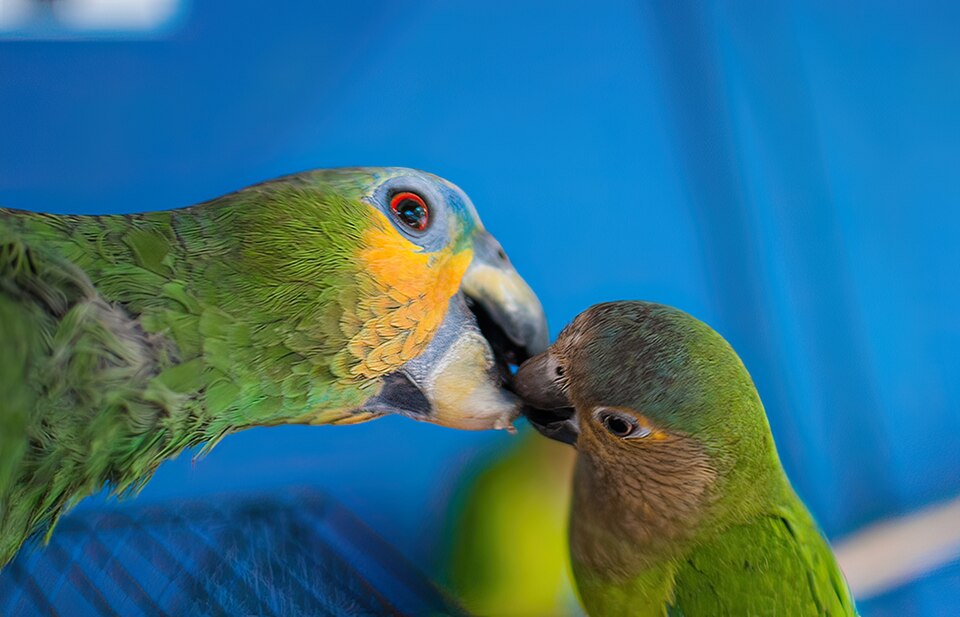 Brown-throated Parakeet
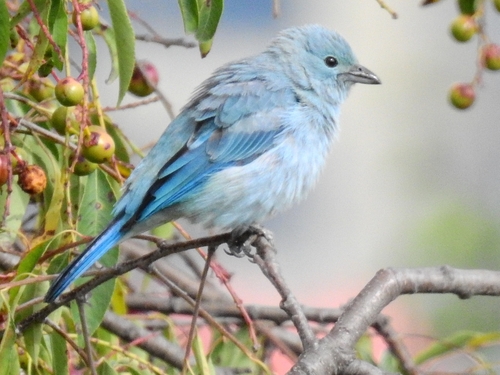 Blue-grey Tanager
In short
The most reliable field mark between Brown-throated Parakeet and Blue-grey Tanager is overall color: the parakeet is mostly green with a yellow face and orange belly patch, while the tanager is a uniform pale blue-gray with darker blue wings and a contrasting blue shoulder patch. Immature parakeets lack much yellow, but still show green tones and parrot-like structure, unlike any tanager. Bill shape is also a strong separator: the parakeet has a long, hooked bill typical of parrots, while the tanager’s bill is short and thick. In flight or perched, the parakeet’s long tail and blue-edged wings contrast with the tanager’s shorter tail and more compact, songbird-like jizz. Voice and behavior differ strongly, but color and structure are usually enough for confident separation.
Identification tips
- Overall color: Brown-throated Parakeet is mostly green with a yellow face (adults) and orange belly patch, while Blue-grey Tanager is pale blue-gray with darker blue wings and a blue shoulder patch. Immature parakeets are duller but still greenish; tanagers are always blue-toned.
- Bill shape: Parakeet has a long, hooked bill typical of parrots; tanager’s bill is short, thick, and conical, never hooked. This is visible even at a distance.
- Tail length and shape: Parakeet’s tail is long and pointed, extending well past the wings; tanager’s tail is shorter and more squared-off.
- Wing and flight pattern: Parakeet in flight shows blue-edged wings and tail, with a long, straight flight profile; tanager’s flight is more undulating, with compact wings and no blue edges on the tail.
- Face pattern: Adult parakeets have a bright yellow face and chin (less in immatures); tanagers have a uniform pale blue-gray face with no yellow or orange.
- Belly color: Parakeet’s belly is grass green with an orange patch (adults); tanager’s belly is pale blue-gray, never green or orange.
- Shoulder patch: Blue-grey Tanager has a contrasting blue shoulder patch (shade varies by subspecies); parakeet’s shoulder is green, blending with the rest of the upperparts.
- Size and bulk: Parakeet is much heavier and longer (84 g, 23–28 cm) than tanager (30–40 g, 16–18 cm); this is often obvious in the field.
- Perching posture: Parakeet perches upright, often in groups; tanager perches more horizontally and appears slimmer.
- Vocalizations: Parakeet is loud, harsh, and screechy; tanager is soft, musical, and twittering. If you hear a parrot-like call, it’s not a tanager.
- Group behavior: Parakeets are often in noisy flocks; tanagers are in pairs or small, quieter groups.
- Habitat overlap: Both can occur in open or urban areas, so do not rely on habitat alone for ID.
- Immature confusion: Young parakeets lack much yellow but remain greenish and structurally parrot-like; young tanagers are dull blue-gray, never green or yellow-faced.
- No sexual dimorphism: Both species have similar plumage in males and females, so sex does not help with ID.
- No distinctive wing panels or edges in immatures: Separation relies on overall color and structure, not on age-specific wing patterns.
Size
Brown-throated Parakeet is notably larger and bulkier than Blue-grey Tanager. The parakeet weighs about 84 g and measures 23–28 cm in length, while the tanager is much lighter at 30–40 g and shorter at 16–18 cm. The parakeet’s longer tail and heavier build are obvious in direct comparison, and its parrot-like proportions (long tail, big head, robust body) contrast with the tanager’s more streamlined, typical songbird shape.
Plumage
- Immature birds: Young Brown-throated Parakeets have very little yellow on the face, but still show mostly green upperparts and a duller version of the adult’s color pattern. Blue-grey Tanager immatures are duller than adults but remain blue-gray overall, never greenish or yellow-faced. No distinctive wing panel or edge pattern is described for either species at any age, so separation relies on overall color and structure.
- Adults: Brown-throated Parakeet adults (nominate) have a yellow face and chin, green upperparts, dull olive breast, grass green belly with an orange patch, and blue-edged wings and tail. Blue-grey Tanager adults are pale bluish on the head and underparts, with darker blue upperparts and a blue shoulder patch (shade varies by subspecies). The tanager never shows yellow, orange, or green tones, and the parakeet never appears overall blue or blue-gray. Sexes are similar in both species.
Behaviour
Brown-throated Parakeets are highly vocal, social, and often seen in noisy flocks, flying with strong, direct wingbeats and long tails trailing behind. They perch upright, often in groups, and may be seen feeding on fruits or seeds. Blue-grey Tanagers are also social but less raucous, moving in pairs or small groups, often foraging quietly among foliage. Their flight is more undulating and less direct, and they perch more horizontally, typical of tanagers and other songbirds.
Habitat
Both species can occur in open or edge habitats, but context may help: Brown-throated Parakeets are found from Costa Rica and Panama through northern South America and nearby islands, often in open woodlands, savannas, and cultivated areas. Blue-grey Tanagers have a wider range from Mexico to northern South America, including the Amazon Basin, and are common in gardens, parks, and forest edges. Overlap is possible, especially in disturbed or urban areas, so habitat alone is not diagnostic.
Voice
Brown-throated Parakeet is loud and harsh, with high-pitched screeches and grating 'scraart scraart' calls, plus rapid chattering and bisyllabic notes. Their calls are variable by location but always parrot-like. Blue-grey Tanager gives a soft, squeaky twittering song with 'tseee' and 'tsuup' call notes, much gentler and more musical than the parakeet’s raucous voice. Vocalizations are usually distinctive if heard well.
Brown-throated Parakeet · Blue-grey Tanager · My Tricky Birds