

Motmot

Brown Thrasher vs Bicknell's Thrush

Toxostoma rufum versus Catharus bicknelli

Play a quiz with Brown Thrasher and Bicknell's Thrush
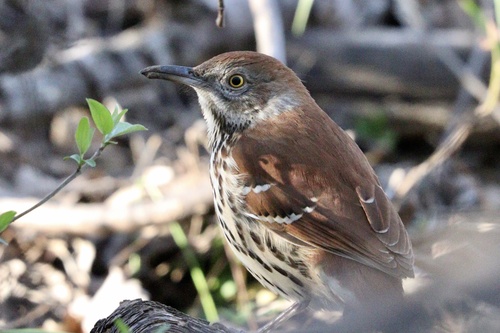
Brown Thrasher (Toxostoma rufum) Brown Thrasher
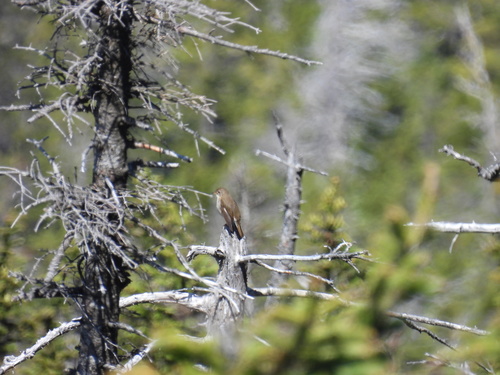
Bicknell's Thrush (Catharus bicknelli) Bicknell's Thrush

Media

Loading…

In short

The most reliable field mark separating Brown Thrasher from Bicknell's Thrush is the bold, dark streaking on the underparts of the thrasher, versus the faint, blurry spots of the thrush. Brown Thrasher is a larger, long-tailed bird with a distinctly curved bill and bright yellow eyes, while Bicknell's Thrush is smaller, with a shorter tail, straight bill, and subtle facial markings. In flight or perched, the thrasher’s rufous upperparts and long, rounded tail stand out, compared to the thrush’s more compact, olive-brown look and chestnut-tinged tail. Habitat is also a strong clue: Brown Thrasher favors brushy tangles and open woodlands in the east and central US, while Bicknell’s Thrush is a rare breeder of high-elevation northeastern conifer forests.

Identification tips

  1. Underpart streaking: Brown Thrasher always shows bold, dark streaks or teardrop spots on a whitish to buffy chest and flanks; Bicknell’s Thrush has only faint, blurry dusky spots, mostly on the upper breast, fading on the sides. This is the single most reliable mark in all ages and seasons.
  2. Tail length and color: Thrasher’s tail is long, rufous, and rounded with paler corners, often cocked or fanned; Bicknell’s Thrush has a shorter, chestnut-tinged tail, with much less contrast and no pale corners. Tail shape is obvious in flight and when perched.
  3. Bill shape: Brown Thrasher has a long, slightly decurved brownish bill, adapted for probing; Bicknell’s Thrush has a straight, slim bill with a yellowish lower mandible and blackish tip. Bill shape is diagnostic at close range.
  4. Eye color: Adult Brown Thrasher has a brilliant yellow eye, while Bicknell’s Thrush has a dark eye with a faint gray eye ring. Juvenile thrasher’s iris is olive, but still paler than the thrush’s.
  5. Facial pattern: Bicknell’s Thrush shows a subtle gray cheek and faint eye ring, but lacks the strong facial contrast of some thrushes. Brown Thrasher’s face is plain rufous with no strong eye ring, but the yellow eye stands out.
  6. Body size and bulk: Thrasher is much larger and bulkier, with a long body and tail; Bicknell’s Thrush is small and compact, similar to other Catharus thrushes. Size is usually obvious if not distorted by distance.
  7. Wing pattern: No strong age-specific upperwing marks are described for either species, so do not rely on wing panels or covert patterns.
  8. Leg color: Bicknell’s Thrush has pink legs; thrasher’s legs are not described as diagnostic.
  9. Behavior: Thrasher often forages on the ground, flicking leaves, and perches in open or semi-open brush; Bicknell’s Thrush stays low in dense conifers, rarely exposing itself, and moves with quick hops.
  10. Habitat: Thrasher is found in lowland brush, hedgerows, and open woods; Bicknell’s Thrush is restricted to high-elevation conifer forests in the northeast. Habitat alone can often rule out one or the other.
  11. Song: Thrasher’s song is loud, varied, and mimicking, with repeated phrases; Bicknell’s Thrush sings a soft, flute-like, rising song ending on a high note. They are not easily confused by ear.
  12. Flight style: Thrasher’s flight is strong and direct with a long tail trailing; Bicknell’s Thrush flies low and undulating, with a shorter tail and more compact profile.
  13. Seasonality: Bicknell’s Thrush is present only in breeding season (late spring–summer) in its limited range; Brown Thrasher is present in its range from spring through fall, sometimes wintering in the south.
  14. Sex and age: Both species are similar in appearance between sexes; juvenile thrasher has olive iris and less crisp upperpart marks, but streaked underparts remain. Juvenile Bicknell’s Thrush is not described as differing from adult in field marks.
  15. Common pitfalls: The most frequent confusion arises from distant or brief views of a thrasher in dense brush, where its streaked underparts or long tail may be obscured. Always try for a clear look at the underpart pattern and tail shape to confirm.

Size

Brown Thrasher is much larger, measuring 23.5–30.5 cm in length and weighing 61–89 g, with a wingspan of 29–33 cm. Bicknell's Thrush is notably smaller at about 17.5 cm and 26–30 g, with a shorter, more compact body. The thrasher’s long tail and larger bulk are generally obvious even at a distance, while the thrush is closer in size to a Hermit or Swainson’s Thrush. If seen side by side, the thrasher's size and proportions are unmistakable.

Plumage

Juvenile and adult Brown Thrashers both show bright rufous upperparts and a long, rounded rufous tail with paler corners. The underparts are buffy to whitish with bold, dark teardrop-shaped streaks across the chest and flanks. Juveniles differ mainly in the olive color of the iris and less crisp upperpart markings, but the streaking remains obvious. Bicknell’s Thrush, in all plumages, is olive-brown to brownish above with a subtle chestnut tinge to the tail (less contrast in worn birds), off-white underparts, and faint dusky spots on the breast that become even less distinct on the sides. The thrush’s facial pattern is subtle: faint gray eye ring and cheeks, and a mostly yellow lower mandible. The thrasher’s bright yellow eye and strong streaking are always diagnostic. No age-specific upperwing or flight marks are described for either species, so focus on underpart pattern and tail color/shape.

Behaviour

Brown Thrasher is often seen foraging on or near the ground, flicking leaf litter with its long bill, and frequently perches in dense brush or atop shrubs, sometimes cocking its tail. Its movements are deliberate and sometimes secretive, but it can be bold when singing. In flight, the thrasher’s long tail and strong, direct flight are distinctive. Bicknell’s Thrush is more elusive, usually staying within dense coniferous thickets, moving with quick, hopping motions and rarely exposing itself for long. It often perches upright with a slight droop to the wings and tail, and flushes with a low, undulating flight.

Habitat

Brown Thrasher is widespread in the eastern and central US and southern Canada, found in brushy edges, hedgerows, open woodlands, and suburban thickets—never in the high-elevation conifer forests preferred by Bicknell’s Thrush. Bicknell’s Thrush is extremely localized, breeding only on mountaintops and disturbed coniferous habitats in the northeastern US and southeastern Canada. If you are in a lowland thicket or suburban area, Bicknell’s Thrush is extremely unlikely; conversely, a singing thrasher in a stunted spruce-fir forest on a mountaintop is almost certainly a misidentification.

Voice

Brown Thrasher’s song is a loud, varied series of repeated phrases, often mimicking other birds, and is much more forceful and musical than the flute-like, ethereal song of Bicknell’s Thrush. The thrush’s song is a jumbled series of rising flute notes, ending on a high note, and is easily confused with Gray-cheeked Thrush but not with the thrasher’s mimicry and repetition. Calls are also distinct: thrasher gives harsh, smacking notes, while Bicknell’s Thrush gives soft, liquid calls.

Submit a better description

Use the same sections as the comparison. Your text is published immediately.

The most reliable field mark separating Brown Thrasher from Bicknell's Thrush is the bold, dark streaking on the underparts of the thrasher, versus the faint, blurry spots of the thrush. Brown Thrasher is a larger, long-tailed bird with a distinctly curved bill and bright yellow eyes, while Bicknell's Thrush is smaller, with a shorter tail, straight bill, and subtle facial markings. In flight or perched, the thrasher’s rufous upperparts and long, rounded tail stand out, compared to the thrush’s more compact, olive-brown look and chestnut-tinged tail. Habitat is also a strong clue: Brown Thrasher favors brushy tangles and open woodlands in the east and central US, while Bicknell’s Thrush is a rare breeder of high-elevation northeastern conifer forests.

  1. Underpart streaking: Brown Thrasher always shows bold, dark streaks or teardrop spots on a whitish to buffy chest and flanks; Bicknell’s Thrush has only faint, blurry dusky spots, mostly on the upper breast, fading on the sides. This is the single most reliable mark in all ages and seasons.
  2. Tail length and color: Thrasher’s tail is long, rufous, and rounded with paler corners, often cocked or fanned; Bicknell’s Thrush has a shorter, chestnut-tinged tail, with much less contrast and no pale corners. Tail shape is obvious in flight and when perched.
  3. Bill shape: Brown Thrasher has a long, slightly decurved brownish bill, adapted for probing; Bicknell’s Thrush has a straight, slim bill with a yellowish lower mandible and blackish tip. Bill shape is diagnostic at close range.
  4. Eye color: Adult Brown Thrasher has a brilliant yellow eye, while Bicknell’s Thrush has a dark eye with a faint gray eye ring. Juvenile thrasher’s iris is olive, but still paler than the thrush’s.
  5. Facial pattern: Bicknell’s Thrush shows a subtle gray cheek and faint eye ring, but lacks the strong facial contrast of some thrushes. Brown Thrasher’s face is plain rufous with no strong eye ring, but the yellow eye stands out.
  6. Body size and bulk: Thrasher is much larger and bulkier, with a long body and tail; Bicknell’s Thrush is small and compact, similar to other Catharus thrushes. Size is usually obvious if not distorted by distance.
  7. Wing pattern: No strong age-specific upperwing marks are described for either species, so do not rely on wing panels or covert patterns.
  8. Leg color: Bicknell’s Thrush has pink legs; thrasher’s legs are not described as diagnostic.
  9. Behavior: Thrasher often forages on the ground, flicking leaves, and perches in open or semi-open brush; Bicknell’s Thrush stays low in dense conifers, rarely exposing itself, and moves with quick hops.
  10. Habitat: Thrasher is found in lowland brush, hedgerows, and open woods; Bicknell’s Thrush is restricted to high-elevation conifer forests in the northeast. Habitat alone can often rule out one or the other.
  11. Song: Thrasher’s song is loud, varied, and mimicking, with repeated phrases; Bicknell’s Thrush sings a soft, flute-like, rising song ending on a high note. They are not easily confused by ear.
  12. Flight style: Thrasher’s flight is strong and direct with a long tail trailing; Bicknell’s Thrush flies low and undulating, with a shorter tail and more compact profile.
  13. Seasonality: Bicknell’s Thrush is present only in breeding season (late spring–summer) in its limited range; Brown Thrasher is present in its range from spring through fall, sometimes wintering in the south.
  14. Sex and age: Both species are similar in appearance between sexes; juvenile thrasher has olive iris and less crisp upperpart marks, but streaked underparts remain. Juvenile Bicknell’s Thrush is not described as differing from adult in field marks.
  15. Common pitfalls: The most frequent confusion arises from distant or brief views of a thrasher in dense brush, where its streaked underparts or long tail may be obscured. Always try for a clear look at the underpart pattern and tail shape to confirm.

Brown Thrasher is much larger, measuring 23.5–30.5 cm in length and weighing 61–89 g, with a wingspan of 29–33 cm. Bicknell's Thrush is notably smaller at about 17.5 cm and 26–30 g, with a shorter, more compact body. The thrasher’s long tail and larger bulk are generally obvious even at a distance, while the thrush is closer in size to a Hermit or Swainson’s Thrush. If seen side by side, the thrasher's size and proportions are unmistakable.

Juvenile and adult Brown Thrashers both show bright rufous upperparts and a long, rounded rufous tail with paler corners. The underparts are buffy to whitish with bold, dark teardrop-shaped streaks across the chest and flanks. Juveniles differ mainly in the olive color of the iris and less crisp upperpart markings, but the streaking remains obvious. Bicknell’s Thrush, in all plumages, is olive-brown to brownish above with a subtle chestnut tinge to the tail (less contrast in worn birds), off-white underparts, and faint dusky spots on the breast that become even less distinct on the sides. The thrush’s facial pattern is subtle: faint gray eye ring and cheeks, and a mostly yellow lower mandible. The thrasher’s bright yellow eye and strong streaking are always diagnostic. No age-specific upperwing or flight marks are described for either species, so focus on underpart pattern and tail color/shape.

Brown Thrasher is often seen foraging on or near the ground, flicking leaf litter with its long bill, and frequently perches in dense brush or atop shrubs, sometimes cocking its tail. Its movements are deliberate and sometimes secretive, but it can be bold when singing. In flight, the thrasher’s long tail and strong, direct flight are distinctive. Bicknell’s Thrush is more elusive, usually staying within dense coniferous thickets, moving with quick, hopping motions and rarely exposing itself for long. It often perches upright with a slight droop to the wings and tail, and flushes with a low, undulating flight.

Brown Thrasher is widespread in the eastern and central US and southern Canada, found in brushy edges, hedgerows, open woodlands, and suburban thickets—never in the high-elevation conifer forests preferred by Bicknell’s Thrush. Bicknell’s Thrush is extremely localized, breeding only on mountaintops and disturbed coniferous habitats in the northeastern US and southeastern Canada. If you are in a lowland thicket or suburban area, Bicknell’s Thrush is extremely unlikely; conversely, a singing thrasher in a stunted spruce-fir forest on a mountaintop is almost certainly a misidentification.

Brown Thrasher’s song is a loud, varied series of repeated phrases, often mimicking other birds, and is much more forceful and musical than the flute-like, ethereal song of Bicknell’s Thrush. The thrush’s song is a jumbled series of rising flute notes, ending on a high note, and is easily confused with Gray-cheeked Thrush but not with the thrasher’s mimicry and repetition. Calls are also distinct: thrasher gives harsh, smacking notes, while Bicknell’s Thrush gives soft, liquid calls.

Discard your changes?

You have unsaved edits. If you leave now, those changes will be lost.

Brown Thrasher · Bicknell's Thrush · My Tricky Birds