

Brown-necked Parrot vs Meyer's Parrot
Poicephalus fuscicollis versus Poicephalus meyeri
Play a quiz with Brown-necked Parrot and Meyer's Parrot
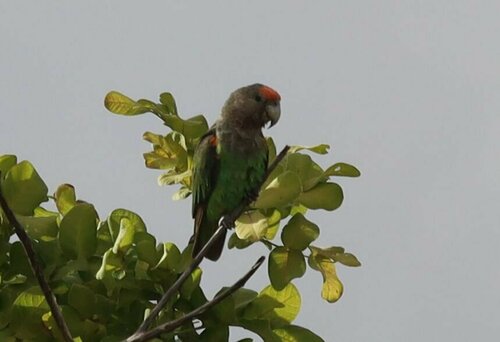 Brown-necked Parrot
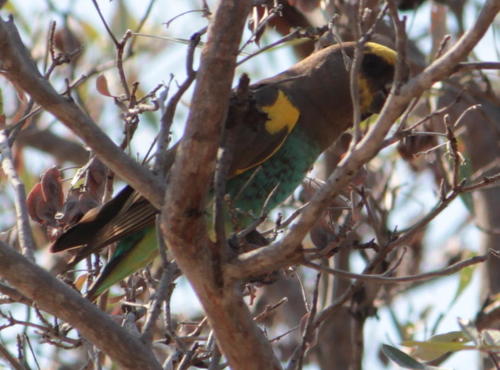 Meyer's Parrot
In short
The most reliable field mark to separate Brown-necked Parrot from Meyer's Parrot is overall size and head/bill structure: Brown-necked is much larger and bulkier, with a noticeably bigger head and bill. In the field, Meyer's Parrot stands out by its bright yellow carpal patches and, in most subspecies, yellow on the crown, as well as a turquoise belly and blue rump. Brown-necked Parrot, by contrast, shows a light grey head, yellow-green upperparts, and lacks the strong yellow and blue contrasts of Meyer's. Both are Poicephalus parrots and can appear superficially similar, but careful attention to size, head color, and wing pattern will reliably separate them.
Identification tips
- Size and structure: Brown-necked Parrot is much larger and bulkier than Meyer's, with a proportionally bigger head and heavier bill. This is often the first clue, especially when seen perched or in flight. Size is reliable when both species are known from the area, but beware lone birds or poor views.
- Head color: Brown-necked has a pale grey head, contrasting with its yellow-green upperparts. Meyer's Parrot has a darker (blackish) head, often with yellow on the crown in most subspecies. The presence of yellow on the head is a strong pointer to Meyer's.
- Carpal (wing bend) patch: Meyer's Parrot shows a bright yellow patch at the carpal joint of the wing, visible both at rest and in flight. Brown-necked Parrot lacks any yellow on the wing.
- Belly and rump color: Meyer's Parrot has a turquoise belly and blue rump, which can show as a flash of color in flight or when the bird is preening. Brown-necked Parrot's underparts are greenish, and it lacks any blue or turquoise highlights.
- Upperparts: Brown-necked Parrot has yellow-green upperparts with a possible blue sheen (in nominate), but never the strong blue of Meyer's.
- Bill size: The bill of Brown-necked is noticeably larger and heavier than that of Meyer's, which is more modest and proportionate to its smaller head.
- Yellow on the head: If you see yellow on the crown, it's almost certainly Meyer's Parrot; Brown-necked never shows this feature.
- Uniformity: Brown-necked Parrot appears more uniform and muted overall, lacking the contrasting color patches of Meyer's.
- Subspecific variation: Meyer's Parrot subspecies vary in the amount of yellow and blue, but all show at least some yellow at the carpal joint and blue on the rump.
- Habitat context: While not diagnostic, Meyer's is more likely in disturbed woodlands and is generally more common; Brown-necked may be more restricted to certain savanna or less disturbed habitats.
- Flight views: In flight, look for the yellow carpal patch and blue rump of Meyer's; Brown-necked will appear larger and lack these color flashes.
- Plumage pitfalls: Immature or worn Meyer's may show reduced yellow, but the blue rump and smaller size still separate them from Brown-necked. Brown-necked never acquires yellow or blue patches.
- No age-specific wing pattern: There are no described juvenile/immature upperwing patterns that aid separation; rely on size and color.
- Perched vs. flight: Both species can be seen perched or flying, but the color patches of Meyer's are often more obvious in flight.
- Voice: No diagnostic vocal differences are described in the available notes, so do not rely on calls for separation.
Size
Brown-necked Parrot is the largest member of its genus, with a stocky build, large head, and heavy bill [wikipedia]. Meyer's Parrot is distinctly smaller and more lightly built. In direct comparison, Brown-necked appears much bulkier and more robust, while Meyer's is compact and less imposing. This size difference is often obvious even at a distance or in flight, especially if both species are known from the same area.
Plumage
No age-specific juvenile or immature upperwing patterns are described for either species in the available notes. For adults, Brown-necked Parrot has a light grey head (not brown or blackish), yellow-green upperparts, and greenish underparts. The nominate subspecies can show a bluer sheen, but never the strong blue or turquoise of Meyer's. Meyer's Parrot is much more colorful: adults (and most subspecies) show blackish feathers, a turquoise belly, blue rump, and most have bright yellow on the carpal joint (bend of the wing) and often the crown. The yellow wing and crown patches are unique to Meyer's among these two, and the blue/turquoise underparts and rump are also distinctive. Brown-necked lacks all these bright patches, appearing more muted and uniform. Subspecific variation in Meyer's affects the extent and intensity of yellow and blue, but the combination of yellow carpal patch and blue rump is consistent.
Behaviour
No direct behavioral differences are described in the notes. Both are typical Poicephalus parrots, likely to be seen perched or in direct flight, but no jizz or flight style differences are noted.
Habitat
Both species are native to Africa and can overlap in range, but Brown-necked Parrot is described as savanna-dwelling in some subspecies, while Meyer's Parrot is widespread and common in woodlands. Meyer's is more tolerant of habitat disturbance and remains common in many areas, while Brown-necked may be more localized. However, habitat alone is not a reliable separator where both occur.