

Brown-cheeked Rail vs White-browed Crake
Rallus indicus versus Poliolimnas cinereus
Play a quiz with Brown-cheeked Rail and White-browed Crake
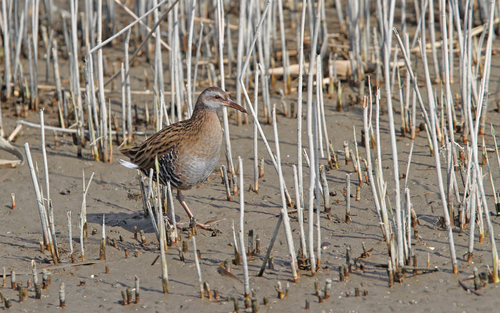 Brown-cheeked Rail
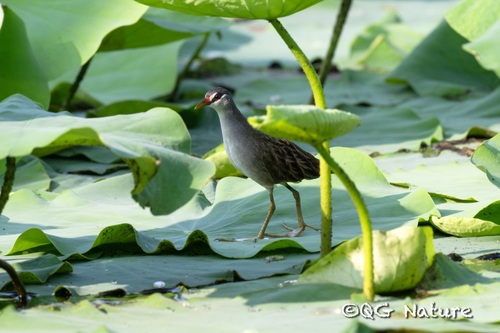 White-browed Crake
In short
The most reliable field mark between Brown-cheeked Rail and White-browed Crake is the bold brown eyestripe and brown-tinged underparts of the Brown-cheeked Rail, compared to the White-browed Crake’s striking white eyebrow and generally paler, more contrasting facial pattern. Brown-cheeked Rail is larger and bulkier, with a longer bill and a more muted, brownish overall appearance. In flight or at rest, look for the Brown-cheeked Rail’s brown cheek and breast, versus the Crake’s crisp white supercilium and more delicate build. Habitat can also help: Brown-cheeked Rail prefers northern marshes and reedbeds, while White-browed Crake is more often found in tropical mangroves and wetlands. Vocalizations differ markedly, but are less likely to be diagnostic in the field unless the birds are calling.
Identification tips
- Brown eyestripe vs. white eyebrow: Brown-cheeked Rail always shows a brown stripe through the eye, blending into brown-tinged underparts; White-browed Crake has a crisp white supercilium above the eye, giving a much more contrasting facial pattern. This is the quickest way to separate them at any age.
- Underparts color: Brown-cheeked Rail has brown-tinged underparts and breast, especially compared to the paler, less brownish underparts of White-browed Crake.
- Throat color: Brown-cheeked Rail shows a white throat contrasting with the brown breast, while White-browed Crake’s throat and face are generally paler and more sharply defined.
- Size and structure: Brown-cheeked Rail is much larger and bulkier, with a longer bill and heavier body; White-browed Crake is smaller, lighter, and more delicate in build.
- Habitat context: If the bird is in a northern temperate marsh or reedbed, especially in Mongolia, Siberia, or northern Japan, Brown-cheeked Rail is more likely. In tropical mangroves or wetlands in Southeast Asia, Australia, or the Pacific, White-browed Crake is favored.
- Behavior: Brown-cheeked Rail tends to move more slowly and deliberately, often walking through reeds; White-browed Crake is more agile, sometimes walking on floating vegetation or among mangrove roots.
- Vocalizations: If heard, Brown-cheeked Rail gives a sharp 'kyu' call and metallic 'shrink, shrink' notes; these are not matched by White-browed Crake.
- Upperparts tone: Brown-cheeked Rail has paler upperparts compared to related rails, but is still generally browner above than the White-browed Crake, which may appear grayer or more neutral.
- Distribution: Brown-cheeked Rail is migratory and mostly found in northern Asia, wintering in southeast Asia; White-browed Crake is resident or locally migratory across a much broader tropical range.
- Facial contrast: The face of White-browed Crake is more sharply patterned, with the white supercilium standing out; Brown-cheeked Rail’s face is more muted and brownish overall.
- Bill length: Brown-cheeked Rail has a noticeably longer bill than White-browed Crake, which has a shorter, more delicate bill.
- Plumage consistency: No age-specific flight or wing pattern marks are described for either species, so rely on head and underparts color at all ages.
- Seasonal confusion: Both species can occur in Japan and Southeast Asia in winter, so use plumage and structure rather than range alone in these regions.
- Potential pitfalls: Immature Brown-cheeked Rails may appear paler above, but always retain the brown eyestripe; White-browed Crake never shows a brown eyestripe, even as a juvenile.
- Sex differences: No strong sexual dimorphism is described for either species, so all marks apply to both sexes.
Size
Brown-cheeked Rail is significantly larger, measuring 23–29 cm in length and weighing 75–190 g [wikipedia]. It appears bulkier and longer-billed than the White-browed Crake, which is smaller and lighter overall [wikipedia]. In direct comparison, expect the Rail to look more robust and less dainty than the Crake, which has a more compact, slender appearance typical of small crakes.
Plumage
No age-specific upperwing or flight pattern marks are described for either species, so focus is on head and body plumage. Brown-cheeked Rail of all ages shows a distinctive brown eyestripe running through the eye, brown-tinged underparts, and paler upperparts compared to related rails. The throat is white, contrasting with the brown breast. White-browed Crake, by contrast, has a prominent white eyebrow (supercilium) above the eye, giving the face a more contrasting and crisp look. The Crake’s underparts are generally paler and less brown-tinged, and its facial pattern is much more sharply defined. These differences are consistent across ages, as no juvenile-specific marks are noted for either species.
Behaviour
Both species are secretive and skulk in dense wetland vegetation, but Brown-cheeked Rail is more likely to be seen walking or running through reeds and marshes, occasionally venturing into open mud or water edges. White-browed Crake is often found in mangroves and can be seen walking on floating vegetation or among mangrove roots. Both can be shy and difficult to flush, but the Rail’s larger size and slower, more deliberate movements can be a clue, while the Crake may appear more agile and quick-footed.
Habitat
Brown-cheeked Rail breeds in northern Mongolia, eastern Siberia, northeast China, Korea, and northern Japan, favoring freshwater marshes and reedbeds [wikipedia]. In winter, it migrates to southeast Asia but remains tied to marshy habitats. White-browed Crake is much more widespread in the tropics and subtropics, found from Australia to Southeast Asia and the Pacific islands, and is particularly associated with mangrove forests and wetlands [wikipedia]. If seen in a mangrove or tropical coastal wetland, White-browed Crake is more likely; in temperate or northern marshes, Brown-cheeked Rail is favored.
Voice
Brown-cheeked Rail has a sharp piping 'kyu' courtship call, longer and clearer than the European Water Rail, and a song of metallic, slurred 'shrink, shrink' notes repeated in series [wikipedia]. Its calls are quite different from those of the Water Rail and are not responded to by that species. White-browed Crake’s vocalizations are not described in the provided notes, so voice is only diagnostic for Brown-cheeked Rail if heard giving its distinctive calls.