

Brown-cheeked Rail vs Okinawa Rail
Rallus indicus versus Gallirallus okinawae
Play a quiz with Brown-cheeked Rail and Okinawa Rail
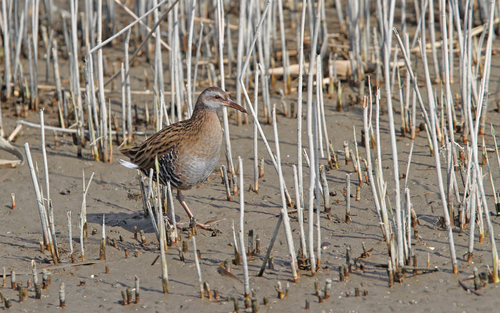 Brown-cheeked Rail
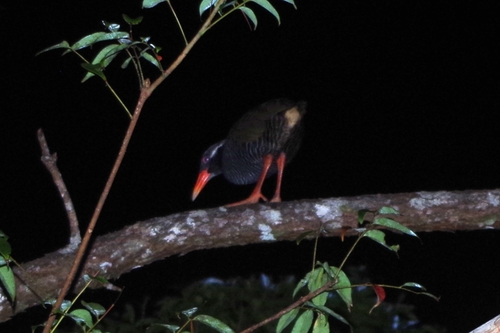 Okinawa Rail
In short
The most reliable field mark between Brown-cheeked Rail and Okinawa Rail is the latter's striking combination of a red bill and legs, black-and-white barred underparts, and almost flightless, short-winged structure. Brown-cheeked Rail is slimmer, more capable of flight, and shows paler, brown-tinged underparts with a brown eyestripe and no strong barring. Juvenile Okinawa Rails are paler and mottled below, but still show a stouter, short-winged build and lack the brown-cheeked's facial pattern. Habitat is a strong clue: Brown-cheeked Rail is a migrant of marshes across northeast Asia, while Okinawa Rail is strictly endemic to the forests of northern Okinawa Island. If you see a rail with a red bill and legs, barred underparts, and poor flight, it is Okinawa Rail; if the bird is slimmer, with a brown face-stripe and more typical rail flight, it is Brown-cheeked Rail.
Identification tips
- Bill and leg color (all ages except juvenile Okinawa Rail): Adult Okinawa Rail has a large, bright red bill with a whitish tip and red legs; Brown-cheeked Rail has a duller bill and legs, never bright red. Juvenile Okinawa Rail has brownish bare parts, so this mark is less reliable for them.
- Underpart pattern (all ages): Okinawa Rail adults have black underparts with narrow white bars; Brown-cheeked Rail has plain brown-tinged underparts, never barred. Juvenile Okinawa Rail is mottled white below, not barred, but still lacks the brown-tinged look of Brown-cheeked Rail.
- Facial pattern (adults): Brown-cheeked Rail shows a brown stripe through the eye and a white throat; Okinawa Rail has a black face with a white spot between bill and eye, and a white line behind the eye. Juvenile Okinawa Rail's facial marks are less distinct but still lack the brown eyestripe.
- Wing and tail structure: Okinawa Rail has very short wings and tail, giving it a rounded, almost tailless look and making it nearly flightless. Brown-cheeked Rail has normal rail wings and tail, and is capable of strong flight.
- Flight behavior: Brown-cheeked Rail will flush and fly when disturbed, often showing a typical rail flight. Okinawa Rail rarely flies, preferring to run or hide; if it does fly, it is weak and for short distances only.
- Size and build: Okinawa Rail is larger and much heavier (about 435 g) than Brown-cheeked Rail (75–190 g), and appears more robust and chunky. Brown-cheeked Rail is slimmer and more elongated.
- Habitat: Brown-cheeked Rail is found in marshes and reedbeds across northeast Asia, especially during migration and winter. Okinawa Rail is strictly limited to the forests of northern Okinawa Island; any rail outside this area is not Okinawa Rail.
- Juvenile confusion: Juvenile Okinawa Rail is paler below with white mottling, brownish bare parts, and a less distinct facial pattern, but still shows the short wings and terrestrial habits. Brown-cheeked Rail juveniles are not described in detail, but should lack strong barring or red bare parts.
- Vocalizations: Brown-cheeked Rail gives sharp, metallic "kyu" and "shrink" calls, distinct from Water Rail. Okinawa Rail is extremely noisy, with loud calls often given in groups, especially at dawn/dusk and sometimes from trees.
- Behavior: Okinawa Rail is often seen running on the ground, bathing in open, or roosting in trees; Brown-cheeked Rail is more secretive, flushes readily, and is less likely to be seen in trees.
- Context and range: If you are outside Okinawa Island, you are almost certainly seeing Brown-cheeked Rail or another rail, not Okinawa Rail. If in dense forest on northern Okinawa, especially if the bird is nearly flightless, it is likely Okinawa Rail.
- Eyes and eye-ring: Okinawa Rail adults have a red iris and eye-ring, adding to the bright facial appearance; Brown-cheeked Rail lacks this feature.
- Tail pattern: Okinawa Rail has dark brown undertail-coverts with pale bars; Brown-cheeked Rail's undertail is not described as barred.
- Roosting behavior: Okinawa Rail often roosts in trees, climbing up to sleep; Brown-cheeked Rail nests and roosts on the ground in marsh vegetation.
- Group calling: Okinawa Rail pairs and groups often call together, sometimes up to 12 birds at once; Brown-cheeked Rail is more solitary in vocalizations.
Size
Brown-cheeked Rail is smaller and lighter: 23–29 cm in length, 75–190 g in weight [wikipedia]. Okinawa Rail is larger and much heavier: about 30 cm long, 435 g, with a wingspan of 48–50 cm [wikipedia]. The Okinawa Rail's bulk and short wings make it appear more robust and less agile than the Brown-cheeked Rail, which is slimmer and built for longer flights.
Plumage
-
Juvenile/immature plumage: Juvenile Okinawa Rails are paler than adults, with white mottling below (not barred), a brownish spot in front of the eye, and a shorter post-ocular stripe. Their bill and iris are brownish, and legs/feet yellow-ochre, lacking the adult's bright red. Brown-cheeked Rail juveniles are not described in detail, but no mention of strong barring or red bare parts.
-
Adult plumage: Okinawa Rail adults are olive-brown above, black below with narrow white bars, and have a black face with a white spot between bill and eye plus a white line behind the eye. The bill and legs are bright red. Brown-cheeked Rail adults are paler above, brown-tinged below (not barred), with a brown eyestripe, white throat, and no red on bill or legs. The brown-cheeked's underparts are plain or lightly tinged, not boldly patterned like Okinawa Rail. Both species have some white on the throat, but only Okinawa Rail has a clear facial spot and stripe pattern.
-
Wings and tail: Okinawa Rail has very short wings and tail, almost flightless. Brown-cheeked Rail has normal rail wings and tail, capable of sustained flight.
Behaviour
Okinawa Rail is almost flightless, running rapidly but rarely flying, and often roosts in trees by climbing. It is noisy, often calling from the ground or low perches, and is usually seen in dense cover but may come out to bathe. Brown-cheeked Rail is a strong migrant, capable of long flights, and is more likely to flush and fly when disturbed. Both species forage on the ground, but Okinawa Rail is more terrestrial and less likely to be seen in open marshes.
Habitat
Brown-cheeked Rail breeds in marshes and wetlands across northern Mongolia, eastern Siberia, northeast China, Korea, and northern Japan, wintering in southeast Asia. It is a migrant, found in freshwater marshes, reedbeds, and wetland edges. Okinawa Rail is strictly endemic to the subtropical moist forests of northern Okinawa Island, Japan, and does not occur outside this restricted range. It prefers dense forest cover, sometimes near streams or forest edges, but never in open marshes or outside Okinawa.
Voice
Brown-cheeked Rail has distinctive vocalizations: a sharp piping "kyu" courtship call, longer and clearer than Water Rail, and a series of metallic, slurred "shrink, shrink" notes. Its calls are different enough from Water Rail that it does not respond to the European species' playback. Okinawa Rail is very noisy, with a variety of loud calls, often given in duet or chorus, especially at dawn and dusk. The specific quality of Okinawa Rail's calls is not detailed, but the context (noisy, group-calling, often from the ground or trees) is distinctive.